Cover the damaged wood today with a plastic drop cloth or heavy-duty garbage bag, tacked firmly in place, and that buys you time to figure out a real fix. From there, your strategy depends on which bird is doing the damage and why: woodpeckers drilling for insects or drumming for territory need a different approach than starlings or sparrows tearing at soffits to nest. Get the identification right, then layer in physical barriers, targeted deterrents, and a seasonal maintenance plan to keep it from coming back.
How to Stop a Bird From Chewing Wood Safely and Humanely

Maya Carver
15 Jun 2026
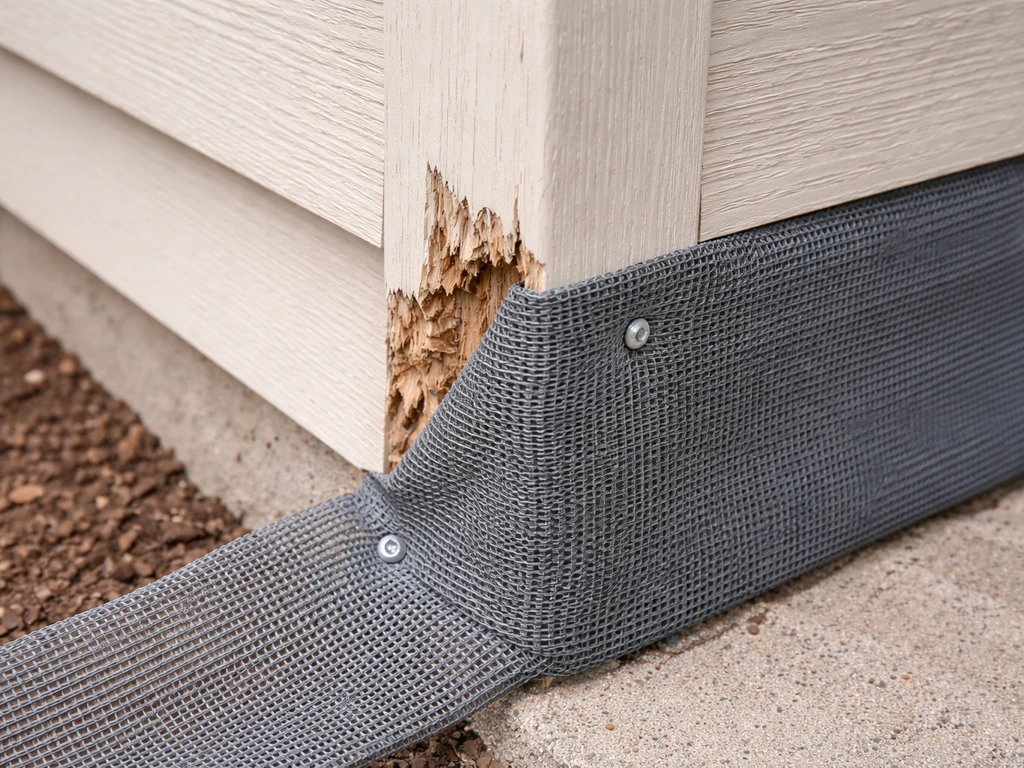
Figure out why the bird is chewing (and which bird you're dealing with)
The damage pattern is usually your best clue. Woodpeckers are the most common offenders around buildings in North America, and the Downy Woodpecker is the most frequently encountered.
The Hairy, Pileated, Acorn, and Northern Flicker also cause problems regularly. If you're seeing quarter- to half-dollar-sized holes that are fairly deep and clustered in one spot, that's classic woodpecker work. The location matters too: holes scattered across cedar siding often mean a bird is drilling for insects living in the wood. A single, neat, deeper cavity in a corner or shaded eave suggests nest construction.
Repeated rapid tapping without much wood removal, usually early morning, is territorial drumming. That last one is purely acoustic behavior, so the bird isn't actually trying to get anywhere.
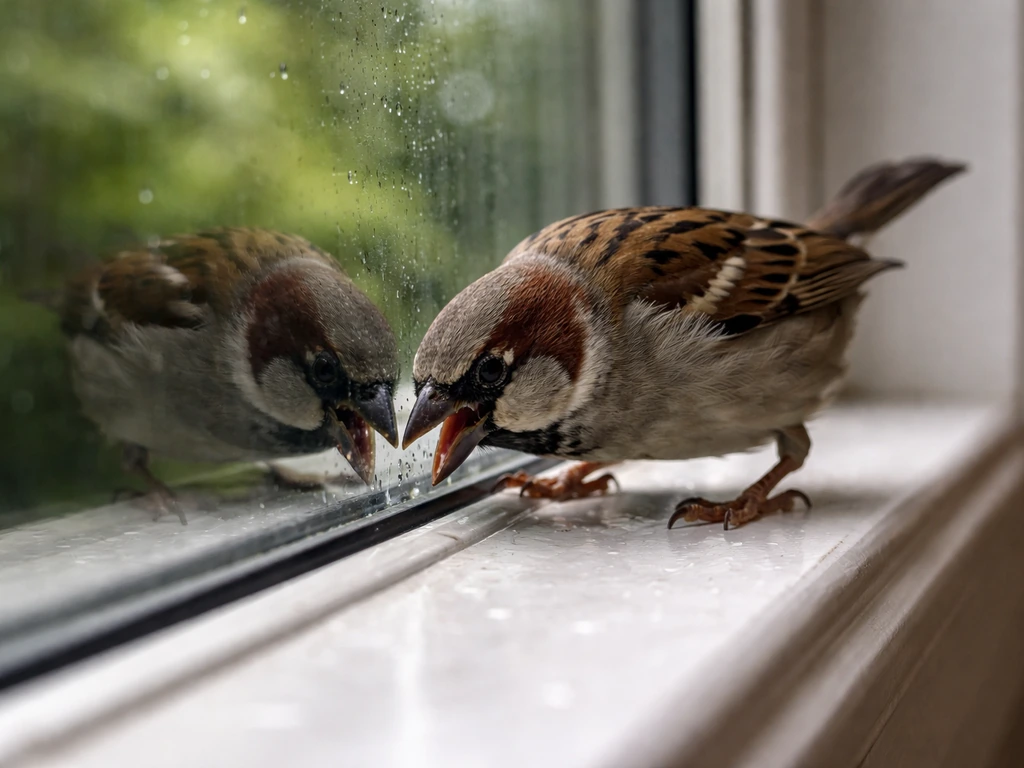
Non-woodpecker species like House Sparrows and Starlings don't drill, but they're experts at exploiting gaps. If you're seeing torn or pulled-away wood fibers near eaves, vents, or soffits rather than clean drilled holes, you're more likely dealing with a cavity-nesting bird looking for a place to build. The repair and exclusion approach is similar, but the deterrents that work for each behavior differ quite a bit.
| Damage sign | Likely bird | Likely reason |
|---|---|---|
| Deep, round holes, quarter- to half-dollar size, clustered | Woodpecker (Downy, Hairy, Pileated) | Foraging for insects in wood |
| Horizontal rows of small, evenly spaced holes | Sapsucker (a woodpecker) | Sap feeding |
| One larger, deeper cavity near a corner or eave | Woodpecker or Flicker | Nest construction |
| Rapid tapping, no significant hole | Woodpecker | Territorial drumming |
| Torn or frayed wood fibers near gaps/vents | Starling, House Sparrow | Nest building, exploring access points |
| Gnawing at fascia or soffits, scattered debris | Starling, Sparrow, or small birds | Roosting, nesting, or foraging |
Stop the damage today: immediate actions
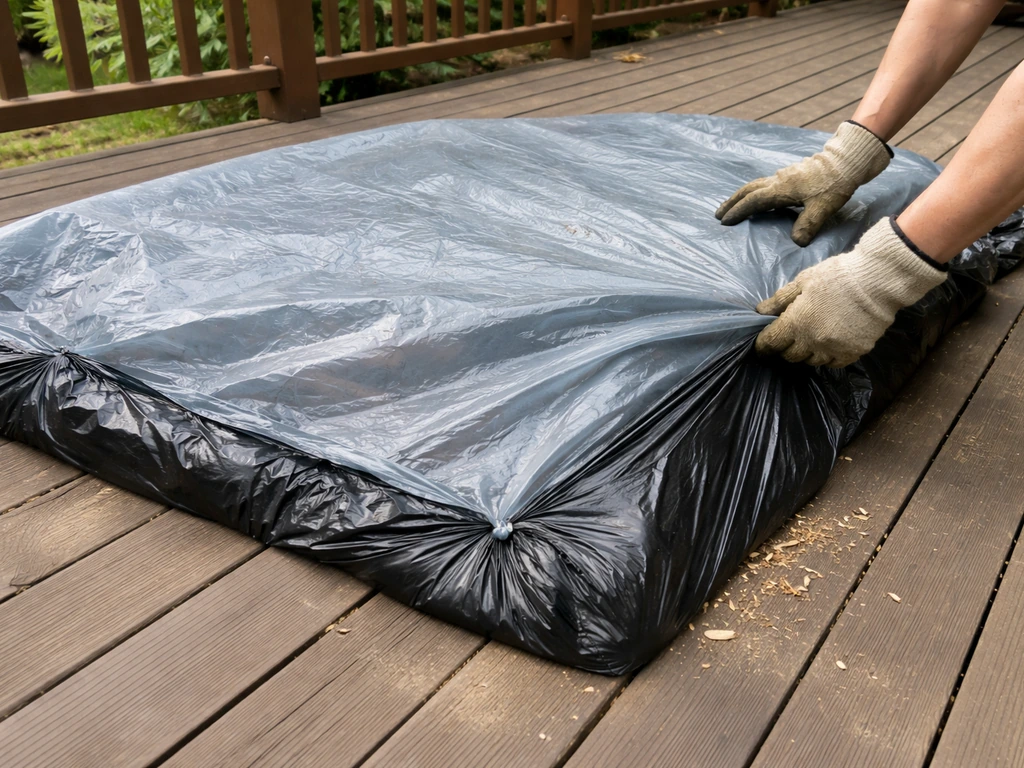
Speed matters here because every return visit reinforces the bird's habit and deepens the damage. The same-day goal is simple: remove the bird's access to the wood before it comes back, ideally before dawn the following morning since most woodpeckers and nesting birds are most active at first light. If you are trying to stop a bird from attacking you directly, focus on avoiding baiting behaviors and using safe distancing while you secure the areas it targets remove the bird's access to the wood.
- Cover damaged areas with a large plastic drop cloth, heavy-duty garbage bag, or a tarp. Tack it securely so it moves in the wind, which adds an extra deterrent effect. This works as an immediate stopgap for flat siding, shingles, or fascia boards.
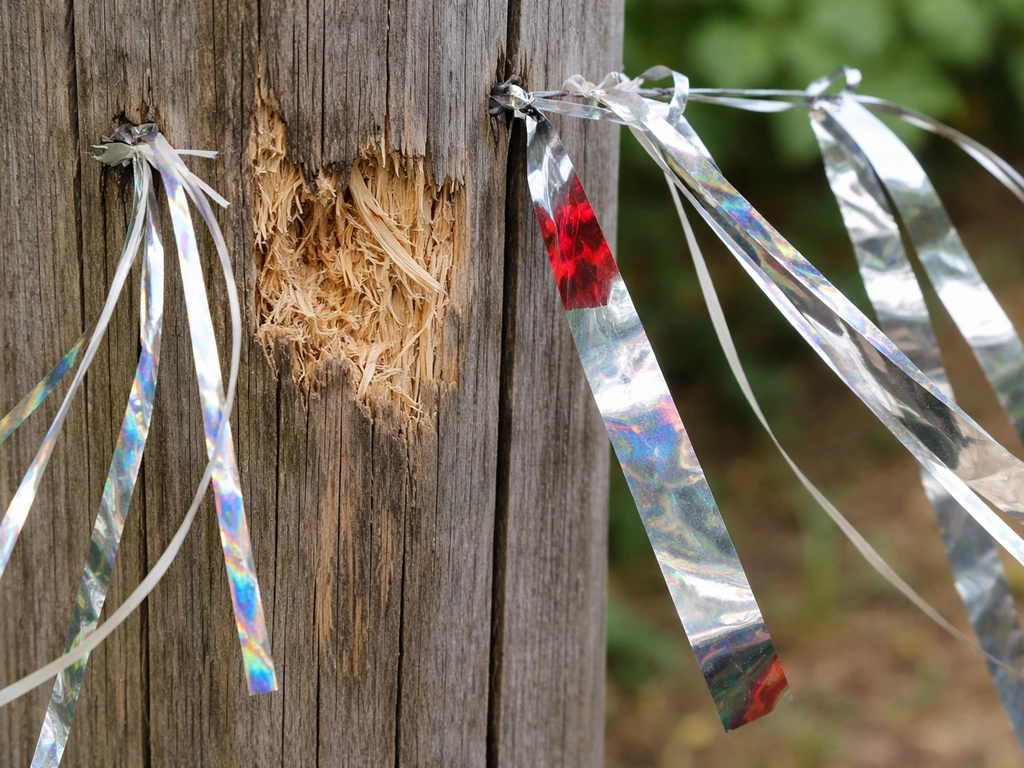
- Hang something reflective or moving directly over the spot. Mylar strips or old CDs on string near the damaged area disrupt the bird's comfort zone while you prepare a longer-term fix. Be realistic: these work best as a short-term distraction, not a permanent solution.
- Remove any visible insects or insect evidence from the surface. If the bird is foraging, treat the underlying pest problem (a licensed exterminator can identify larvae or carpenter bees in the wood) to eliminate the food source that's drawing it in.
- Take away any nearby food sources that might be attracting birds generally: birdfeeders close to the building, open compost, or accessible garbage.
- If there's a small access gap at a soffit, vent, or eave, loosely stuff it with hardware cloth or heavy mesh temporarily until you can install a proper screen. Do not seal it completely yet, as a bird or chick inside would be trapped.
If you can hear activity inside a wall or eave cavity right now, stop before blocking anything. That situation requires checking for an active nest first, and there are legal requirements around how you handle that. Jump to the safety and legality section below before doing anything else.
Physical barriers and wood-protection strategies
Physical exclusion is the most effective long-term method, consistently more reliable than any behavioral deterrent alone. If you want a direct checklist for how to stop a bird biting, focus first on exclusion, then add the right deterrents for the bird’s behavior physical exclusion. UC IPM identifies installing bird netting as the most effective method to stop woodpecker damage, and that holds true for most wood-chewing scenarios. The key is installation: wrong spacing renders netting useless.
Bird netting
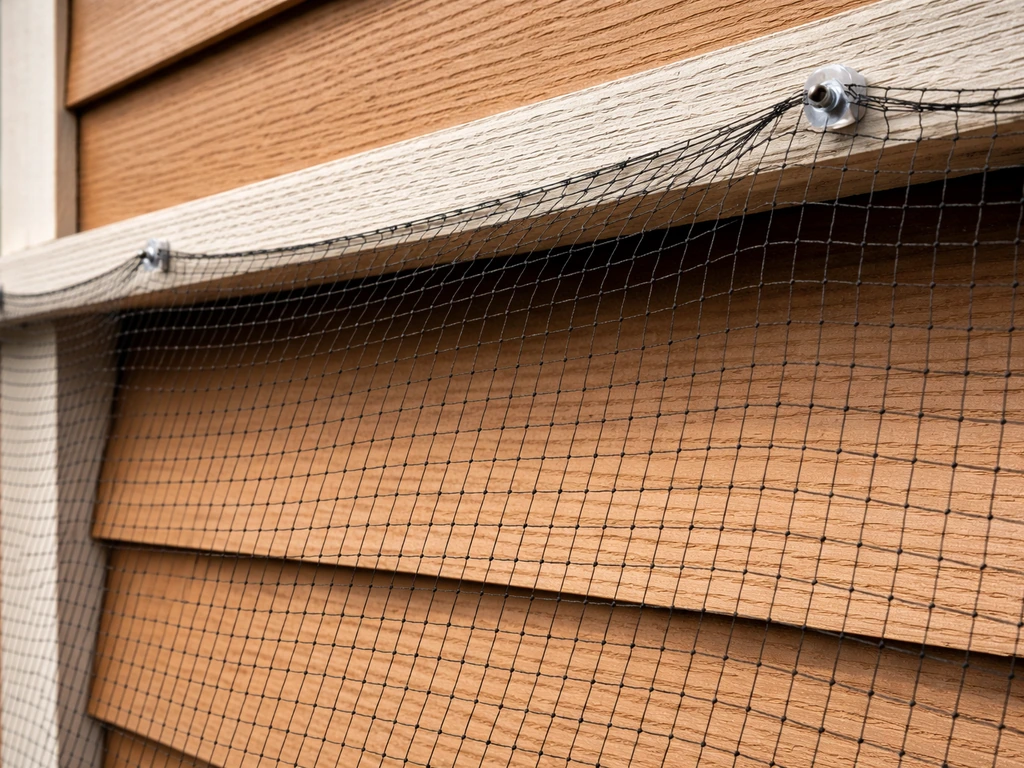
Use 3/4-inch bird netting for side-of-building coverage. The critical rule: maintain at least 3 inches of clearance between the netting and the damaged surface on flat walls, and at least 6 inches under eaves. Less than that, and the bird can press through the mesh and still reach the wood. Attach the top edge securely to the soffit or roofline, let it hang down the face of the building, and anchor the bottom edge out from the wall so it forms a tent-like angle. This stops the bird from landing and working the surface. Check all edges are sealed so there's no gap the bird can slip behind.
Hardware cloth and sheet metal
For smaller, localized damage areas, 1/4-inch hardware cloth or lightweight sheet metal can be fastened directly over the damaged section. This is especially useful on fascia boards, corner trim, or specific siding panels. Hardware cloth lets you seal a damaged area while still allowing inspection and is easy to cut to shape. Sheet metal is more durable and completely removes the surface texture the bird was working on. Fasten both securely with screws or staples rated for outdoor use, and overlap the edges beyond the damaged zone by at least 2 inches on each side.
Sealing and reinforcing vulnerable wood
Bare, weathered, or soft wood is more attractive to birds than painted or treated surfaces. Once damage is repaired, prime and paint all exposed wood, or apply a hardening wood consolidant to softer areas. Cedar and redwood siding are particularly targeted, so consider replacing badly damaged sections with composite or fiber-cement siding in high-risk areas. Any gap larger than 1/2 inch in soffit panels, around vents, or at roof-wall junctions should be screened or caulked with an exterior-grade, paintable sealant.
Deterrents that actually work for wood chewing and nesting
Deterrents work best as a complement to physical exclusion, not a replacement for it. Deterrents work best as a complement to physical exclusion, not a replacement for it how to stop a bird from plucking its feathers. The honest reality is that many commonly sold deterrents have limited or inconsistent effectiveness, and birds habituate to static deterrents quickly. Here's what the evidence supports and what to be realistic about.
Visual deterrents
Reflective streamers, [Mylar ribbon, and flash tape](/prevent-cat-attacks-on-birds/how-to-stop-a-bird-from-attacking-its-reflection) hung directly at the damage site can work as a short-term disruption, but Transport Canada's evaluation found there is very little biological basis for their long-term effectiveness and that habituation happens quickly. Move them every few days if you use them, and don't rely on them past a week or two. Life-sized plastic owls with movable or paper wings have shown some short-term effect on woodpeckers in studies, but again, only when repositioned regularly.
Auditory deterrents
Distress-call systems that broadcast a woodpecker in distress followed by a predator call (such as a hawk) have shown effectiveness in studies and real-world use. Cornell Lab research noted a sound system broadcasting woodpecker distress calls followed by a predator call as one of the better-performing deterrents in a field comparison. These units need to be placed near the active damage site and rotated or adjusted regularly to prevent the bird from learning they're harmless.
Tactile and taste deterrents
Sticky bird gel applied to surfaces makes landing and clinging unpleasant. Products like Bird-X Bird Proof Gel are listed as lasting up to one year under most weather conditions and can be applied to siding, trim, and ledges. Important: seal porous wood surfaces before applying gel, or it soaks in and loses contact effectiveness quickly. Liquid bird repellents (some are marketed specifically for woodpeckers) work on a similar principle and can be sprayed on surfaces. These are not a primary solution but can reinforce a physical barrier at the edges and corners.
Redirection: giving the bird somewhere else to go
If a woodpecker is drumming for territory rather than drilling for insects, you won't stop it by covering the wood alone because it's not after the wood, it's after the sound. Install a purpose-made drumming board (a resonant surface mounted away from the building) or a nest box in a nearby tree to offer alternatives. Placing a suet feeder away from the building has also been used as a redirection strategy to shift the bird's attention, though results vary.
Long-term repair and prevention: the seasonal plan
One-time fixes rarely hold permanently. A seasonal maintenance approach is what actually keeps wood-chewing problems from returning year after year.
Spring (February to May): highest-risk nesting period
This is when woodpeckers and cavity-nesting species are most actively seeking nest sites and drumming for territory. Install or inspect netting and hardware cloth before birds become active. Check all soffit panels, fascia boards, and eave gaps and seal anything larger than 1/2 inch before February if you're in a temperate climate. If you need to install exclusion on a building that has had previous bird activity, do it in winter so you're not disturbing an active nest.
Summer (June to August): foraging and fledgling activity
Foraging damage tends to peak in summer when insect larvae are active in wood. If woodpeckers are targeting a specific section of siding, have a pest professional inspect for carpenter bees, wood-boring beetles, or other insects inside. Treating the pest problem reduces the attractiveness of the wood significantly. Inspect any exclusion mesh for storm damage or separation and repair before fall.
Fall and winter (September to January): roosting and shelter seeking
Starlings, sparrows, and some woodpeckers look for roosting sites and winter shelter in building cavities. This is the best time to do structural repairs and upgrades: replace damaged wood, install new exclusion screening, repaint weathered surfaces, and seal gaps. Any work done now avoids disturbing nesting birds and puts your building in the best condition before the next spring nesting season.
Annual maintenance checklist
- Inspect all soffits, eaves, fascia, and siding for new gaps or damage each January
- Check and re-secure all bird netting and hardware cloth after winter storms
- Repaint or reseal any bare wood before February
- Replace any soft or rotted wood sections that could attract foraging birds
- Inspect for wood-boring insect activity each May and treat if found
- Refresh or reposition any deterrents that have been in place more than 2 to 3 weeks
- Document any recurring damage locations to target proofing efforts the following fall
Safety, legality, and what to do about an active nest
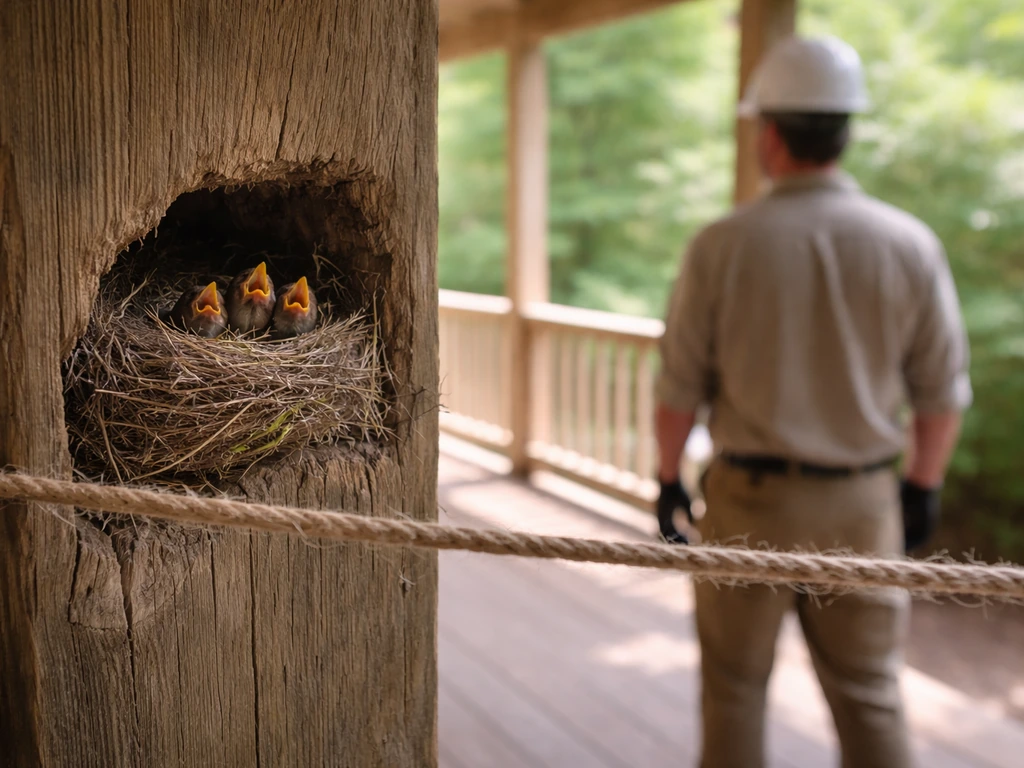
This is the part that catches a lot of people off guard. In the United States, most wild birds are protected under the Migratory Bird Treaty Act (MBTA). It is illegal to destroy a nest that contains eggs or chicks, or to take actions that harm dependent young, without a federal permit. That includes woodpeckers, flickers, starlings, and sparrows.
The active nest protection stays in effect until the young are fully fledged and no longer dependent on the nest. Under 50 CFR 21. 14, there is a limited authorization to remove a migratory bird from the interior of a building without a permit, but that authorization explicitly does not apply to birds or nests on the exterior of buildings, such as on siding or under eaves, which is exactly where most wood-chewing damage occurs.
In the UK, all wild birds and their nests are protected under the Wildlife and Countryside Act 1981. The RSPB is clear that it is an offence to intentionally damage or destroy a nest while it is in use or being built, or to take or destroy eggs. The EU Birds Directive provides similar protections across EU member states, including a blank" rel="noopener noreferrer">prohibition on deliberate significant disturbance during breeding and rearing. If you're in any of these jurisdictions and a bird is actively nesting in your building, the right move is to wait it out and plan your exclusion work for after fledging.
An active nest is defined, under FWS guidance, as one containing viable eggs or chicks, remaining active until fledged young are no longer dependent on the nest. If you're not sure whether a nest is active, watch the site for 20 to 30 minutes from a distance before touching anything. Signs of activity include adults entering and exiting regularly, sounds of nestlings, or a bird sitting on the nest.
- Never block an entry point if a bird or nest is inside: you could trap and kill protected birds, which carries federal or criminal penalties
- Do not remove, relocate, or destroy an active nest containing eggs or chicks without a permit
- If you are unsure whether a nest is active, treat it as active until confirmed otherwise
- Exclusion and sealing work should be done in winter (ideally before February) to avoid all nesting conflicts
- Always wear gloves and a dust mask when working near nesting areas due to bird droppings and parasites
- Use fall protection equipment when working on ladders or near eaves
Troubleshooting and when to call a wildlife professional
If you've put deterrents in place and the bird is still showing up, there's usually a fixable reason. Work through this checklist before assuming you need to escalate.
| Problem | Likely cause | Fix |
|---|---|---|
| Bird returns to same spot daily despite deterrents | Habituation to static deterrents | Move or change deterrents every 5 to 7 days; add a sound deterrent |
| Netting not stopping damage | Insufficient clearance from surface | Recheck spacing: minimum 3 inches on walls, 6 inches under eaves |
| Bird moved to a new spot nearby | Deterrents displaced it but didn't solve the root cause | Identify and address underlying reason (insects, nesting site availability) |
| Damage continues despite mesh over the area | Gaps at mesh edges or corners | Inspect all attachment points; seal any gap larger than 3/4 inch |
| Multiple birds appearing, not just one | Roosting flock, not a single problem bird | Scale up exclusion; contact a wildlife professional for flock management |
| Sounds of activity inside wall or cavity | Possible nest inside structure | Do not seal; call a licensed wildlife specialist to assess the nest status |
When to call a wildlife professional
Some situations are genuinely beyond DIY scope, and trying to handle them yourself risks legal trouble, injury, or making the problem worse. Contact a humane wildlife control professional or a building bird-control specialist if any of these apply:
- You can hear birds or detect an active nest inside a wall, attic, or eave cavity and need to know if it's active before proceeding
- Damage is extensive across multiple elevations of a large building or facility
- You've tried physical exclusion and deterrents for two or more weeks with no reduction in activity
- A protected species (such as a woodpecker) is roosting or nesting inside the building structure itself and you need a federal permit assessment
- You're managing a commercial property, school, or facility where fall protection and working-at-height rules apply to access areas
- You suspect a significant insect infestation inside the wood that is driving persistent bird activity, requiring a pest management professional alongside wildlife control
When you call a wildlife professional, have this information ready: which bird species you believe is involved, the locations and approximate size of the damage, how long the activity has been happening, whether you've seen or heard activity inside the structure, and what you've already tried. That saves time and helps them come prepared with the right tools.
Wood-chewing bird problems and building-pecking behavior are closely related. If you are dealing with ear-biting behavior from a bird, the same prevention mindset applies: reduce access to the parts it targets and discourage the behavior with consistent, safe deterrents. If you're dealing with pecking on window frames, exterior trim, or metal surfaces rather than actual wood removal, the same species and the same core fixes apply: physical exclusion first, targeted deterrents second, legal awareness always.
These same steps can guide you in how to stop a bird from pecking the house once you know the behavior and entry points pecking on window frames, exterior trim, or metal surfaces. The behavior is persistent because it's instinct-driven, but with the right barriers in the right places, and a seasonal maintenance habit, most building owners can resolve it without professional help and keep it from coming back.
FAQ
How can I tell if a woodpecker or cavity-nesting bird is actively nesting before I cover the damaged area?
Before you block anything, verify whether the bird is actively nesting (viable eggs or chicks). If you see adults repeatedly entering and exiting, hear nestling sounds, or spot a bird sitting on the structure, do not install exclusion or repairs yet. In that case, wait until fledging is complete, then install the barrier and complete the wood repair.
What should I expect after installing netting or hardware cloth, and what does it mean if the bird keeps returning?
If you remove the bird’s access to the wood quickly, you should usually see a drop in visits within days. If activity increases or the bird starts working nearby spots, that often means gaps remain at edges, corners, or around vents. Recheck all seams, overlaps, and any clearance around netting or hardware cloth, then seal any openings larger than about 1/2 inch with an exterior-grade sealant.
Why does bird netting sometimes stop working even after it was installed?
Netting can fail when the clearance rule is not followed, when the bottom edge is not anchored so it forms a tent-like angle, or when there are gaps at the top and sides. Also inspect for storm damage, sagging mesh, or separation from the soffit, then repair before the next active season. A small gap near the roofline is often enough for a bird to bypass the barrier.
What clearance distances matter most when installing netting, especially under eaves?
If the damage is on a flat wall, you generally need netting clearance of at least 3 inches from the surface, so the bird cannot press through the mesh. Under eaves, you generally need more clearance, at least 6 inches, and you must secure the top and anchor the bottom so the mesh tents away from the wood.
What if I stop the chewing but the bird comes back, could insects still be the cause?
If you suspect birds are chewing for insects rather than only for nesting or drumming, treating the underlying pests is often what makes the pattern stop. Have a pest professional check for carpenter bees, wood-boring beetles, or other larvae in the specific siding section, then address those sources before or alongside wood repair.
Can I use sticky gel or sprays as the main solution, and why does it sometimes fail?
First repair the wood surface (prime and paint, or consolidate soft areas) before applying sticky gels or liquid repellents. If porous wood is unsealed, products can soak in, leaving little residue on the landing surface, which reduces effectiveness. Use gels or liquids only as reinforcement, not as your only barrier.
What if the bird is mostly drumming, not drilling or chewing, how do I stop it?
Drumming behavior can continue even when wood access is blocked if the bird is seeking a resonant surface for territory communication. In that case, you need an alternative, such as a purpose-made drumming board mounted away from the building or a nearby alternative nesting site. Covering the damaged wood alone may not stop the sound-driven behavior.
What should I do if I hear activity inside a wall or eave cavity right now?
If you suspect a cavity-nesting bird is inside a wall or eave, do not seal the area immediately. Watch the site from a distance for about 20 to 30 minutes to confirm whether young are present, then plan exclusion and repairs after fledging. Sealing during an active nest can create legal issues and can also trap dependent young.
Are reflective tape, plastic owls, or sound systems enough without installing physical barriers?
A quick “deterrent only” approach can backfire because birds habituate to static cues, and you can end up with repeated damage while you wait for the cue to work. If the bird is repeatedly targeting the same spot, the most reliable next step is exclusion, then add deterrents only as short-term support while the barrier is newly installed.
When should I stop DIY and call a professional wildlife control or building bird-control specialist?
DIY escalation is risky in situations involving active nesting, significant structural access needs, or uncertainty about species. If you cannot confidently confirm the presence or absence of eggs or chicks, or if the damage is in hard-to-access exterior voids, contact a humane wildlife control or building bird-control specialist with the species estimate, damage location and size, duration of activity, and what you have tried.
What maintenance timeline helps prevent this from returning every year?
To reduce the chance of repeat damage, complete the structural work and sealing before the birds become active in your region, then recheck the barrier after storms and during seasonal transitions. Also schedule insect-focused inspections when foraging damage peaks, since untreated wood pests can keep the area attractive even after barriers are added.
If the damage is only in one small spot, can I cover just that area instead of doing whole-panel exclusion?
For localized damage, covering just the damaged section with 1/4-inch hardware cloth or lightweight sheet metal can work well if it is securely fastened, overlaps beyond the damaged zone by at least about 2 inches on each side, and is sealed so there are no slip-through edges. If the surrounding area is also weathered or soft, you may need to expand the covered area after inspecting what is behind the surface.
What if I’m unsure about the legal risk of handling a nest on the exterior of my home?
If you are unsure about whether the bird is protected under your local laws, treat active nests as off-limits and plan exclusion for after fledging. In the meantime, focus on temporary steps that do not disturb or seal active nests, and consult a wildlife professional if you are in a jurisdiction with strict protections.