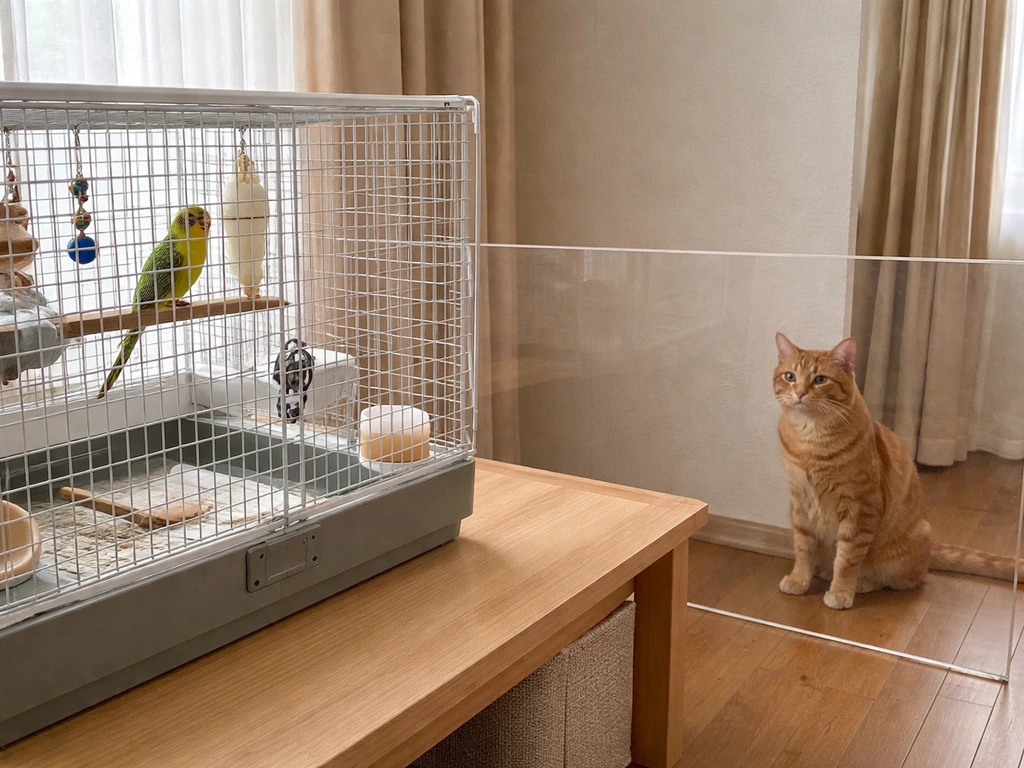
The fastest way to stop your cat from harassing or hunting your bird right now is simple: physically separate them. Put the cat in another room, close the door, and give yourself a moment to assess the situation without either animal in danger. Everything else, the training, the cage upgrades, the long-term routine changes, only works if you start from a place of controlled separation. Here is exactly what to do, step by step, starting today.
How to Get My Cat to Leave My Bird Alone Safely

Maya Carver
27 May 2026
Quick safety steps for right now
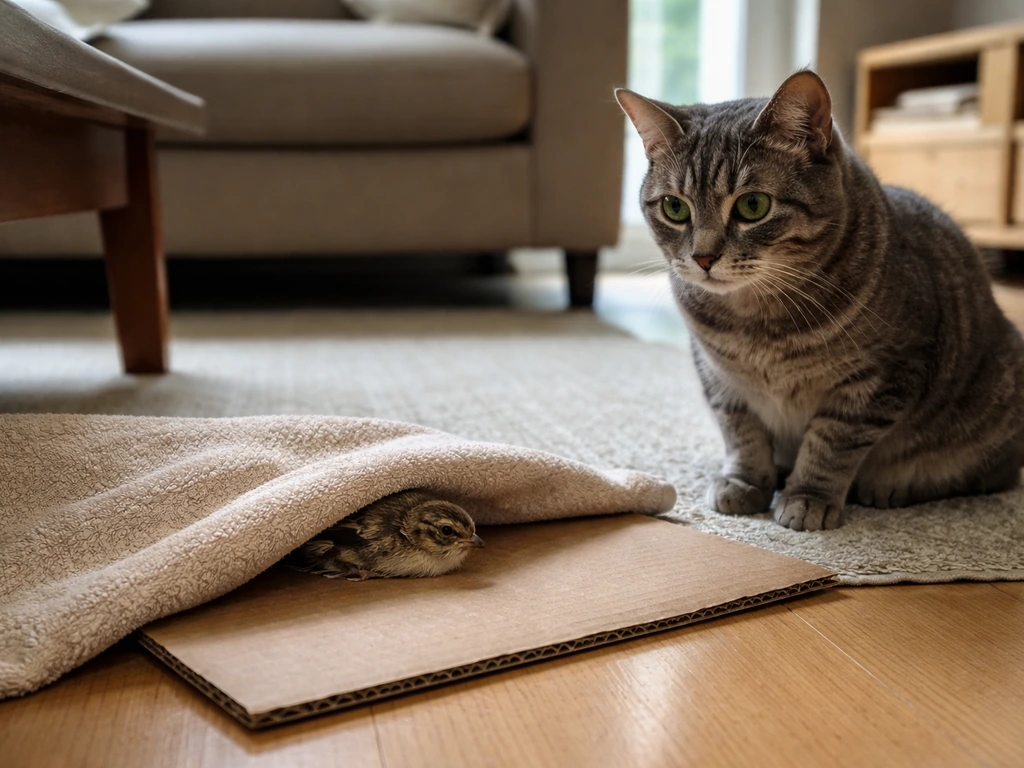
If your cat is actively stalking, chasing, or has already made contact with a bird, do not reach in with your bare hands to grab the cat or pull the bird free. Injured or frightened animals bite and scratch unpredictably, and cat bites in particular can cause serious infections that need prompt medical attention. Protect yourself first, then the animals.
- Use a towel, pillow, or piece of cardboard to create a barrier between the cat and the bird, then guide the cat into a separate room and close the door firmly.
- Do not chase or corner the cat aggressively. A cornered cat is far more likely to bite or scratch you.
- Once separated, check the bird carefully. Even if it looks fine, any cat contact, including a scratch or a moment in the cat's mouth, is a medical emergency for birds. Cat saliva carries bacteria that can cause fatal systemic infection in birds within hours, even from minor contact.
- If a pet bird was touched by the cat, call an avian vet immediately. Do not wait to see if symptoms develop.
- If a wild bird was involved, contain it gently in a ventilated cardboard box lined with a soft cloth, keep it in a warm, quiet, dark space, and contact a licensed wildlife rehabilitator as soon as possible. Do not offer food or water.
- Keep the cat isolated until you have a proper management plan in place. Do not allow unsupervised access again until you have worked through the steps below.
The predatory sequence in cats moves fast: silent watching, tail twitching, a low crouch, and then the strike. The key insight from animal behavior research is that interrupting the stalk stage, before the pounce, is far easier and more effective than trying to intervene mid-attack. So your goal from this point forward is to prevent the cat from ever getting into that focused, locked-on stalking posture near the bird.
Cat-proofing the bird setup
The bird's physical environment needs to be treated as a secure zone the cat simply cannot breach. This is not optional, and it is not just about keeping the cage door latched. It is about making the entire area around the bird inaccessible and unstimulating to a predator. Follow the same principles of safe separation and cat-proofing to keep a cat away from a bird cage.
Cage and enclosure upgrades
- Use a cage with a secure, cat-proof latch. Simple swing-up latches can be nudged open by a determined cat. Replace them with carabiner clips or twist-lock mechanisms.
- Make sure the cage bars are close enough together that the cat cannot get a paw inside. For small birds, bar spacing should be no more than half an inch.
- Place the cage on a heavy, stable stand that cannot be tipped. A cat jumping onto or hanging from a cage can knock it over, which is traumatic even without direct contact.
- Add a solid base tray guard or a physical skirt around the bottom of the cage so the cat cannot reach paws under the cage.
- Do not place the cage near furniture, shelves, or curtain rods that the cat can use as launching points to reach the top of the cage.
Room layout and access barriers
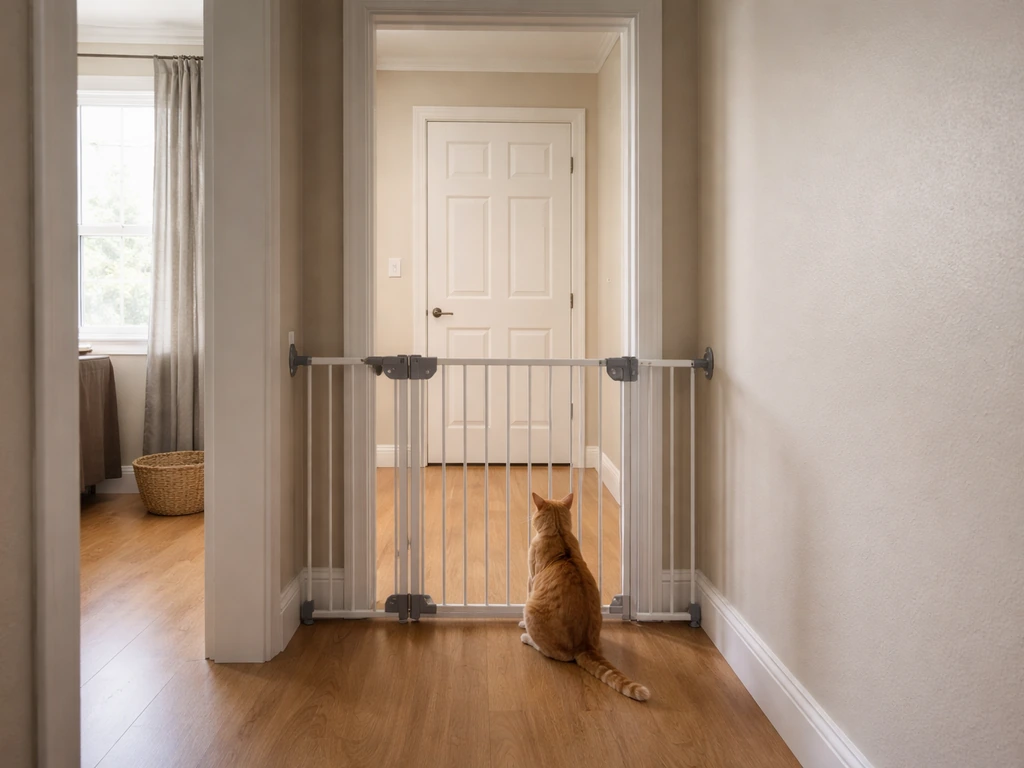
- Dedicate a separate room to the bird if at all possible, with a door the cat cannot open. This is the single most effective structural change you can make.
- If a separate room is not possible, install a tall, freestanding baby gate with a cat-proof height (at least 4 feet, ideally with an overhang or mesh top) in the doorway to the bird's area.
- Use double-door entry if you can (a second barrier like a screen door or a curtain with magnets), so there is always one closed barrier between the cat and the bird even if someone accidentally leaves the first one open.
- Remove any perches, cat trees, or furniture within jumping distance of the bird's cage or feeder area.
- Consider placing a motion-activated air sprayer near the cage as a deterrent backup, not as a primary strategy, but as a safety net if the cat approaches when you are not watching.
Control the cat's triggers
A cat does not decide to stalk a bird out of spite. The bird's movement, sound, and smell are powerful triggers for the cat's built-in prey drive. Reducing those triggers is just as important as adding physical barriers, because a cat that is constantly exposed to a bird it cannot reach will often become more obsessed, not less.
Manage what the cat can see, hear, and smell
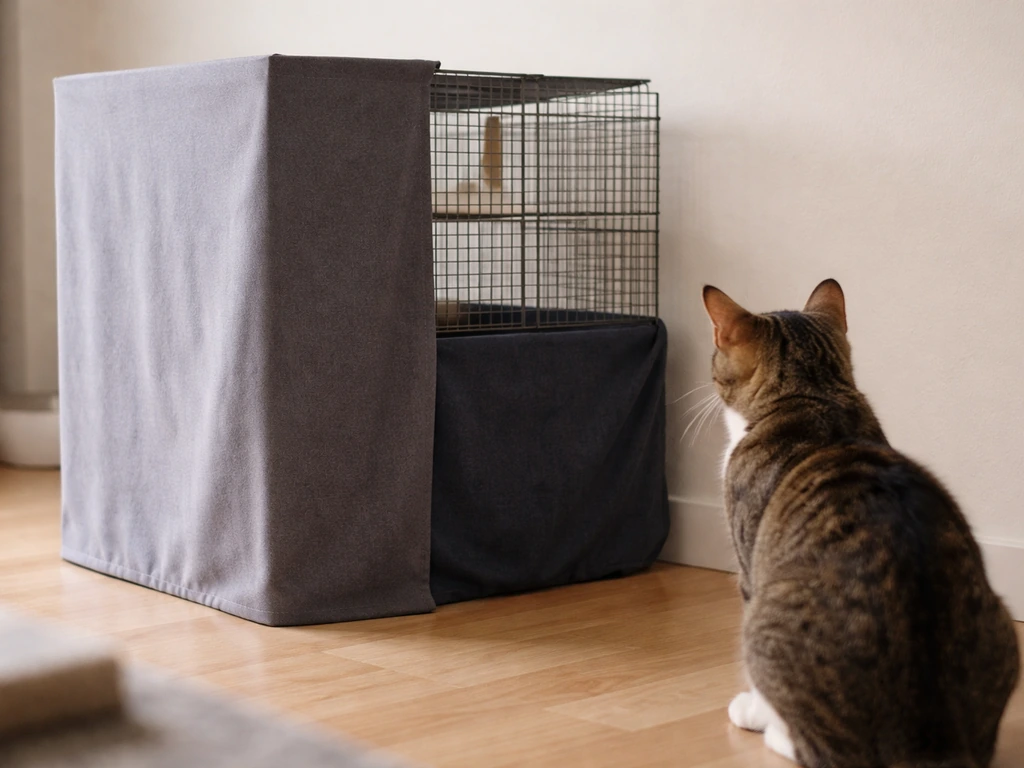
- Block the cat's visual access to the bird as much as possible. Cover lower portions of the cage with a cloth or position the cage so the bird is not directly visible from the cat's usual routes.
- Run a white noise machine or fan near the bird's room to muffle the sounds that trigger the cat's prey focus.
- Do not let bird feathers, food droppings, or bedding scatter into areas where the cat roams. The scent alone can keep the cat keyed up.
- Avoid handling the bird and then immediately interacting with the cat without washing your hands. The bird scent on you can trigger a sudden predatory response.
Supervision and daily routine
Scheduling matters more than most people realize. Cats are most likely to stalk and pounce when they are under-stimulated or in a high-arousal state. Timed play sessions before the bird's most active periods, typically morning and late afternoon, can significantly reduce the cat's predatory focus on the bird. A ten-minute wand toy session that mimics the stalk-chase-catch sequence burns off that drive in a safe direction before the bird starts moving around its cage.
- Schedule active play with wand toys or feather teasers 15 to 20 minutes before the bird's most active or noisy periods.
- End play sessions with a small food reward to complete the natural hunt-catch-eat sequence, which helps the cat settle rather than staying in an aroused state.
- Never leave the cat unsupervised with access to the bird's space, regardless of how well things have been going.
- Use meal puzzles and foraging toys to keep the cat mentally occupied during the hours when the bird is most active.
Training to reduce stalking and pouncing
Training will not eliminate prey drive, but it can give you a reliable way to redirect the cat and build a conditioned response that means 'leave the bird alone' earns something good. Think of it as adding a layer of control on top of your physical barriers, not replacing them.
The basic behavior plan
- Start with clicker training fundamentals if you are not already using a marker. Charge the clicker by clicking and immediately giving a high-value treat 10 to 15 times in a row until the cat reliably looks at you when it hears the click.
- Teach a solid 'Leave it' cue in a neutral setting first, far from the bird. Place a low-value treat under your hand, wait for the cat to back off or look away, then click and reward with a better treat from your other hand. Repeat until consistent.
- Gradually practice 'Leave it' at increasing distances from the bird's room, with the bird out of sight but within scent range. Never push the cat past the point where it can respond. If it locks on and ignores you, you are too close.
- Use desensitization and counterconditioning: pair the bird's presence (at safe distance, behind barriers) with high-value rewards for calm, relaxed behavior from the cat. Over many sessions, the cat begins to associate the bird's sounds and smells with good things happening to it rather than with a hunting opportunity.
- Never punish stalking behavior with physical correction. Punishment increases stress and arousal, which can make the predatory response worse. Interrupt calmly, redirect, and reward the redirection.
What realistic progress looks like
Some cats will become reliably indifferent to a caged bird over weeks of consistent training. Others, especially cats with strong prey drives, will never be safe to leave unsupervised with a bird regardless of training. Be honest about your individual cat. If after six to eight weeks of consistent work the cat still fixates intensely on the bird whenever it is in range, the answer is permanent structural separation, not more training.
Indoor vs outdoor bird situations
The right fix depends heavily on what kind of bird situation you are dealing with. A pet bird in a cage has very different vulnerabilities than a wild bird visiting a window feeder or a bird roosting on a balcony.
| Situation | Main risk | Top priority fix |
|---|---|---|
| Pet bird in cage, indoor cat | Direct physical contact, stress from constant harassment | Secure room separation, cage-proofing, training routine |
| Wild bird at window feeder, indoor cat | Cat jumping at windows, bird collision from startling | Move feeder away from windows, apply window film/decals, block cat's window access |
| Wild bird on balcony, indoor-outdoor cat | Direct predation outdoors | Keep cat indoors, install balcony screen/enclosure |
| Wild bird in yard, free-roaming cat | Hunting and killing wild birds | Keep cat indoors full-time or use a secure outdoor enclosure (catio) |
Feeders and windows
If your cat is launching at windows where birds land, the problem has two parts: the cat's behavior and the physical setup. Move feeders at least 3 feet from windows so startled birds have room to escape without hitting the glass. If you want the feeder closer for viewing, place it within 1 foot of the window instead, where birds cannot build up enough speed to be injured if startled into the glass.
Apply window decals or collision-deterrent film, spacing markings no more than 2 to 4 inches apart to be effective. One-way transparent film lets you see out while the window appears opaque from outside, reducing the attraction for birds. Block the cat's access to the windowsill during feeder hours using a physical barrier or double-sided tape on the ledge.
Balconies and outdoor access
Balconies are high-risk zones. A cat on an unscreened balcony can catch a bird mid-flight or ambush one that lands to rest. The most practical solution is a cat enclosure ('catio') that gives the cat outdoor time in a fully screened space where birds cannot enter and the cat cannot exit. If building a permanent structure is not possible, retractable mesh balcony barriers designed for cats are available and provide good protection. Keeping cats indoors is the most consistently recommended approach from bird conservation and animal welfare organizations alike, and it also protects the cat from outdoor hazards.
Prevention upgrades for longer-term bird protection
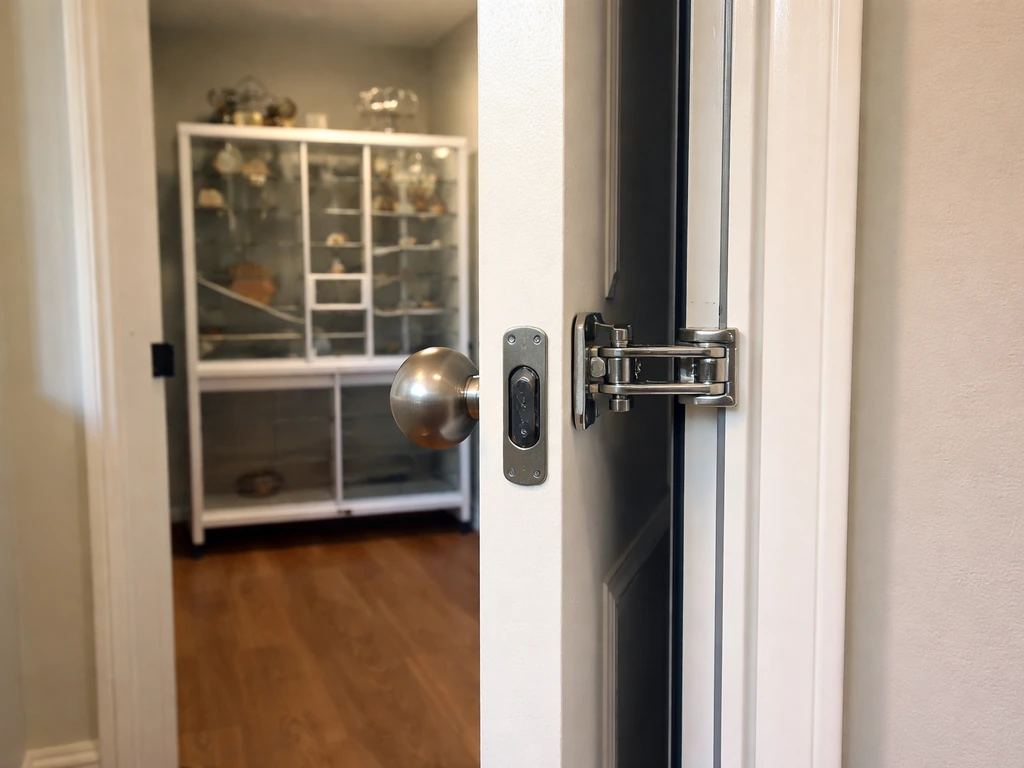
Once the immediate crisis is managed, shift your focus to making the environment structurally resistant to future incidents. These are the upgrades worth investing in for lasting protection.
- Install a dedicated bird room with a solid-core door and a cat-proof latch or handle cover. This is the single best long-term investment.
- Upgrade window and door screens to heavy-gauge hardware cloth or reinforced pet-proof screening in any room where birds are present or feeders are visible.
- Add a second cage to the bird's enclosure setup: a sleep cage in an inner, cat-free room for nighttime, and a day cage in a monitored area. Nighttime is when many incidents happen because supervision drops.
- Use a smart doorbell camera or inexpensive pet camera pointed at the bird's area to monitor interactions remotely. Reviewing footage helps you catch early warning signs like the cat stationing itself near the bird repeatedly.
- Review your home's layout seasonally. During spring and fall bird migration, wild birds are more active near windows, which raises your indoor cat's arousal level even if there is no pet bird in the home.
- Enrich the cat's environment year-round with climbing structures, puzzle feeders, window perches (on windows away from feeders), and regular interactive play. A cat that has ample outlets for its prey drive is less fixated on the bird.
When to escalate: vets, wildlife professionals, and animal control
Some situations go beyond what DIY management can handle. Knowing when to call in a professional is not admitting defeat. It is the right call for the safety of both animals. If you find an injured bird, Tufts Wildlife Clinic recommends contacting a local wildlife rehabilitator for guidance and assistance.
When to contact a vet
- Any pet bird that had physical contact with your cat, even a brief one, needs to be seen by an avian vet the same day. Do not wait for visible symptoms. Cat saliva bacteria can cause fatal infection within 24 to 48 hours in birds, even from a minor scratch.
- If your cat's predatory behavior is escalating, constant, or directed at multiple animals in the home, speak to a veterinary behaviorist. In some cases, anxiety or an underlying medical issue is driving heightened arousal, and there are safe medication options that can help alongside a behavior plan.
- If your cat was injured during an incident, even minor scratches or bites from a bird, have it checked. Bird bites can also cause infection.
When to contact a wildlife rehabilitator or animal control
- Any wild bird that was caught, scratched, or in the cat's mouth needs immediate care from a licensed wildlife rehabilitator, even if it appears uninjured. Contact your local wildlife rehabilitation center or call USFWS for a referral.
- If the bird involved is a protected species under the Migratory Bird Treaty Act (which covers most wild songbirds, raptors, and waterfowl in the US), you are legally required to report an injured bird and get it to a licensed rehabilitator. Keeping it yourself is not legal.
- If a neighbor's free-roaming cat is repeatedly predating birds at your feeders or nesting boxes and the owner is unresponsive, contact your local animal control. Many jurisdictions have ordinances covering free-roaming cats and wildlife protection.
Your prioritized next steps
Start today with separation and a vet call if there was any contact. If the worst happens and you need guidance on what to do when your cat kills a bird, follow the post-incident steps right away. If you are dealing with cat kills bird situations, the same prevention and supervision steps apply, but you should also consider escalating quickly to a professional for a safer long-term plan cat kills bird how to stop.
This week, audit the bird's enclosure and room access and make the structural fixes. Over the next two to four weeks, build the play routine and start the 'Leave it' training foundation. At the six-week mark, honestly evaluate whether the cat's behavior has meaningfully changed or whether you need permanent structural separation and a veterinary behavior consult. The goal is a home where the bird is not under constant stress and the cat is not constantly frustrated.
Both are achievable, but physical barriers and daily management are what actually protect the bird. Training and enrichment support the plan; they do not replace it.
FAQ
If my cat is already near the bird, is it ever safe to grab either animal?
Use a towel or blanket as a barrier between them if you must intervene, and do not put your hands near the bird's beak or the cat's mouth. Keep the cat separated first, then check both animals for injuries, and call your avian vet promptly if there is any contact, even if the bird seems fine.
Will letting my cat watch the bird from a distance help, or does it make stalking worse?
Yes. A cat can learn that the bird is “new” every time the bird moves, so letting the cat watch for long periods through a gap can increase fixation. Keep viewing time short and only during supervised, calm moments, then separate again before the cat reaches the crouch and tail-twitch stage.
What counts as a cat-proof “secure zone” for the bird, beyond locking the cage door?
Keep the bird’s room as a “one-way” system: the bird can access its safe zone, the cat cannot access it at all. Use doors, baby gates, and closed barriers together, and verify there are no bypass points like cracked doors, open vents, or cat “escape routes” behind furniture.
How do I train “Leave it” in a way that actually works with predatory behavior?
Start by pairing “Leave it” with something you control, like a treat that appears after the cat turns away, not while it is focused. Practice in low-distraction moments first, then gradually increase distance, and end sessions before the cat gets aroused enough to crouch and freeze.
Should I feed my cat during bird time to reduce hunting, or can that backfire?
Feeding a high-value meal right before a bird’s most active times can backfire if the cat still gets keyed up by movement and then associates that arousal with the bird. The safer approach is scheduled play to lower arousal first, then normal feeding, then strict separation or barrier time during bird movement.
How consistent do the routine and barriers need to be for results to stick?
Many cats prefer consistency, so use the same routine and same barrier positions every day. If barriers get moved “just temporarily,” the cat may escalate the moment it learns access patterns. Plan any changes for times when the cat is fully contained in a separate room.
How can I check whether my current setup is truly secure when I’m not watching every second?
Test your setup with a “cat alone” trial after you install it. Put the cat in its normal boundary, confirm it cannot reach the bird area through any route (including top-of-cage reach, if the bird is caged), and fix weak points before you add training sessions again.
Does the plan change if my bird is out of its cage or on a stand near the floor?
If the bird is in a free-flight room, treat that space like the bird’s “secure zone,” not the cat’s. You may need to keep the bird in its cage or in a fully separated playpen during the learning period, because free-roaming birds create unpredictable movement triggers.
What early warning signs mean I should stop the session and separate them immediately?
Look for escalating body language: silent staring, tail twitching, low crouch, sudden stillness, and pacing toward the access point. If you see these consistently, shorten the cat’s access time to the bird area, increase separation, and consider whether structural separation is needed sooner.
My cat never makes contact, but the bird seems stressed. Should I still treat this as urgent?
Even if you never see an actual bite or scratch, birds can be stressed by repeated close calls. If there is persistent “freeze” behavior, refusal to eat, puffing, or hiding after incidents, treat it as a high-stakes situation and intensify management rather than assuming training alone will fix it.
For window or balcony situations, what’s the most common mistake people make?
Window and balcony fixes should include cat access control, not just bird deterrents. A barrier only works if the cat cannot jump onto it, wedge under it, or reach the sill, so choose options that account for your cat’s height and jump ability.
What should I do medically after any attempt or contact, even if the bird looks okay?
After any contact, especially any bite risk, schedule a vet check for the cat and a prompt avian assessment. Cat oral bacteria can cause rapid infections, and birds can hide pain; don’t wait for visible wounds before getting medical advice.
At what point does “training” stop being the right solution and permanent separation becomes necessary?
If the cat continues to fixate even with separation and enrichment, you may be at the point where training is not enough. A practical decision aid is the six-to-eight-week evaluation, then move toward permanent structural separation and, ideally, a veterinary behavior consult to reduce the chance of repeating incidents.