A storm bird is simply any bird that ends up inside your home or building during or after a storm, usually disoriented, exhausted, and panicking. The fastest way to remove it humanely is to darken the room, open one clear exit (a door or window), and give it a few minutes to find its own way out. Most birds leave on their own once there is an obvious escape route and no distractions. The rest of this guide covers what to do when that does not work, how to handle an injured bird, how to clean up safely, and how to stop it from happening again.
How to Get Rid of a Storm Bird Safely and Humanely
Maya Carver
19 May 2026
What "storm bird" actually means and why they end up inside
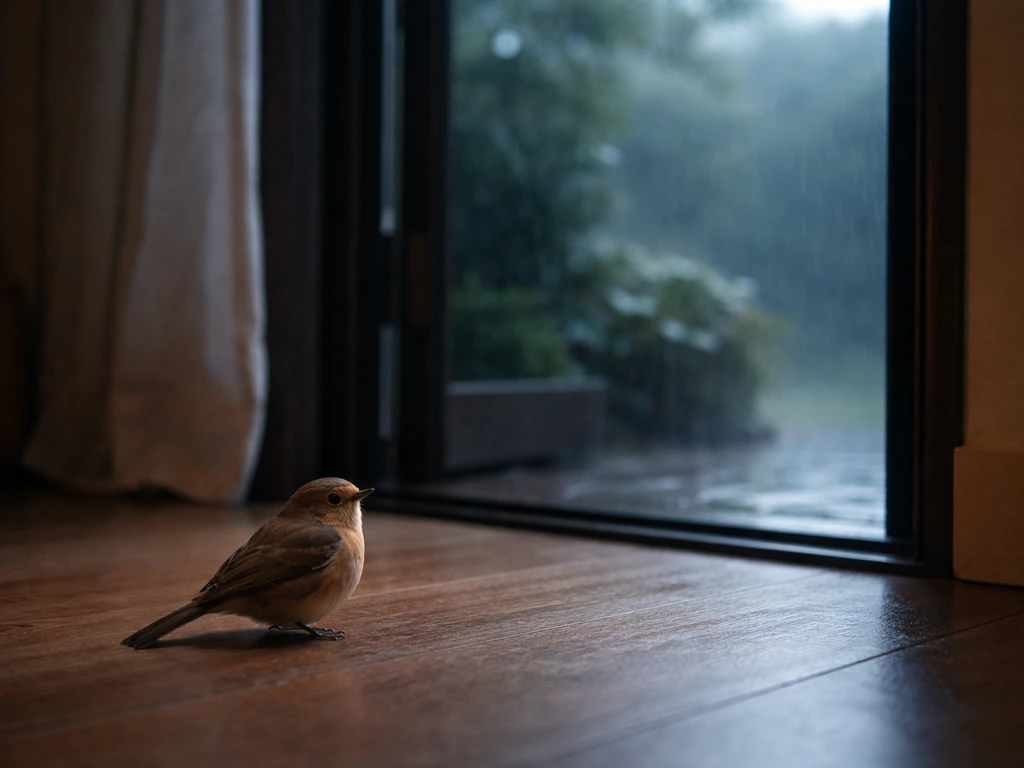
The term storm bird does not refer to a single species. It describes any bird, songbird, pigeon, starling, owl, or otherwise, that ends up inside a building because a storm pushed it there. During heavy rain, high winds, or severe weather, birds lose their ability to maintain normal flight and perching behavior. They actively seek shelter and will take almost any opening they can find: an open window, a cracked vent, a chimney, a gap under roof eaves, or a propped-open garage door. Migrating birds are especially vulnerable because storms can disorient them mid-flight, causing them to fly toward lit windows or any structure that breaks the wind.
Once inside, the bird is almost always terrified. It will fly toward light (which usually means it repeatedly strikes windows), exhaust itself rapidly, and can injure or kill itself within hours if not helped. The disorientation is compounded indoors because artificial lights and glass reflections make it impossible for the bird to navigate normally. The sooner you act, the better the outcome for the bird and the less mess you deal with afterward.
Quick emergency actions when a bird is indoors
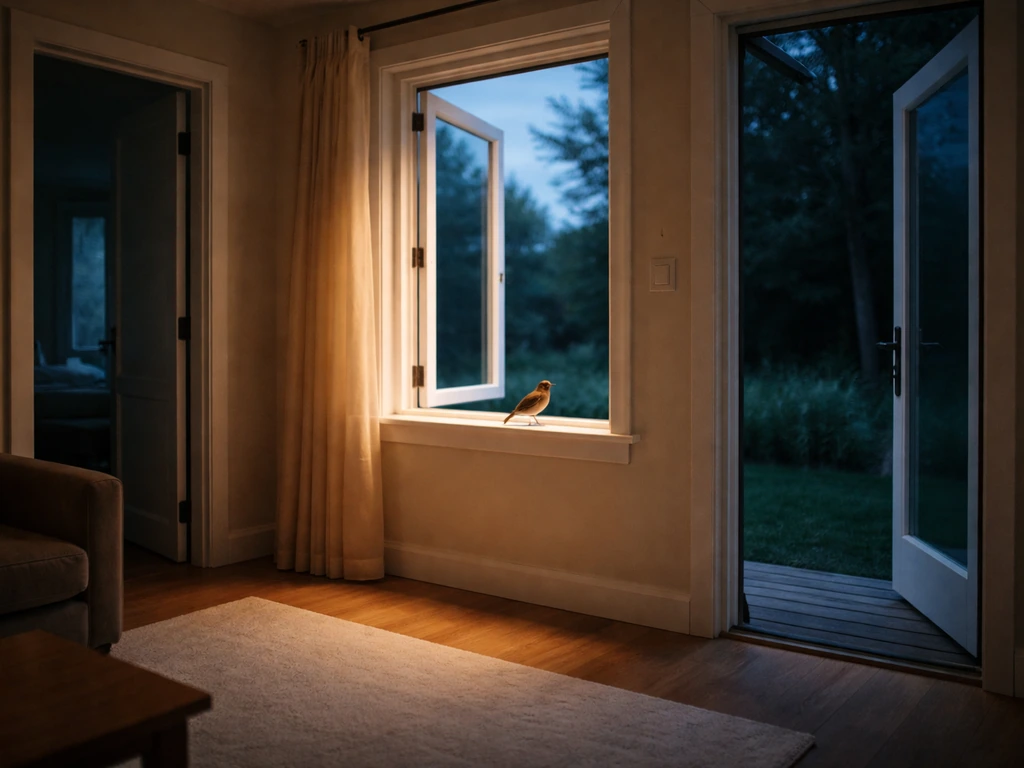
Before you try to physically guide or catch the bird, set up the right conditions. This takes two minutes and dramatically increases the chance the bird exits on its own.
- Stay calm and move slowly. Sudden movements cause the bird to fly harder and higher, increasing injury risk and exhaustion.
- Clear the room of pets and other people. Dogs, cats, and curious children make the bird panic more.
- Turn off all lights in the affected room or area.
- Cover any windows or skylights that do not open, using a sheet, blanket, cardboard, or towel. Birds mistake glass for open space and will keep flying into it.
- Open one clear exit: the largest accessible door or window leading directly outside. Remove any screen if you can.
- Leave the room quietly and give the bird 10 to 15 minutes to find the exit on its own.
The logic behind darkening the room is straightforward. Disoriented birds fly toward light, so if the only light source in the room is the open doorway or window leading outside, the bird will naturally orient toward it. This is the same principle behind the Lights Out programs that Audubon and other conservation groups promote during migration seasons to prevent birds from circling lit buildings in confusion. Bird Conservancy of the Rockies likewise explains that disoriented birds may waste energy flying around to re-orient, leading to exhaustion and sometimes death, which is why Lights Out is used during migration and other at-risk periods Lights Out programs that Audubon and other conservation groups promote during migration seasons.
Step-by-step removal: create an exit and guide it out safely
If the bird has not left after 15 minutes, you need to gently encourage it toward the exit. Do not chase or grab the bird unless it is injured or completely exhausted.
- Confirm your exit is fully clear and that all other windows are covered. Recheck for gaps in window coverings.
- Re-enter the room slowly. Keep the lights off.
- Use a large, soft item (a bedsheet, a large towel, or a piece of cardboard) held in front of you to gently herd the bird toward the open exit. Move slowly and steadily, not in sudden lunges.
- A broom held horizontally, bristles toward the bird, can also work as a gentle herding tool. Sweep it slowly in the direction of the exit without swinging or threatening the bird.
- If the bird lands on a surface, give it a moment to rest before you continue guiding it. An exhausted bird that lands is not giving up; it is catching its breath.
- Once the bird is near the exit, pause and back away. Many birds will hop or fly out once they sense the open air.
- If the bird is resting on a low surface and you cannot guide it out any other way, place a large towel or cloth over it gently, pick it up through the fabric (so your bare hands do not touch it and it cannot see you), and carry it outside. Set it down in a sheltered spot outdoors and remove the cloth.
A few things to avoid: do not yell, clap, or wave your arms quickly. Do not spray water at the bird. Do not use any chemical deterrent sprays indoors. If the bird turns out to be a robin, the safest approach is still to remove it using the indoor emergency steps above, similar to what this guide covers for how to get rid of a robin bird. And do not try to grab a flying bird out of the air. You will not succeed and you will only terrify it further.
If the bird is in a large space like a warehouse or gymnasium
Large buildings present a bigger challenge. The San Diego Humane Society recommends making the entire space as dark as possible, covering skylights if you can do so safely, and opening the largest ground-level exit available. Position someone near the exit with a flashlight pointing outward (not at the bird) so the bird has a lit target to fly toward. Be patient: in large spaces this can take an hour or more. Do not attempt to climb heights to chase the bird. Fall risk is not worth it.
If the bird won't leave or is injured: what to do next
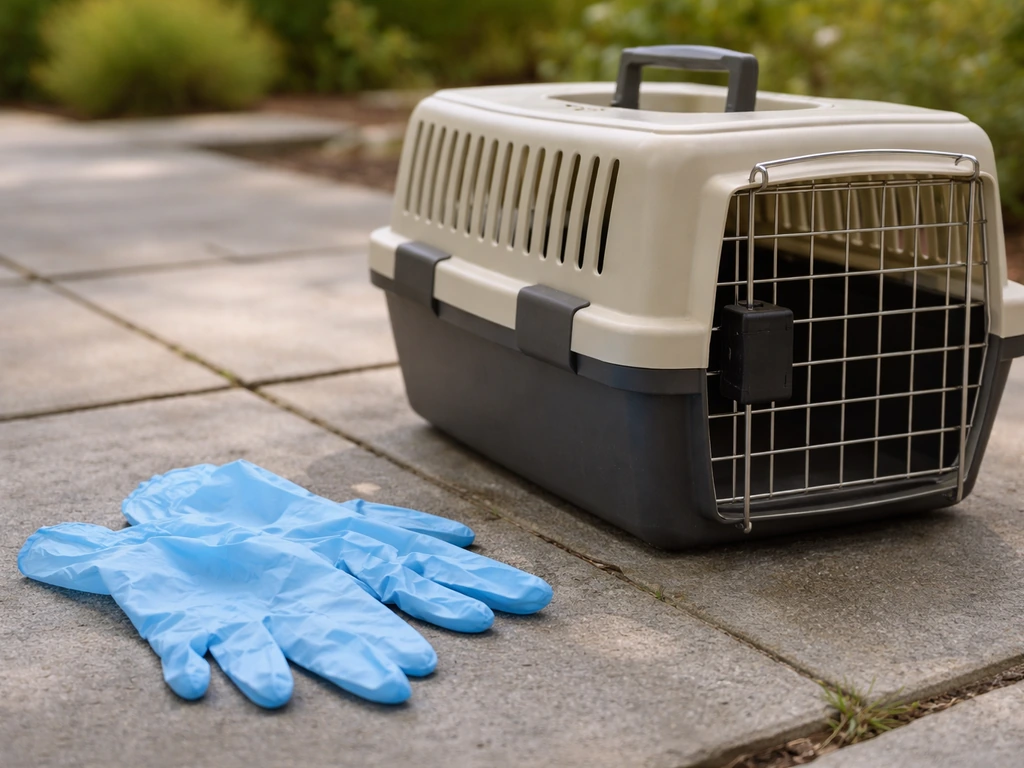
If the bird is clearly injured, cannot fly, is sitting on the floor with its eyes closed, is breathing with its beak open, or looks like it has struck a window hard, do not try to keep herding it toward an exit. A bird in that state needs immediate help.
- Put on gloves before handling. A thin pair of nitrile or rubber gloves is enough.
- Gently place the bird in a small cardboard box lined with a paper towel. Do not use a plastic container: the bird needs airflow. Poke several small air holes in the sides if needed.
- Do not give the bird food or water. Well-intentioned feeding can cause aspiration injury in a stressed bird.
- Put the box in a quiet, dark, warm spot (around 70 to 75°F) away from pets and noise.
- Contact a licensed wildlife rehabilitator as soon as possible. The sooner a bird reaches professional care, the better its chances. Search your state wildlife agency website or call your local animal control for a referral.
- Follow the rehabilitator's instructions exactly. Under U.S. federal regulation (50 CFR §21.14), if a trapped migratory bird becomes exhausted, ill, or injured, you are required to contact a federally permitted migratory bird rehabilitator.
The good news on legal exposure: you do not need a federal permit to humanely remove a healthy migratory bird from inside your home or business. The U.S. Fish and Wildlife Service allows any person to remove a trapped migratory bird from a building when the bird poses a health or safety risk, is damaging property, or may injure itself due to being trapped. That covers the vast majority of storm-bird situations. Where the rules change is if the bird is injured and you want to keep it for rehabilitation purposes, that requires a blank" rel="noopener noreferrer">federal permit held by a rehabilitator, not you.
After removal: cleanup, hygiene, and checking for entry points
Bird droppings carry real health risks. Histoplasma capsulatum, the fungal pathogen that causes histoplasmosis, thrives in bird feces and can become airborne when droppings are disturbed. Bird flu (avian influenza) is another concern, particularly with sick or wild birds. Learn more about safe handling and disposal if you suspect the bird may have carried disease bird flu (avian influenza). Do not skip cleanup, and do not rush it dry.
- Wear disposable gloves and an N95 respirator (not just a dust mask) before cleaning any droppings.
- Lightly mist droppings with water or a diluted disinfectant before wiping. Never dry-sweep or use a leaf blower near droppings, which aerosolizes spores.
- Use disposable paper towels or rags. Seal them in a plastic bag before throwing them away.
- Disinfect the affected surface with a standard household disinfectant or a diluted bleach solution.
- Wash your hands thoroughly after removing gloves.
- If the bird was visibly sick (discharge from eyes/beak, neurological symptoms), treat the cleanup as a higher-risk situation and consider calling a professional cleaning service.
Find the entry point while it is fresh in your mind
Right after removing the bird and cleaning up, do a quick walk-around to figure out how it got in. Common entry points include open or unscreened vents (dryer vents, soffit vents, ridge vents), gaps at roof eaves and fascia boards, uncapped chimneys, broken or missing window screens, and gaps around pipe penetrations. Mark anything you find with tape or a note so you can address it before the next storm. Do this while the details are fresh.
Preventing storm-time bird entry: sealing, screens, lighting, and habitat control
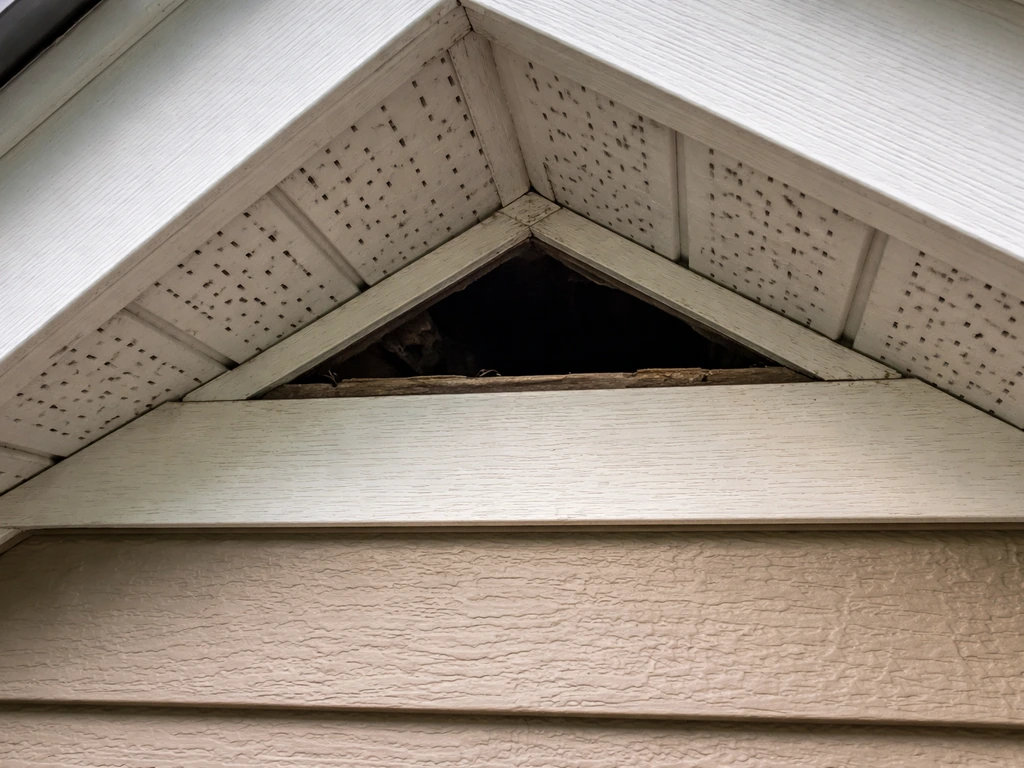
The most effective long-term strategy is making your building unattractive and inaccessible to birds before a storm hits. A combination of physical exclusion, lighting management, and habitat reduction covers most situations.
Physical exclusion: gaps, vents, and screens
Seal any gap larger than half an inch on the exterior of your building. For vents, install commercial vent covers with built-in screens. For larger openings like open loading bay doors or barn openings, heavy-gauge bird exclusion netting with a mesh size of three-quarters of an inch or smaller will keep most pest birds out while still allowing airflow. The USDA confirms that three-quarter-inch mesh netting is effective for excluding most common pest bird species. For smaller holes in wood, masonry, or around pipes, use hardware cloth (half-inch by half-inch steel mesh), caulk, or expanding foam depending on the material.
For window screens, use durable, moisture-resistant, corrosion-resistant mesh. Standard aluminum or fiberglass window screening is fine for most residential situations. Make sure screens fit tightly in their frames, especially after winter when frames can warp or shift.
Lighting management
Artificial lights are one of the biggest contributors to storm-time bird disorientation. During storms and especially during spring and fall migration (roughly late March through May, and August through November in most of the U.S.), consider turning off or shielding non-essential exterior and interior lighting visible from outside. The Audubon Lights Out program has demonstrated that simply reducing building lighting during migration dramatically cuts bird collisions and disorientation events. Motion-activated lighting rather than continuous lighting is a practical middle ground for security purposes.
Window collision prevention
Storm-blown birds frequently strike windows from outside too. Audubon's guidance on window collisions notes that physical barriers on the exterior of glass, such as film, tape patterns, or external screens, need to cover the surface without large open spaces. A pattern spacing of 2 inches wide by 4 inches tall (the "2x4 rule") is a commonly used standard to prevent birds from perceiving a gap they can fly through.
Habitat and attractant reduction
Birds seek shelter near food and water. Before storm season, take stock of what is drawing birds close to your building in the first place.
- Move bird feeders at least 30 feet from the building, or remove them entirely during migration season.
- Eliminate standing water near the building's perimeter.
- Trim back dense shrubs and vines growing directly against the building's walls or eaves, which provide convenient pre-storm roosting spots.
- Clear gutters and downspouts so they do not collect debris that attracts insects and in turn attracts insectivorous birds.
A note on commercial deterrents
Gel coatings, rubber owls, glass owls, and similar commercial deterrents have limited and often short-lived effectiveness, according to GSA reviews of bird control methods. Birds habituate to static objects quickly. If you use them at all, move them regularly and combine them with the physical exclusion measures above. They should not be your primary strategy.
Storm-season prevention checklist
| Task | When to do it | Priority |
|---|---|---|
| Inspect and repair all vent covers and screens | Early spring and early fall | High |
| Seal gaps at eaves, fascia, and roof penetrations | Early spring and after any major storm | High |
| Check chimney cap is in place and intact | Before storm season | High |
| Enroll in or review Lights Out schedule for migration periods | Late March and late August annually | Medium |
| Apply window collision deterrent film or tape | Any time, check annually for wear | Medium |
| Move or remove bird feeders near the building | Start of migration season | Medium |
| Trim back vegetation against building walls and eaves | Late winter / early fall | Medium |
| Walk the building exterior after every major storm | After each storm event | High |
When to escalate: protected species, legal considerations, and who to call
Most birds that end up in buildings during storms are common species, but not all of them. In the U.S., almost all native wild bird species are protected under the Migratory Bird Treaty Act (MBTA). This means you cannot harm, harass, or possess them, even with good intentions. Removing a healthy, uninjured bird from your building without harming it is legal and does not require a permit. But there are situations where you need to stop and make a call.
- The bird appears sick, injured, or is unable to fly: contact a licensed wildlife rehabilitator immediately. Do not attempt extended DIY care.
- You suspect the bird is a threatened or endangered species (raptors like owls and hawks, certain sparrows, shorebirds): do not attempt removal yourself. Call your state wildlife agency or the U.S. Fish and Wildlife Service regional office.
- The bird is in a location you cannot safely reach without climbing or ladder work: call a professional wildlife removal service rather than risking a fall.
- You are dealing with a colony or recurring infestation rather than a single storm event: this moves into wildlife management territory that typically requires professional assessment and, depending on species, permits.
- The bird is showing signs consistent with avian influenza (neurological symptoms, sudden death, respiratory distress): do not handle it without full PPE and notify your state animal health official or USDA APHIS.
When you call a wildlife rehabilitator or animal control, have this information ready: the species if you know it (or a description), where exactly the bird is, whether it appears injured or just disoriented, and how long it has been inside. That helps them prioritize and gives you faster, more specific guidance.
For facility managers dealing with repeated storm-entry events, keep a log. Note the date, weather conditions, species if identifiable, and which part of the building the bird entered through. Patterns will emerge quickly and will tell you exactly where to focus your exclusion work. A single repeated entry point sealed correctly is worth more than a dozen general deterrents scattered around the property.
Storm birds are a common problem, but they are also a solvable one. A calm, methodical approach gets the bird out safely in most cases, and a focused prevention plan means you are not dealing with the same situation every time the weather turns.
FAQ
What if the storm bird keeps flying toward the same window or corner after I darken the room and open an exit?
Give it a full cycle, then remove extra distractions. Turn off other lights in adjacent rooms if you can, close interior doors that create additional dead ends, and make sure the open exit is the only “escape-looking” opening. If you have multiple doors, leave only one accessible so the bird does not keep choosing the wrong direction.
Is it ever okay to use a vacuum, towel, or cardboard box to capture a storm bird?
Not for a healthy, active bird. Sweeping, trapping, or funneling it with household tools usually increases panic and can cause wing or keel injuries. Use guided exit methods instead, and only intervene physically when the bird is injured or unable to move normally.
How can I tell if the bird is injured versus just disoriented?
Injury signs include inability to stand, broken or hanging wing, bleeding, blood on the surface, repeated open-mouth breathing, or a clear “hit” response after window contact. Disoriented birds may sit briefly with eyes open and later perk up, or move away when given a direct exit route. When in doubt, treat it as injured and contact help.
What should I do if the bird is on a high ledge or inside a ceiling/attic space?
Do not climb to chase it, and avoid repeated long attempts that keep it trapped. Focus on the closest safe exit path: reopen a nearby window or door where the bird can reach the living area, and if it is in a wall or attic, consider calling animal control or a licensed wildlife handler because access and fall hazards are common.
Can I keep the bird overnight if it still has not left?
Avoid trying to contain it unless it is injured. If it is healthy and simply stuck, continue the Lights Out and single-exit approach. If it still will not exit after a reasonable attempt, contact animal control or a wildlife rehabilitator rather than leaving it trapped longer, especially overnight when lighting and temperatures may worsen the situation.
Should I cover or remove pet food, and keep pets away during cleanup and release attempts?
Yes. Bring dogs and cats to an interior room or outside on leash, and remove accessible food sources in the area. Even calm birds can startle and injure themselves, and pets can harm the bird, escalate the panic, or spread droppings on floors.
How do I clean up bird droppings safely if I cannot identify the bird health risk?
Do not dry-sweep or vacuum with standard household equipment. Use appropriate protection, keep people and pets away, and follow a cautious wet-clean approach so droppings do not become airborne. If the area is heavily contaminated or the bird looked ill, consider contacting a professional cleaner for guidance.
What if I find feathers near the building, but I cannot find a living storm bird?
Check common entry points and nearby window areas for a secondary spot. If you suspect the bird is injured inside a structure (wall, soffit, chimney), do not open openings wider than necessary. Contact animal control or a wildlife handler who can locate the bird without creating additional hazards.
Will taping or film on windows harm birds, and how long should it stay?
Window treatments should be applied as a complete exterior pattern with no large visible gaps in the “flight path.” It should remain in place during peak migration periods, typically spring and fall, and be inspected after storms because partial peeling can recreate perceived openings.
If I have to open vents or access panels to check entry points, is that safe during storms?
Wait until conditions are calm. Creating new openings during high winds can allow more birds in and can pose fall or electrical risks. Do the walk-around and sealing after the weather passes, and prioritize safe, ground-level access.
What if the bird is a protected species, does that change the removal steps?
The core humane removal steps for a healthy, uninjured bird are the same, do not attempt to harm or trap it in a way that risks injury. The practical difference is what not to do after: do not possess or keep it for rehabilitation unless you are permitted. If you want to help beyond release, contact a permitted rehabilitator.
How should I document the situation for repeated storm-entry events without creating extra stress for the bird?
Log from a distance when possible. Note time, weather conditions, where you saw the bird, and any visible entry gaps, then add photos after the bird is out and the area is safe. For ongoing facilities, a quick marked map of recurring entry points is often more useful than describing it in words later.