The fastest way to keep a bird away is to remove what's drawing it there and block the route it's using. That means identifying the attractant (food, water, a sheltered perching spot, or an open gap into your home) and then making the space physically unappealing or inaccessible. Everything else, including deterrents, is a support layer on top of that foundation. Here is how to work through it systematically, starting today.
How to Keep a Bird Away: Step-by-Step Fixes Today
Maya Carver
22 Mar 2026
Step 1: Quick safety check and identify the situation
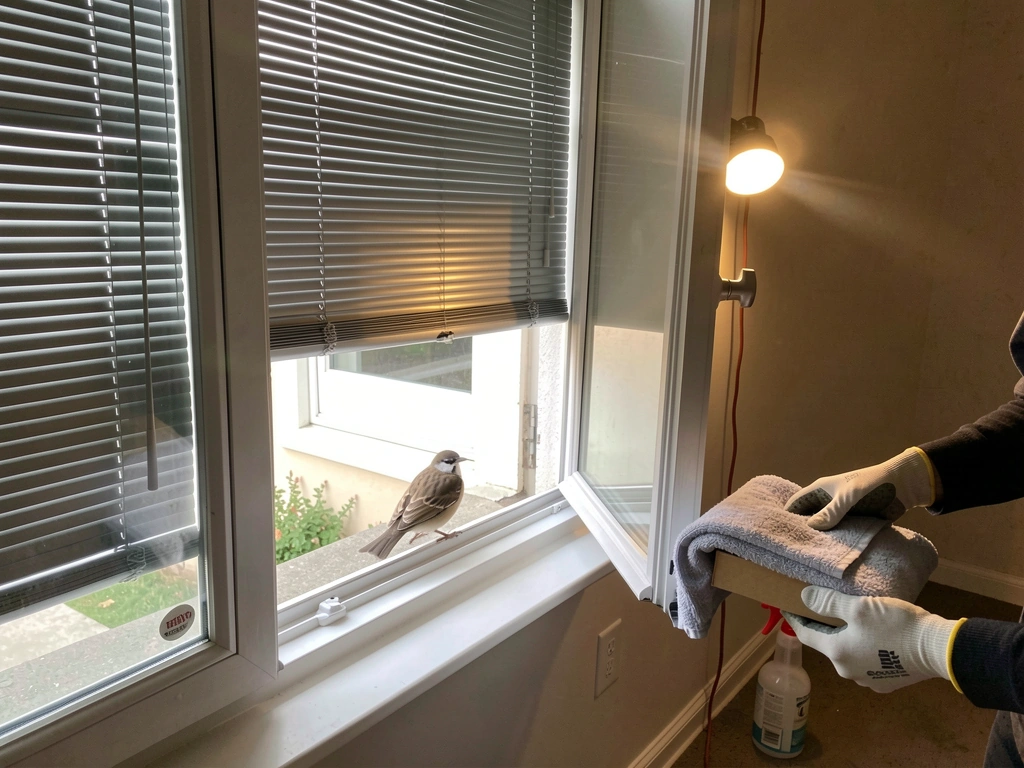
Before you do anything else, figure out exactly what you are dealing with. The answer changes what you do next, how urgently you need to act, and what legal constraints apply.
Ask yourself three questions. First: is the bird inside or outside your home? If the bird is inside your home, focus on how to guide a bird out calmly and safely before you seal up entry points. Inside requires immediate action with a different sequence (covered below). Second: is there a nest involved? A nest with eggs or chicks changes your legal options significantly in most countries. Third: is this one bird passing through or a recurring problem at a specific spot? Recurring visits almost always mean there is an attractant you have not removed yet.
On the safety side, avoid direct contact with the bird wherever possible. Frightened birds peck and scratch, and wildlife can carry disease. If the bird has been inside and left droppings, treat that area carefully. Bird droppings can harbor infectious organisms such as Histoplasma, so the priority is to exclude the bird first and then clean up without aerosolizing the dried material. Wear gloves and a dust mask during any cleanup, and wash your hands thoroughly with soap and water afterward.
Make your home unattractive from the inside out
Birds keep coming back because something at your property is rewarding them. Find and eliminate those rewards and most birds will redirect on their own within a few days. If you want a clear, step-by-step approach, follow the guidance on how to make a bird leave your house.
Seal gaps and repair damaged entry points
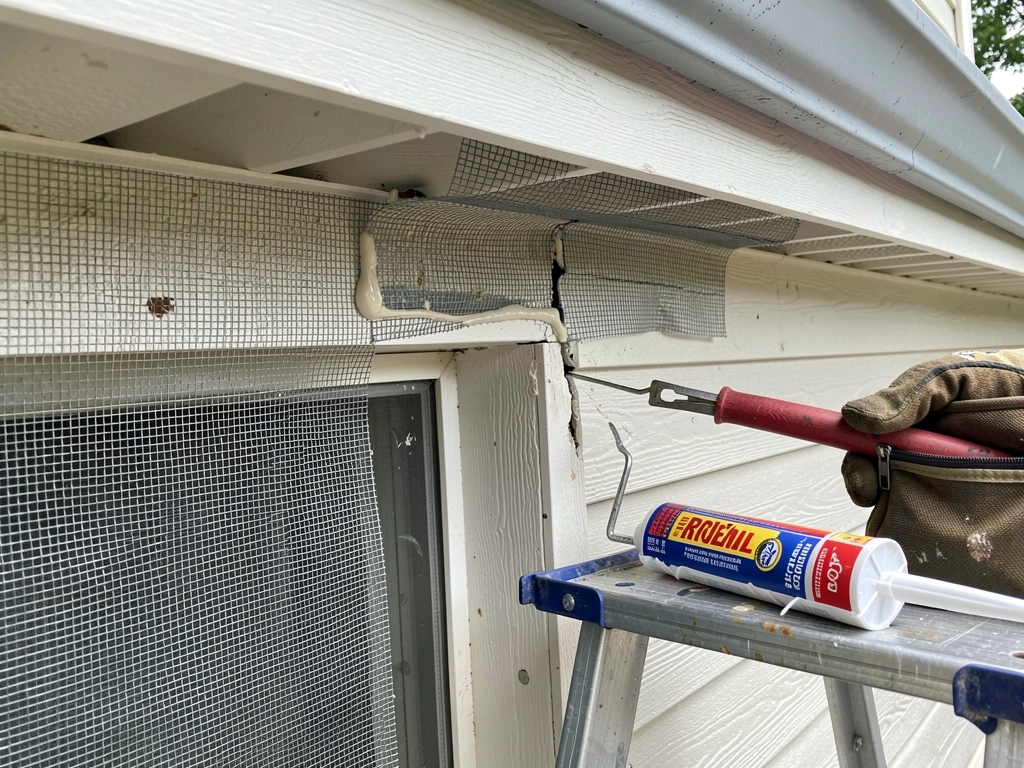
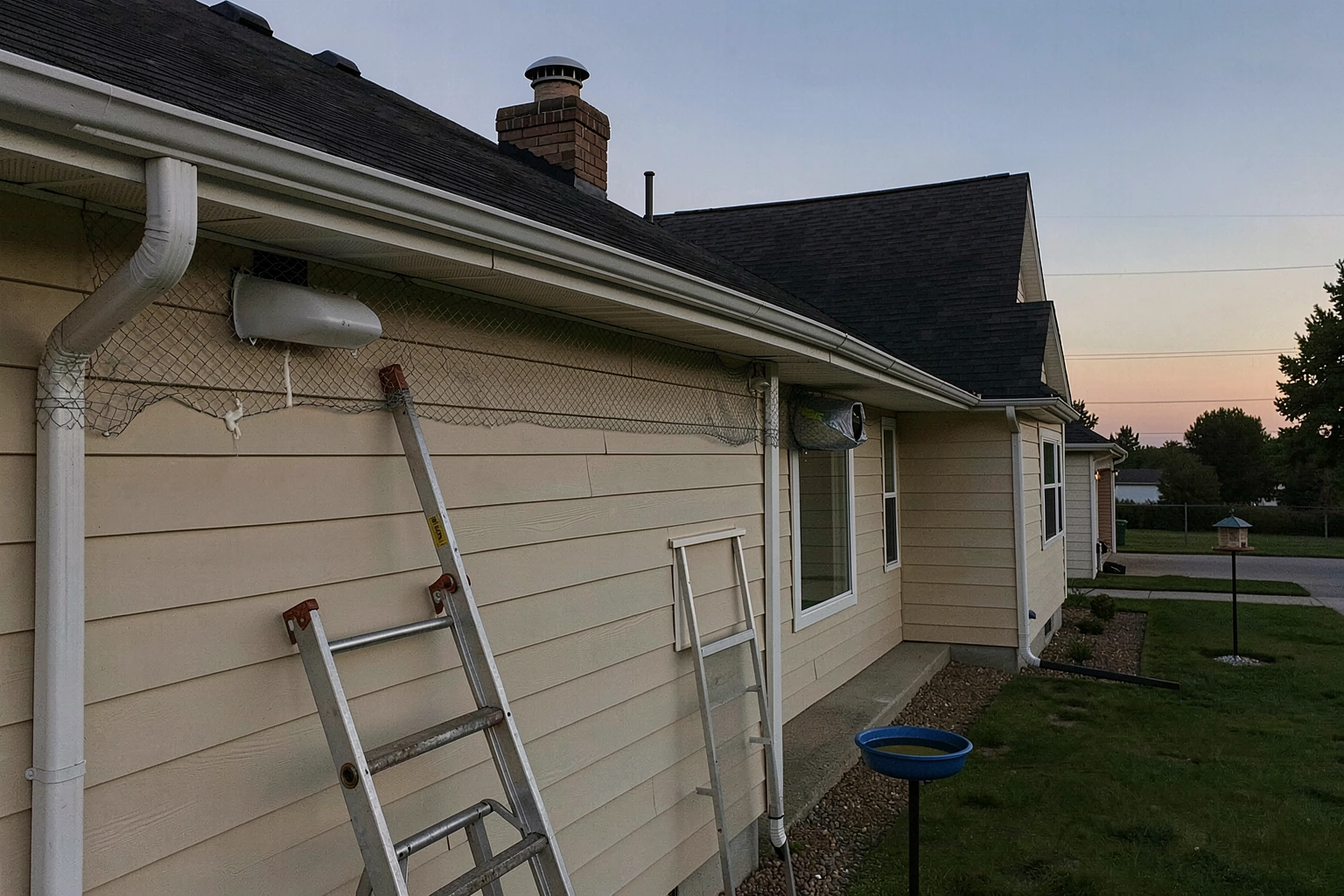
Walk the full perimeter of your home, including the roofline, eaves, vents, soffits, and any gaps around utility pipes. Common entry points are torn window screens, open ridge vents, uncapped chimneys, gaps where roof meets siding, and damaged fascia boards. A gap as small as 1.5 inches is large enough for smaller species like sparrows or starlings. Use hardware cloth (half-inch galvanized mesh) for vent covers, foam backer rod plus exterior caulk for smaller cracks, and wood filler or sheet metal for larger gaps. Chimney caps are a one-time fix that eliminates one of the most common bird entry routes permanently.
Remove food and water sources
If you have bird feeders within about 15 feet of your home, move them farther out or take them down temporarily until the bird problem is resolved. Secure trash cans with lids that lock or clamp, because exposed garbage is a reliable food source for scavenging species. Check for standing water: clogged gutters, pet water bowls left outdoors, birdbaths, and low spots in the yard where water pools. Eliminating standing water is especially useful if pigeons or starlings are the problem, as they need to drink frequently. Even a patch of fallen fruit from a tree can be enough to anchor a bird to your yard, so pick it up.
Bird-proofing the yard and entry areas
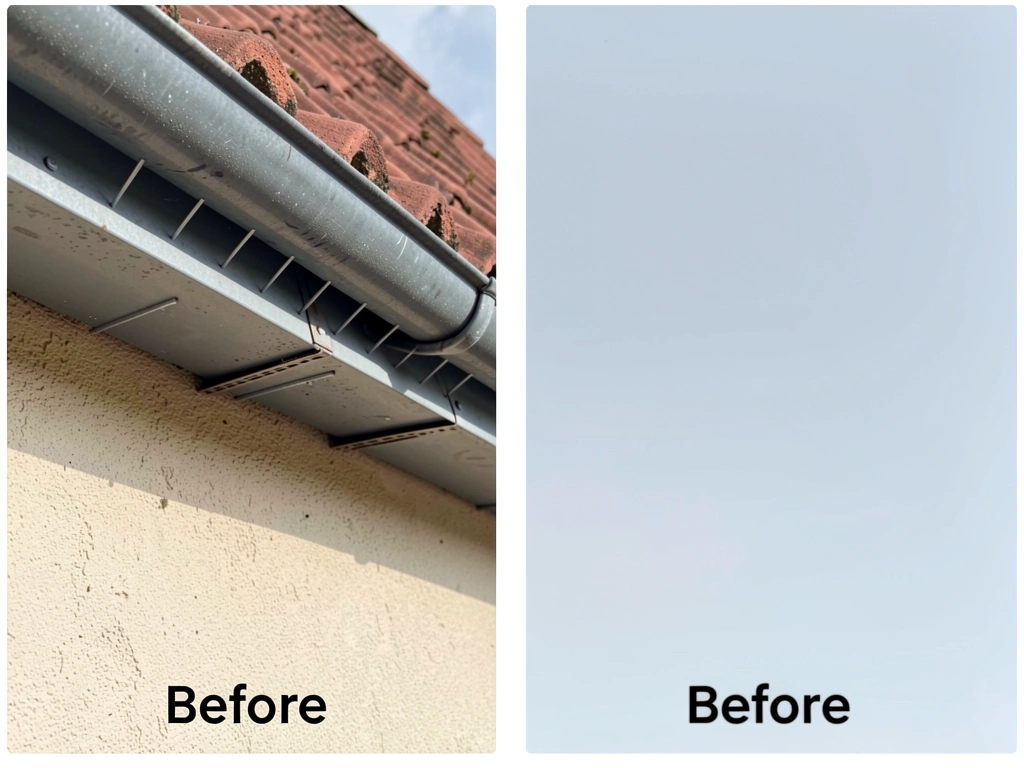
The exterior of your home and the area immediately around it is where most of the recurring activity happens. Addressing this zone is what converts a short-term fix into a lasting one.
Ledges, sills, and rooflines are where birds like to perch before finding a way in. Install physical barriers on these surfaces: angled ledge strips (also called slope systems, typically a 45-degree plastic or metal insert) make it impossible to land comfortably, and anti-roosting spikes do the same job on wider flat surfaces like gutters and roof edges. Netting is the most comprehensive solution for enclosed areas like under deck overhangs or in carports. Use a minimum 19mm mesh for general bird exclusion and make sure the net is installed taut with no gaps at the edges.
For windows, collision is a secondary concern but worth addressing because a bird repeatedly striking a window often means it is seeing a reflection of the sky or trees and treating the glass as an extension of its territory. Apply UV-reflective window film, exterior screens, or bird tape (spaced roughly 4 inches apart vertically and 2 inches apart horizontally on the outside of the glass). This breaks up the reflection without blocking your view significantly.
Safe and humane deterrents: what actually works
Deterrents work best as a second layer after you have addressed attractants and entry points. On their own, they rarely solve the problem permanently because habituated birds learn to ignore them. That said, used correctly, they can accelerate the process significantly.
Visual deterrents
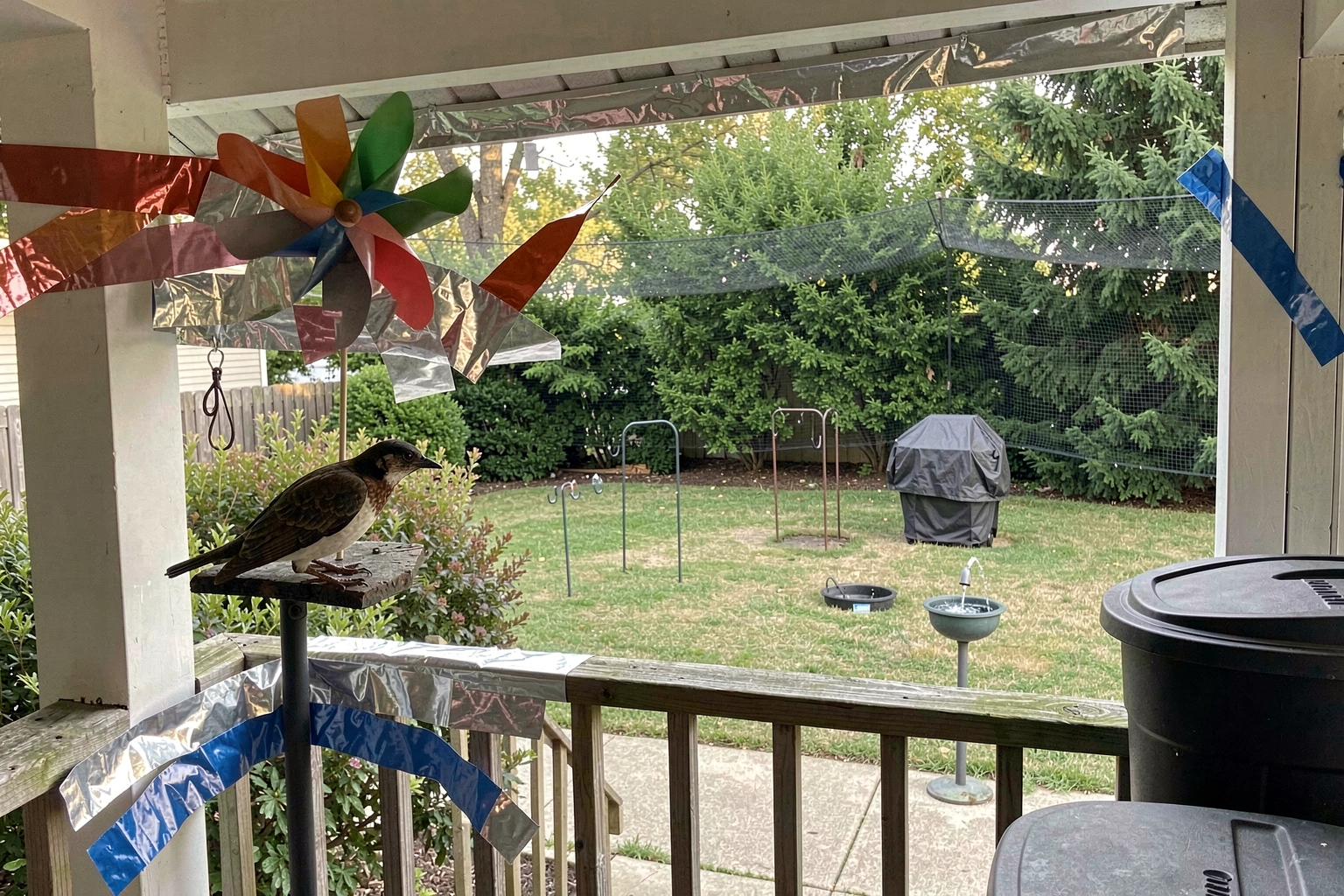
Reflective tape, old CDs, or purpose-made holographic bird tape hung in strips near problem areas create moving, unpredictable light patterns that birds find unsettling. Predator decoys, including plastic owls, hawk silhouettes, and coyote figures, can be effective initially but birds adapt quickly, sometimes within a few days. Move them to a new location every two to three days to maintain the effect. Place them at the actual problem spot, not just nearby, and at eye level or elevated if the bird is targeting a roofline or ledge.
Sound deterrents
Ultrasonic devices emit frequencies above human hearing that birds find irritating. They are most effective in enclosed or semi-enclosed spaces like attics, carports, and barns, and much less effective outdoors where the sound disperses. Recorded distress calls and predator calls are an alternative for outdoor use. These work best for species-specific problems because the recordings need to match the species you are targeting. Play them at irregular intervals rather than on a fixed loop, which birds tune out quickly. Check your local noise regulations before using audio deterrents near neighbors.
Taste and texture deterrents
Bird-repellent gel is a sticky coating applied to ledges and sills that birds dislike landing on. It works well on narrow ledges but can trap insects, collect debris, and become messy in hot weather, so it needs periodic reapplication. For surface-level deterrents, hot pepper-based liquid sprays (capsaicin) applied to surfaces or even around garden areas discourage birds from landing and feeding. Reapply after rain. These are non-toxic and humane, though they do need consistent maintenance to remain effective.
| Deterrent Type | Best Use Case | Effectiveness Over Time | Maintenance Needed |
|---|---|---|---|
| Reflective tape / holographic strips | Windows, eaves, garden areas | Moderate, fades with habituation | Rotate placement every few days |
| Predator decoys | Open yards, roof edges | Short-term unless moved regularly | Reposition every 2-3 days |
| Ultrasonic devices | Enclosed spaces (attics, carports) | Good in confined spaces | Low, occasional repositioning |
| Distress / predator call recordings | Outdoor perching areas | Good if species-matched | Must vary timing and interval |
| Anti-roosting spikes / slope strips | Ledges, sills, gutters, rooflines | High, long-lasting | Inspect annually for damage |
| Bird-repellent gel | Narrow ledges and sills | Moderate, degrades with weather | Reapply every few months |
| Capsaicin spray | Garden beds, landing surfaces | Moderate | Reapply after rain |
Give the bird a better option elsewhere
This step gets skipped more than any other and it matters more than most people expect. If you only remove perching spots and food sources without offering an alternative, the bird simply finds another spot on your property or your neighbor's. The goal is to redirect, not just repel.
Place a bird feeder, bird bath, or a simple perch like a wooden post with a flat platform at least 30 feet from the house (farther is better). If the bird was nesting in your eaves, a nest box designed for that species installed in a tree at a safe distance gives it somewhere appropriate to go. This is especially useful if the bird is territorial and keeps returning because it considers your home its territory. Giving it a legitimate perch or shelter in the yard often resolves the conflict without a fight.
If the bird is already inside your house
A bird inside the house is stressed, disoriented, and likely to injure itself by flying into walls or windows. The priority is to create a clear, obvious exit and reduce panic, not to chase or grab the bird. If your bird seems panicked, you may also want to review how to lure a bird out of your house so the exit feels like the easiest option. If you are trying to guide a bird out of your house, start by creating a clear exit and keeping the bird from panicking.
- Clear the room. Remove people, pets, and anything fragile, and then leave yourself, closing interior doors so the bird cannot get deeper into the house.
- Darken the room as much as possible except for one clear exit. Open one window or door fully and close the blinds or curtains on all others. Birds orient toward light, so a single bright opening becomes the obvious escape route.
- Wait quietly outside the room for 10 to 20 minutes. In most cases, the bird will find the exit on its own. Check through the door crack or window from outside before re-entering.
- If the bird is grounded or exhausted, use a towel or box to gently cover it and carry it outside. Do not grip the bird directly. Place the covered bird near a shrub or low branch and step back. Avoid direct hand contact, and wash your hands thoroughly with soap and water afterward.
- Once the bird is out, find and seal how it got in before the day is over. Common routes are an open chimney flue, a torn screen, or a gap around an attic vent.
- If the bird left droppings inside, clean them up carefully. Dampen the area first with a spray bottle of water and a small amount of disinfectant to avoid releasing dust, and use disposable gloves and a mask. This reduces the risk from organisms like Histoplasma that can be associated with bird droppings.
When DIY is not enough: professionals and legal considerations
Most bird problems can be solved with the steps above, but there are situations where you need outside help or need to check the rules before acting.
Active nests and protected species
In the United States, most wild bird species are protected under the Migratory Bird Treaty Act. Disturbing an active nest (one with eggs or chicks) is illegal without a permit, even if the nest is in an inconvenient spot. If you discover an active nest, the practical approach is to wait until nesting is complete, which typically takes four to six weeks for most common species, and then exclude the bird and remove the nest. If the situation is urgent (for example, a bird nesting in an electrical panel or ventilation duct), contact your state wildlife agency or a licensed wildlife control operator who can advise on legal options. Unprotected nuisance species include European starlings, house sparrows, and feral pigeons in the US, which means you have more flexibility in how you handle them.
When to call a professional
Call a licensed wildlife control professional if the infestation involves a large flock with extensive roosting or droppings accumulation (a health and structural concern), if the bird has made it into a wall cavity or inaccessible attic space, if you cannot locate the entry point after a thorough inspection, or if your DIY deterrents have been in place for two or more weeks with no improvement. Look for operators who use Integrated Pest Management approaches and who are willing to explain exactly what methods they use. Humane exclusion, netting, and physical barriers should be the primary tools, not trapping or lethal control as a first resort.
What professionals typically do
A wildlife control professional will typically start with a full property inspection to find every entry point, then install professional-grade exclusion materials (heavy-gauge netting, chimney caps, vent covers, and hardware cloth) while the birds are out. For large roost problems, they may use bird flock dispersal techniques including high-powered audio systems and falconry (using trained raptors to scatter the flock). These methods are legal, non-lethal, and effective for persistent urban bird populations where standard deterrents have failed.
The most important thing to take away: deterrents and scare tactics are temporary tools. If you still want practical options for that exact situation, see also how to scare a bird out of house as a related approach. If you need practical scare tactics, focus on deterrents that move, sound, or change the light patterns, and rotate them so birds do not get used to them. Permanent solutions always come back to sealing access points and removing what is drawing the bird there in the first place. Do those two things and you stop the problem at its source rather than just relocating it. If you are trying to scare a bird away from its nest, make sure you first remove the attractants and avoid disturbing protected active nests without proper permits.
FAQ
How do I figure out which bird it is, and why does it matter for how to keep a bird away?
The species affects nest legality, preferred food, and the right mesh size and perching deterrents. Take a clear photo, note the size of droppings and the entry route (roof, vent, chimney, doorway), then match those details before choosing exclusion materials or any deterrents like audio or nest alternatives.
What should I do first if a bird is inside my home right now?
Close off other rooms, turn off overhead fans, open one easy exit (a door or window) with lights directed outward, and keep windows you cannot open covered so the bird has one obvious escape route. Avoid chasing or grabbing, because panic increases injuries and makes it harder to guide it out.
How long should I wait for exclusion and attractant removal to work before trying new deterrents?
Give physical exclusion measures and attractant removal several days, then reassess after about 1 to 2 weeks. If birds keep returning to the same point after you have sealed the obvious entry route, you likely missed a gap or the attractant is still present (like water, fallen fruit, or an accessible perch).
Can I use spikes, tape, or gel if the bird is nesting nearby?
Be cautious. Any method that harms or blocks an active nest can create legal trouble for protected species. If you see eggs or chicks (or a strong nesting sign like ongoing feeding), pause exclusion of the nest area and contact a wildlife professional or your state wildlife agency for permitted options.
Are bird droppings safe to clean as soon as the bird leaves?
Clean only after you have excluded the bird and eliminated access. When droppings are still dry, avoid sweeping or dry-brushing because it can aerosolize particles. Use protective gear (gloves and a dust mask), dampen before wiping where appropriate, and wash hands thoroughly afterward.
What if I cannot find the entry gap even after checking the perimeter and roofline?
Look for hidden pathways such as attic eaves, soffit seams, vent stacks, and gaps behind gutters (often masked by trim). If you still cannot locate the access point, it can be from wall cavities or interior ducts, which is a strong reason to bring in a pro for a full inspection.
Should I remove bird feeders immediately if I’m trying to keep a bird away?
If the bird is feeding from the feeder, remove or move it temporarily so the food attractant is gone. However, if you are dealing with a species that is actively nesting nearby, don’t assume removal is enough, since the bird may still return for shelter or nest access until exclusion is completed.
Do I need to clean standing water sources like gutters and bowls to solve the problem?
Yes, if the birds are using them to drink or bathe. Simply scaring birds away without removing water can lead to repeated visits until the water source is corrected (fix clogs, change or cover outdoor bowls, and eliminate low pooling areas).
Will predator decoys and reflective tape work if I have multiple birds or frequent visitors?
They are usually best for initial disruption, not long-term control, especially with repeat visitors. For multiple birds, habituation happens faster, so prioritize sealing and removing attractants, then use moving light or elevated placement only as a short-term support while you complete the exclusion work.
How can I reduce bird window collisions if the bird is repeatedly hitting the same glass?
Treat it as a reflection problem. UV film and exterior screens help by breaking up sky and tree reflections, and bird tape works better when it is placed on the outside at the bird’s approach level, not deep inside the room. If collisions are ongoing, consider covering only the affected pane first to evaluate results.
Do ultrasonic devices work outdoors?
They tend to be much less effective outdoors because sound disperses quickly. If you try them, use them in enclosed or semi-enclosed spaces like carports or attics and combine them with physical exclusion, otherwise birds often ignore the sound after repeated exposure.
How do I keep from trapping insects or creating a mess when using bird gel or pepper sprays?
Plan for maintenance. Gel can collect debris and may become unsightly in hot weather, and capsaicin needs reapplication after rain and repeated exposure. For cleaner long-term control, prefer physical barriers like slope systems or netting rather than relying on sticky or liquid deterrents.
What makes a “safe distance” for alternative perches or nest boxes, and does it need to be far?
Aim for at least 30 feet from the house for additional feeding or perching, farther if possible. If the bird is nesting, place a nest box designed for that species at a safe distance and in a location that fits the bird’s natural preference, so you redirect the conflict instead of pulling the problem closer to entry points.
If a bird is protected by law, what is the usual legal and practical path to get rid of it?
For active nests, waiting until nesting is complete is commonly the safest route, then exclude and remove afterward. If the nest is in an urgent location like ducts or electrical areas, contact your local wildlife authority or a licensed operator to discuss permitted measures rather than attempting DIY exclusion.
When should I stop DIY and hire a wildlife control professional?
Escalate if there is extensive roosting or heavy droppings, the bird is inside inaccessible spaces (wall cavities or attic), you cannot locate the entry after a thorough inspection, or you see no improvement after 2 or more weeks of correct exclusion and attractant removal. Also hire if you suspect an active nest in a constrained or sensitive structure.
What are common DIY mistakes that still leave birds coming back?
Missing the last entry point, addressing only one attractant (like perches) while leaving water or food accessible, and using deterrents without sealing access. Another frequent issue is creating a new landing spot when installing netting or barriers, so check edges for gaps and ensure surfaces are genuinely unlandable.
Next Article
How to Scare Away a Bird: Step-by-Step Deterrent Plan
Step-by-step plan to scare birds safely using visual, sound, and habitat changes, with placement, timing, and troublesho