The fastest way to stop a bird from flying into your window is to break up what the bird sees from outside: either the reflection of sky and trees in the glass, or the illusion that it can fly straight through. You can do both with materials you probably already have at home. This guide covers what works today, what works long-term, and how to troubleshoot if the problem keeps happening.
How to Stop Birds From Flying Into a Window

Maya Carver
22 Mar 2026
Why birds keep hitting your windows
Birds don't understand glass. When they look at a window, they see one of two things: a mirror image of the sky, trees, or shrubs behind them, which looks like open habitat worth flying into, or a transparent pane that shows habitat or open space on the other side. In both cases, the window looks like a navigable path. The U.S. sees up to two billion bird-window collisions per year, and it's not because birds are careless. It's because glass is genuinely invisible to them.
At night, the problem shifts. Migrating birds use the moon and stars for navigation. Artificial light from buildings pulls them off course, and once they're disoriented and flying near a structure, they become far more vulnerable to daytime glass collisions too. Turning off lights is not just an environmental gesture. It directly reduces strikes.
Dark-tinted or heavily reflective glass can also create a 'tunnel' effect, where birds perceive an open path through or past the building. If you have a window that faces another window on the far side of a room, or a large glass door that frames a view of your backyard, that's a high-risk setup. Windows near bird feeders, baths, or dense plantings are also collision hot spots.
Fixes you can do right now
If you're dealing with a bird repeatedly hitting the same window today, here's what you can do immediately, before buying anything.
Daytime: break up the reflection from outside
The key rule: anything you put on the inside of the window will not stop daytime collisions. Birds are reacting to what they see from outside, which is a reflection or a clear view through the glass. Blinds, curtains, or stickers placed on the interior side are nearly useless during the day. Your deterrent needs to be visible from the outside.
Here are materials you can use today without a hardware store trip:
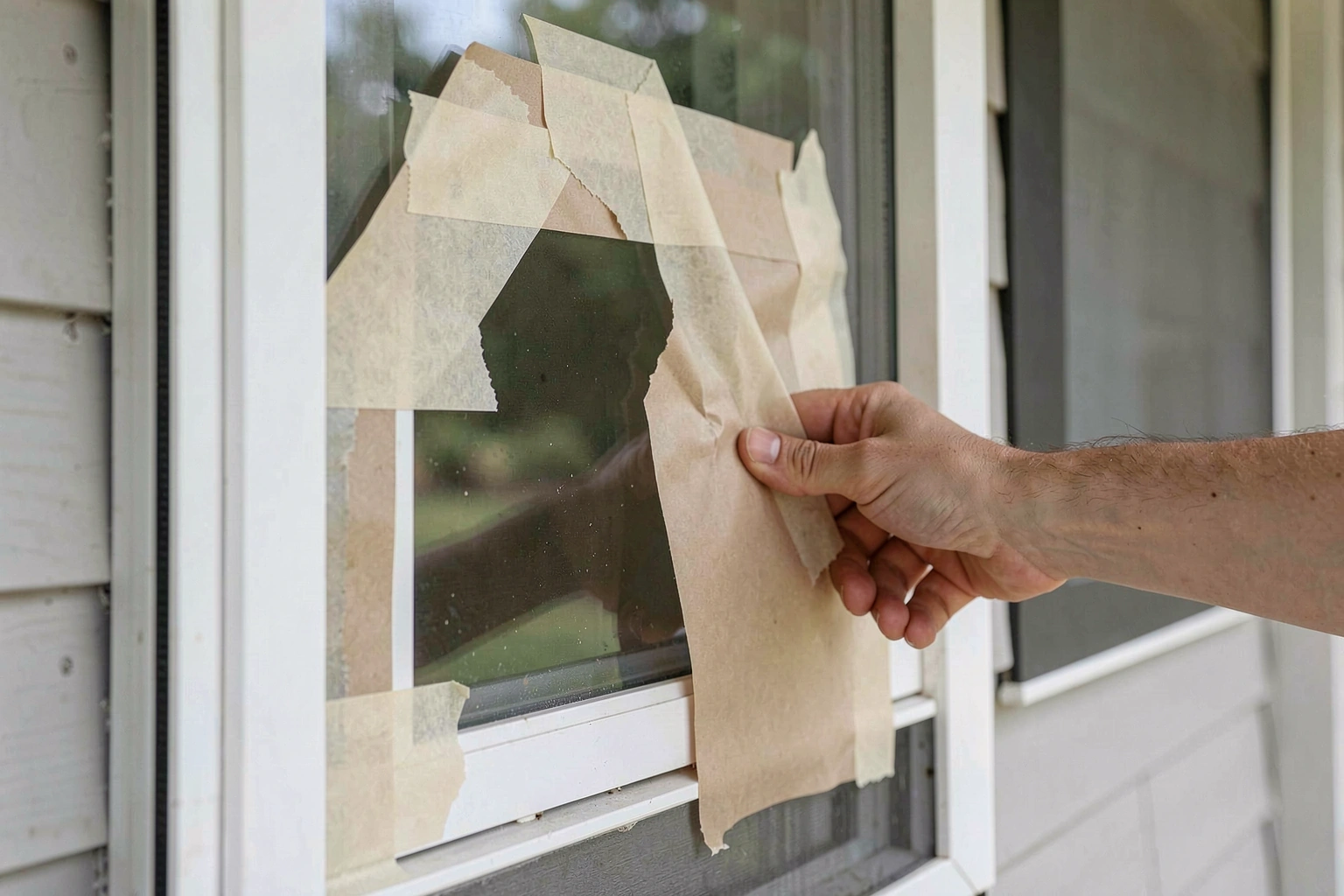
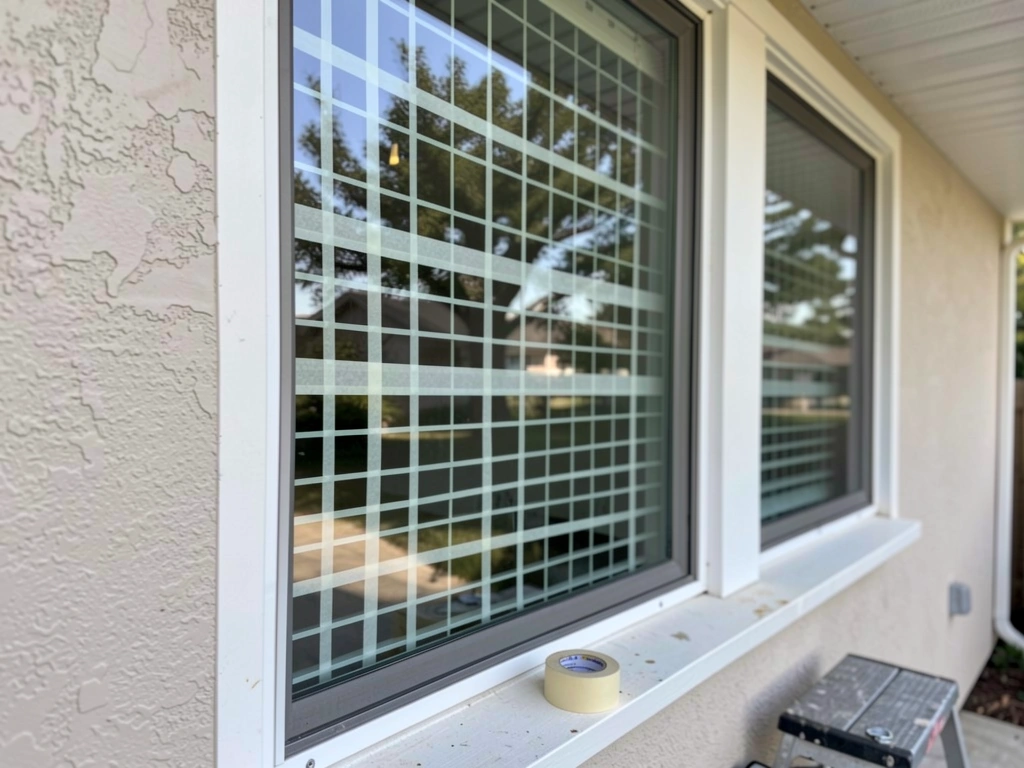
- Tape strips applied to the outside of the glass in a grid pattern (painter's tape or masking tape works). Strips must be spaced no more than 5 cm (2 inches) apart in both directions, covering the whole pane.
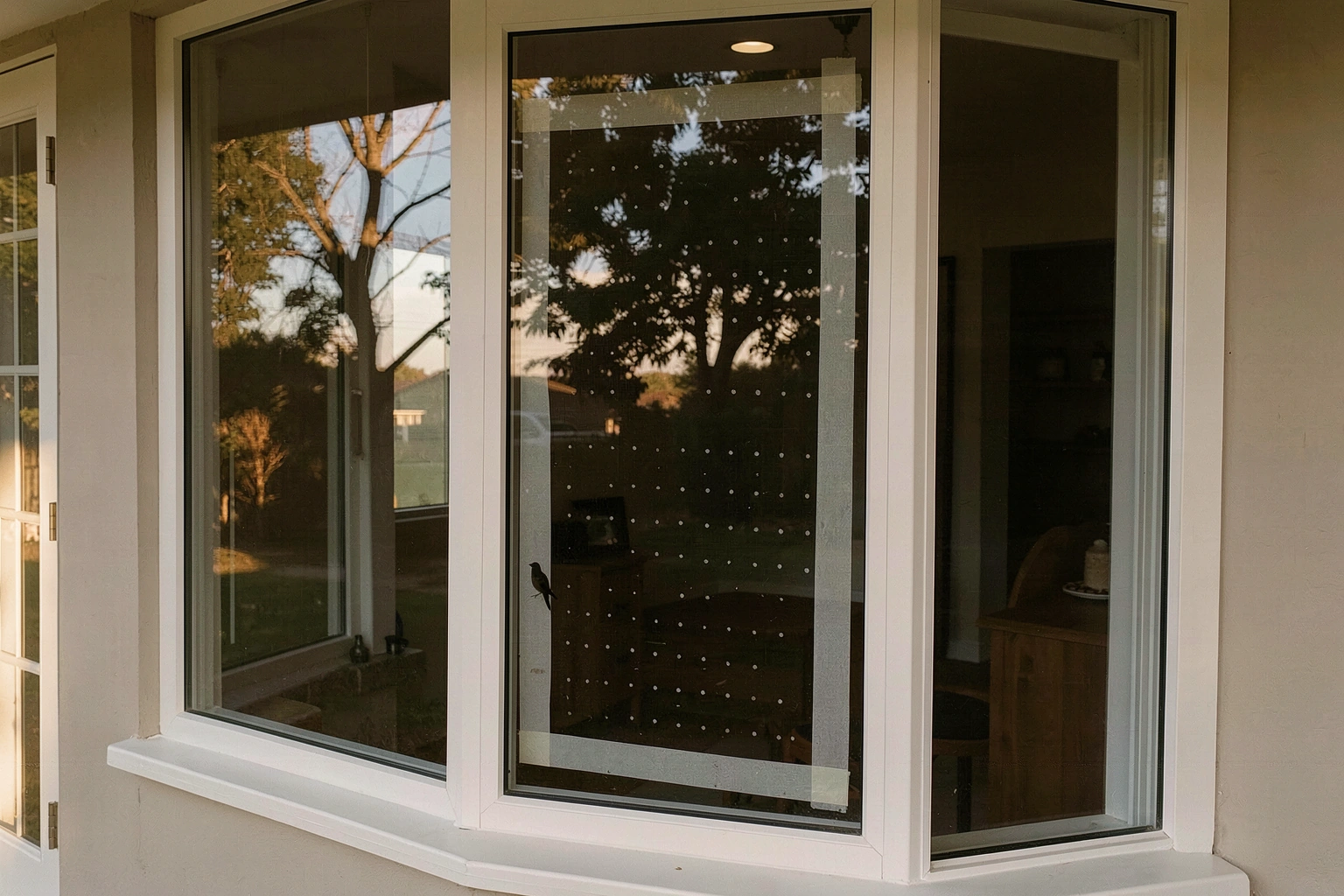
- Tempera paint or whiteboard markers to draw a grid, dots, or pattern directly on the exterior glass surface. These wash off easily later.
- Paper or cardboard taped to the outside of the window, covering the most reflective or transparent sections.
- Move a bird feeder that's sitting close to the window. Feeders within about 1 metre of the glass actually reduce injury risk because birds don't build up enough speed to hurt themselves. Feeders placed 5 to 10 metres away are also safer. The danger zone is the middle distance, roughly 1 to 5 metres, where birds have room to accelerate.
Nighttime: lights off or redirected
If collisions are happening at night or you're in an area with heavy migratory bird traffic, lighting changes are your most powerful same-day tool. Close blinds and curtains to keep interior light from shining outward. Turn off nonessential exterior and upper-floor lights. If you have outdoor lights you can't fully turn off, angle them downward so they don't project horizontally or upward toward the sky. Iowa's DNR, for example, recommends turning lights off between 11 pm and 6 am during peak migration months (April to May and August to October). Research modeled in major studies suggests that reducing building lights at night can cut bird collisions by six to eleven times, depending on the season.
Long-term prevention options that actually work
Once you've stopped the immediate problem, it's worth investing in a more durable solution. These options make the glass permanently or semi-permanently visible to birds from the outside.
| Option | How It Works | Durability | Best For |
|---|---|---|---|
| Window films with dot/line patterns | Applied to exterior glass; breaks up reflections across the whole pane | Several years with UV-stable products | Large picture windows, sliding doors |
| Bird-safe decals (exterior) | Spaced adhesive stickers in a grid pattern on exterior glass | 1 to 3 years; UV coatings degrade outdoors | Smaller windows, renters |
| Exterior screens or netting | Mounted 5 cm (2 inches) or more in front of the glass; softens impact and breaks up reflection | Long-term if maintained | High-collision areas, windows near feeders |
| Fritted or bird-safe glass | Glass manufactured with ceramic frit patterns baked in | Permanent | New construction or major renovations |
| Tempera paint / soap patterns | Drawn directly on exterior glass | Weeks to months; weather-dependent | Temporary fix or testing a pattern before buying film |
A note on UV-reflective products: some decals and films are marketed as 'invisible to humans, visible to birds' because they reflect ultraviolet light. In theory, birds can see UV wavelengths that humans can't. In practice, the UV coatings on these products degrade relatively quickly with outdoor exposure. They can work, but don't assume they're permanent. Check manufacturer guidance and plan to replace them.
How to set up and place deterrents correctly
This is where most people go wrong. A single hawk decal stuck in the centre of a large window does almost nothing. Birds are not scared off by one sticker. They simply fly through the gap around it. Coverage and spacing are everything.
- Go outside and look at the window from a bird's perspective. Walk back 5 to 10 metres and look at the glass. Do you see a clear reflection of sky or trees? Can you see through to the other side? Those are the areas you need to treat.
- Apply your deterrent to the exterior surface of the glass, not the inside.
- Space your markers no more than 5 cm (2 inches) apart vertically and horizontally. This is the standard recommended by FLAP Canada, the American Bird Conservancy, and U.S. Fish & Wildlife Service. Gaps larger than that are enough for a bird to attempt passage.
- Cover the entire pane, not just the centre or the corners. Birds will find and use any large uncovered section.
- If using netting or screens, mount them at least 5 cm (2 inches) in front of the glass so they can act as a proper physical buffer rather than sitting flush against the surface.
- Prioritise windows closest to bird attractants: feeders, bird baths, dense shrubs, and trees. These windows get the most traffic.
- After applying your deterrent, go back outside and check again. If you can still see a large clear reflection or a clear view through the glass, add more coverage.
What to avoid, and what to do if a bird gets hurt
What doesn't work
- Interior-only treatments during the day. Blinds, curtains, and inside-facing stickers don't stop daytime collisions because the bird never sees them.
- Single or sparse decals. One hawk sticker, one spider web decal, or a few dots scattered across a large window are not enough. Spacing matters as much as the pattern itself.
- Assuming reflective or dark glass is 'safer.' Heavily tinted glass can actually increase collisions by creating a strong mirror effect or a false impression of open tunnel space.
- Relying on a predator silhouette to 'scare' birds. Research and field experience show that birds habituate to static images quickly. Coverage beats intimidation every time.
If a bird hits your window and is injured
Don't try to nurse the bird yourself or leave it on the ground for long. Place it gently in a paper bag or a small cardboard box with a few small ventilation holes. Put a soft cloth or tissue inside for footing. Keep the container in a quiet, dark, warm room away from pets and people. Don't give it food or water. Then contact a licensed wildlife rehabilitator in your area as soon as possible. In the U.S., the Migratory Bird Treaty Act means most wild birds are federally protected, so handling them beyond this basic care without a permit is not legally straightforward. In Canada, similar protections apply under the Migratory Birds Convention Act, and FLAP Canada can direct you to the right resources. In the UK, the Wildlife and Countryside Act 1981 covers bird protections. The point is: stabilise, contain, and hand off to a professional.
If birds keep hitting after you've made changes
Collisions continuing after you've applied deterrents usually means one of a few things. If the bird is still hitting even after you fix reflections, focus on lights at night too as a related way to stop red bird from hitting window how to stop red bird from hitting window. If you are seeing bird pecking at window how to stop it, also treat it as an ongoing visual trigger and verify that daytime reflections and nearby glass views are fully broken up, then address nighttime lights as a related step. Work through this checklist before assuming the method itself doesn't work.
- Check your spacing. Go outside and measure the gaps between your markers. If any section has gaps wider than 5 cm (2 inches) in either direction, birds will still attempt to fly through. Add more coverage.
- Check whether your treatment is on the exterior. If you applied film, decals, or patterns to the inside of the glass, redo them on the outside.
- Look for uncovered sections. Even a quarter of an untreated pane can be a problem, especially if it reflects sky or frames a visible through-view. Cover the whole surface.
- Check for nearby attractants that you haven't addressed. A feeder at medium distance from the window, a birdbath reflecting in the glass, or dense planting immediately outside can keep drawing birds to that spot. Relocate the attractant or treat additional windows in the same area.
- Consider whether night lighting is still a factor. If you're seeing mostly early-morning strikes during migration season, artificial light may still be pulling birds toward your building overnight. Double-check curtains, exterior fixtures, and upper-floor lighting.
- If a specific bird seems to be returning repeatedly and pecking or flying at the glass rather than colliding accidentally, that's a different behavioural issue, often territorial in spring when a bird sees its own reflection as a rival. Temporary exterior coverings on that specific pane usually resolve it within a few weeks once the bird stops getting a reflection to react to.
The most common reason deterrents fail is incomplete coverage, not the wrong product. Before switching methods, audit your existing setup from the outside with fresh eyes. Once you address both reflection and light, you can usually <a data-article-id="F03A5B11-7FF1-47A8-9B5C-E019CEAB1862">stop the bird from hitting your window</a> within a day or two <a data-article-id="E0EF42BE-C955-4A06-B2D3-6B24DF87DD09">stop a bird from hitting your window</a>. If you've covered the whole window with correct spacing and collisions are still happening, the next step is to look at whether there's another window nearby creating a visual corridor, or whether lighting changes at night are still needed alongside the daytime treatment.
FAQ
Do I need to cover the entire window, or is a small patch enough to stop birds from hitting it?
Cover the whole visible “path,” not just a focal spot. Birds will route around a small gap, so effective coverage means consistent spacing across the entire pane and any nearby adjacent glass that forms a corridor.
Why don’t stickers or decals on the inside stop the bird during the day?
During daytime strikes, birds are responding to what they can see from outside. Interior items can be invisible or too subtle from the bird’s viewpoint, so place deterrents on the exterior side or use solutions that are clearly visible outward.
What should I do if the bird keeps hitting the same window even after I added a deterrent?
Do an outside “line of sight” check at bird level. Look for nearby reflections, another glass surface that frames a clear path, or interior lights still shining at night. If the corridor still exists, you may need a second treatment on a neighboring window or stronger daytime visibility.
How can I tell whether nighttime lighting is still driving the problem?
Observe after dark, especially near migration months. If collisions cluster in the evening or early morning, keep blinds closed and reduce exterior lights. For fixtures you cannot turn off, angle them downward to prevent horizontal spill toward the sky and trees.
Are dark-tinted or reflective windows always safe from collisions?
Not always. Tinted and highly reflective glass can create a “tunnel” effect that makes birds perceive an opening through or past the building. If you see the sky or vegetation strongly reflected, treat the glass anyway and avoid relying on tint alone.
If I use UV-reflective film or decals, how long will they last?
Plan for replacement. Outdoor UV-reflective coatings degrade relatively quickly, so treat them as a temporary or semi-permanent fix unless the manufacturer specifies long durability and you can monitor performance over time.
Should I put a deterrent on the window that faces a yard, or is it enough to treat the window closest to the bird feeder?
Treat every pane that can be seen as navigable from where the birds approach. If one window frames another across a room, or the feeder sits in line with a distant glass surface, birds can still follow that visual route.
What’s the safest way to handle a bird that’s already injured from a window strike?
Minimize stress and movement. Stabilize it in a ventilated paper bag or small cardboard box with soft material for footing, keep it warm and dark, and avoid food and water. Then contact a licensed wildlife rehabilitator as soon as possible.
Can I keep the bird outside and wait for it to fly away?
Don’t leave it unattended for long. Birds stunned by impact can be easy prey and may worsen on the ground. Provide immediate containment for safety and seek professional help quickly.
Is it ever okay to scare birds away directly, like with noise or a person standing by the window?
Temporary human presence can reduce hits in the moment, but it is not a durable solution and birds can acclimate. Use it as a short-term bridge while you install outward-visible deterrents and adjust lighting.
Next Article
How to Stop a Bird From Pecking at a Window Fast
Step-by-step fixes to stop birds pecking windows fast, using reflection blocking, barriers, and long-term prevention.