If birds haven't laid eggs yet, you can remove any nest material right now, install physical deterrents, and modify the porch so it stops looking like prime real estate. If there are already eggs or chicks in the nest, federal law requires you to leave it alone until the young have fledged and the nest goes inactive. Either way, there are things you can do today to stop the problem from getting worse and to make sure it doesn't happen again next season.
How to Keep a Bird From Nesting on Your Porch

Maya Carver
6 May 2026
Quick Assessment and Emergency Actions for Right Now
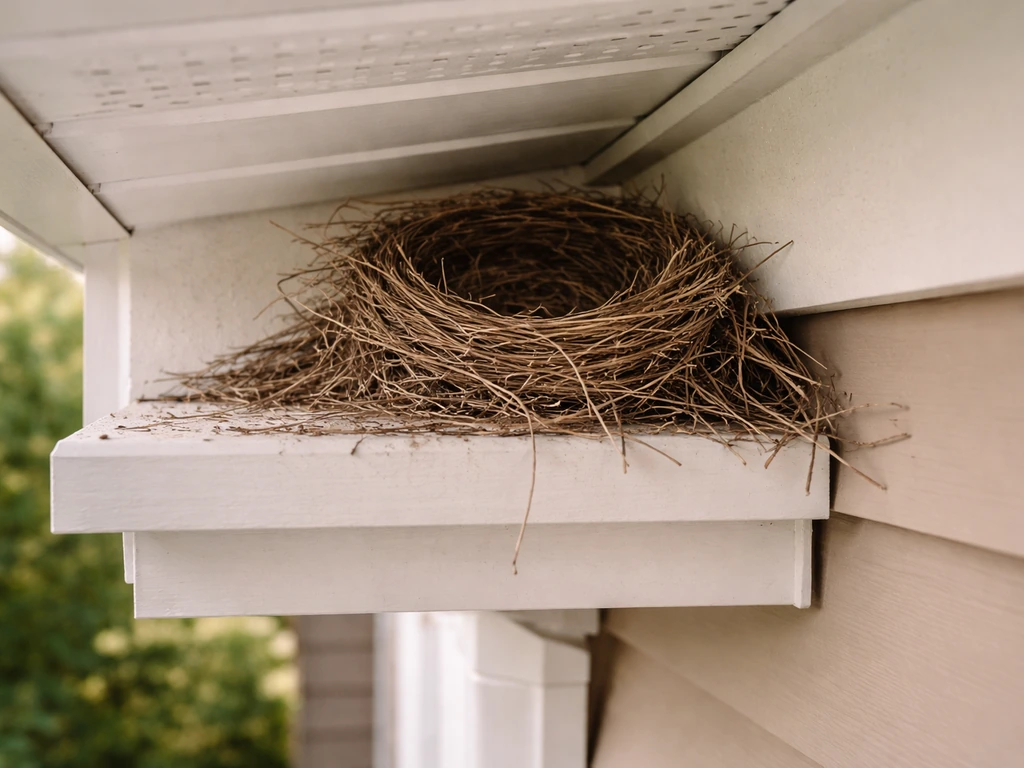
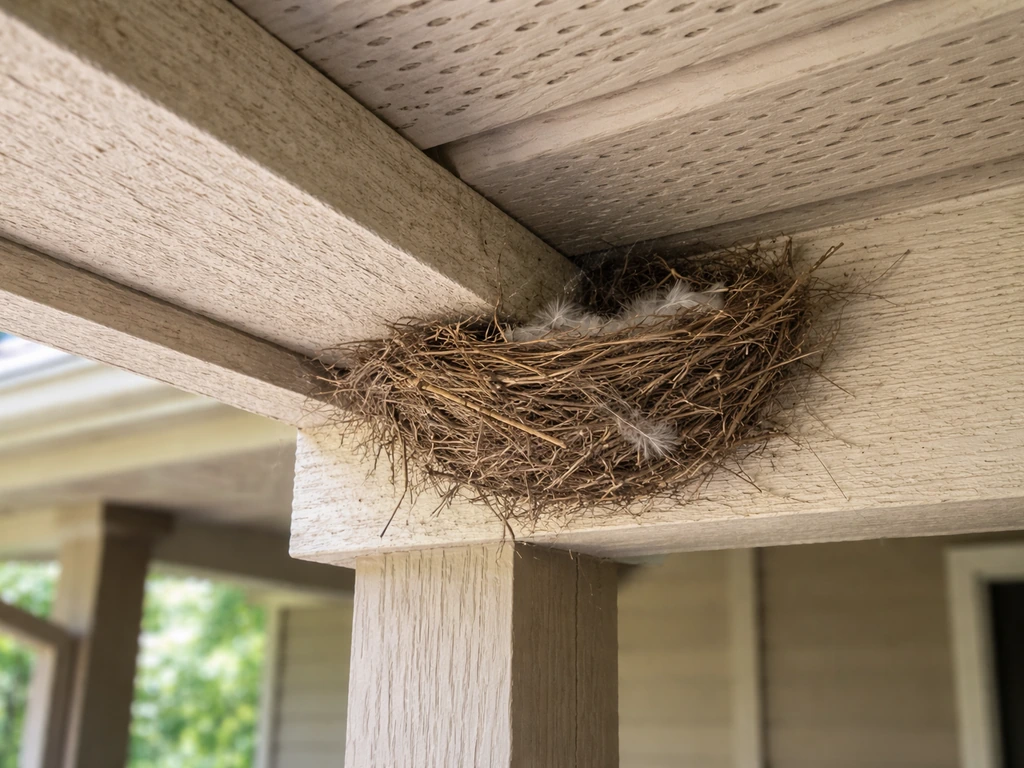
Before you touch anything, spend two minutes checking the nest. Is there any material already built? Are there eggs or chicks present? Your answer changes everything you're legally allowed to do.
- No nest yet, just scouting birds: Act immediately. Install deterrents today and block any ledges, gaps, or rafters the bird is eyeing.
- Nest material present but no eggs: Remove the material now, clean the surface, and put deterrents up the same day. Birds work fast, so don't wait.
- Eggs or chicks present: Stop. Under the Migratory Bird Treaty Act (MBTA), it is illegal to destroy a nest that contains eggs or chicks. You must wait until the nest is inactive (young have fledged and are no longer dependent on the nest) before removing anything.
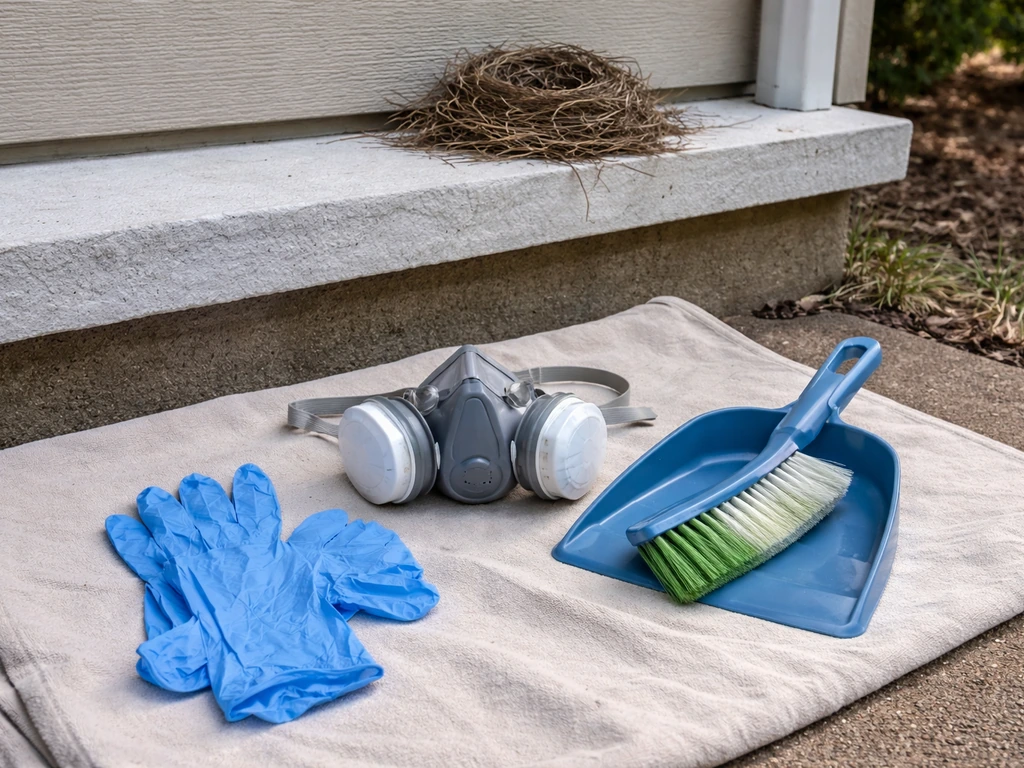
- Fledglings have left but nest is still there: The nest is now inactive and can be removed. Wear gloves and a dust mask, bag the material, and wash down the area with a disinfectant solution.
Put on gloves before handling any nest material. Dried bird droppings and nesting debris can carry bacteria, fungi (like Histoplasma), and parasites. A simple N95 mask and disposable gloves are enough for a small porch cleanup. If you're working at height, make sure your ladder is on a stable surface and have someone spot you.
Identify the Bird Species and Why Your Porch Is Attractive
The species matters a lot here, both for choosing the right deterrent and for understanding your legal obligations. Different birds have different nesting habits, and some are far more protected than others.
Common Porch Nesters
| Bird | Preferred Porch Spot | Key Trait | Protected Under MBTA? |
|---|---|---|---|
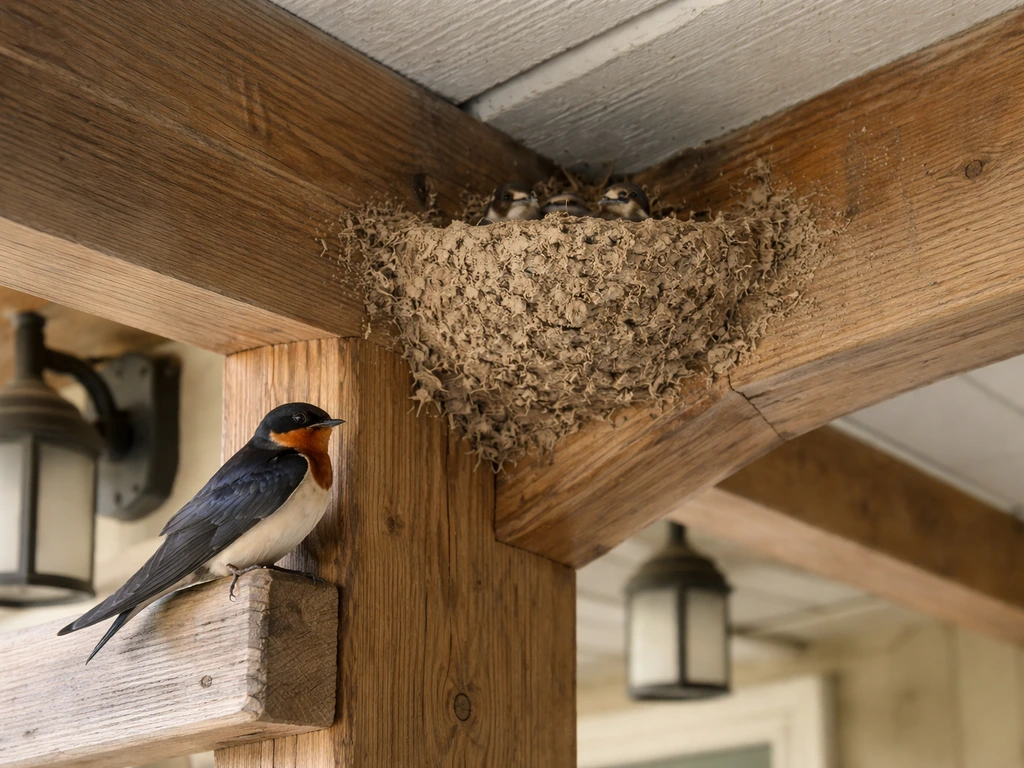
| Barn Swallow | Eaves, rafters, cross beams, light fixtures | Mud cup nest; fast builder (7–14 days); reuses sites year after year | Yes, fully protected |
| Cliff Swallow | Eaves, soffits, corners under overhangs | Gourd-shaped mud nest; colonial nester, often in groups | Yes, fully protected |
| House Sparrow | Gaps in soffits, vents, shelf edges, hanging plants | Messy grass/debris nest; non-migratory; not protected under MBTA | No (introduced species) |
| American Robin | Ledges, corner shelves, light fixtures | Mud-and-grass cup nest; very persistent rebuilder | Yes, fully protected |
| Mourning Dove | Flat ledge surfaces, potted plants, porch furniture | Flimsy twig platform; may lay directly on bare surfaces | Yes, fully protected |
| European Starling | Vents, gaps, enclosed spaces, nest boxes | Cavity nester; non-migratory in most of US; not protected under MBTA | No (introduced species) |
To identify what you're dealing with, note the nest shape and material, the bird's coloring and size, and where exactly on the porch it's building. Barn and cliff swallows make distinctive mud nests and return to the same site each spring. Robins use mud reinforced with grass. House sparrows stuff gaps with loose grass, feathers, and litter. If you're unsure, a quick photo search in the Cornell Lab's free Merlin app will ID your bird in seconds.
Why Your Porch Is the Target
Birds pick porches for the same reasons you built one: shelter from rain and wind, a solid overhead structure, and proximity to food and water. Specifically, rafters and eaves mimic cliff overhangs for swallows. Ledges and shelves offer robins and doves a flat building surface. Enclosed spaces like vents and soffits gaps are perfect for sparrows and starlings. Add a nearby birdbath, pet water bowl, open trash, or pet food left outside, and your porch looks even better to a bird shopping for a nesting address.
Immediate Deterrents That Won't Hurt Birds
These tactics work best when you put them up before birds commit to a site. Once a bird has a strong attachment to a spot (especially after eggs are laid), deterrents alone rarely work. The goal is to make your porch less appealing than every other option within range. Use multiple types together because no single method is reliably effective on its own.
Visual Deterrents
- Reflective tape or foil strips: Hang strips from eaves or ceiling joists so they flutter and reflect light. Move them every few days so birds don't habituate.
- Predator decoys: Owl or hawk silhouettes placed near the target spot can discourage early scouts. Reposition them every 2–3 days or birds will figure out they're fake.
- Flash tape and holographic bird scare tape: These combine reflection and movement. Tie short lengths to rafter ends, light fixtures, or the porch ceiling.
Sound and Motion Deterrents
- Ultrasonic devices: Mixed effectiveness at best. Birds can often hear outside the range these devices target, and many studies show limited long-term deterrence. Use them as part of a broader strategy, not as a standalone fix.
- Wind chimes or moving objects: Pinwheels, spinning reflectors, or wind chimes near the nest site add movement and noise that disrupts early scouting. Rotate positions regularly.
- Motion-activated sprinklers: Highly effective if the bird is approaching from a fixed angle. A motion sprinkler near the entry point to a favorite ledge can break the habit fast.
Habitat Disruption
- Remove any nesting material the moment it appears. Check daily during spring (March through June for most species). Early intervention is the single most effective tactic.
- Temporarily remove or relocate hanging planters, decorations, and shelf items that give birds a platform or anchor point.
- If swallows are the problem, hanging plastic sheeting, burlap strips, or even newspaper from eaves to just above floor level creates a visual barrier that disrupts their approach to nesting ledges.
The research is clear: deterrents need to be in place before birds establish a use pattern. Once a bird has nested in a spot and returned successfully, it becomes much harder to convince them to go elsewhere. Timing matters more than which specific product you use.
Porch Proofing: Block Entry Points and Remove Nesting Materials Fast
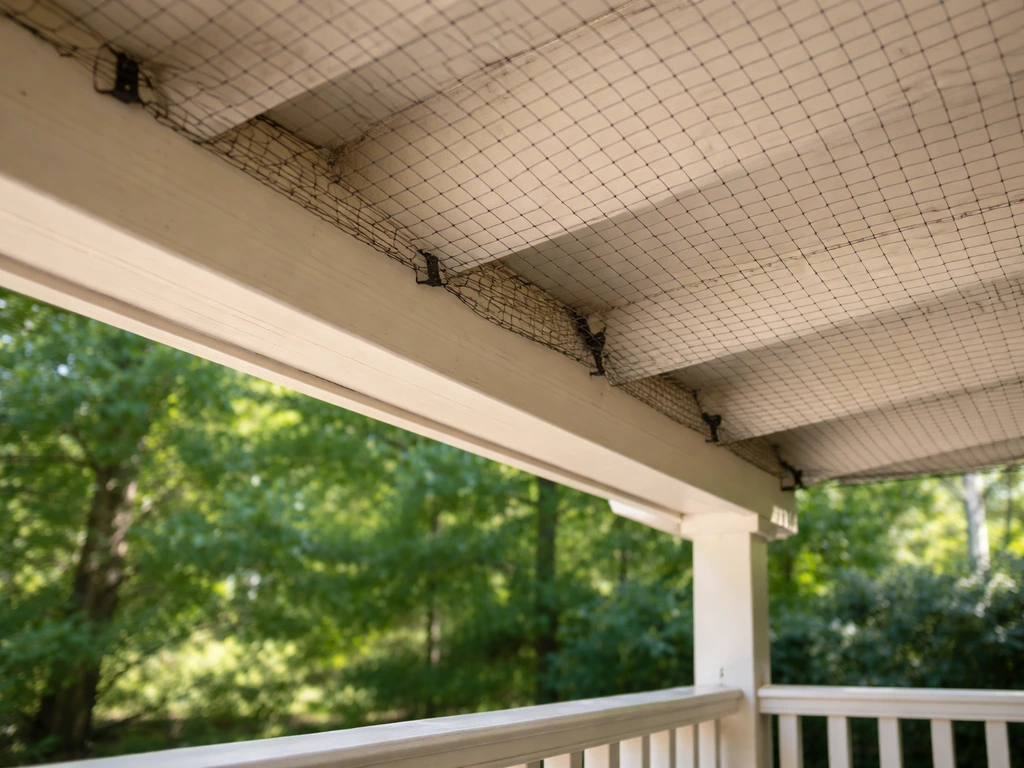
Physical exclusion is the most reliable long-term solution, and it's what USFWS specifically recommends for persistent nesters like swallows. The idea is simple: eliminate the surfaces and gaps where birds can attach or build a nest in the first place.
Netting
Bird exclusion netting installed under eaves or across the porch ceiling is highly effective. For sparrows, swallows, and other small birds, use 3/4-inch mesh (19mm). Nixalite's K-Net HT and Bird Barrier's StealthNet are both commonly specified products that use this mesh size. The netting should run from the eave or fascia board down to the wall or porch floor so there's no gap birds can slip through. Install it with tension cables or a frame system so it holds its shape. Limp, sagging netting is less effective and looks bad.
Ledge Spikes and Coils
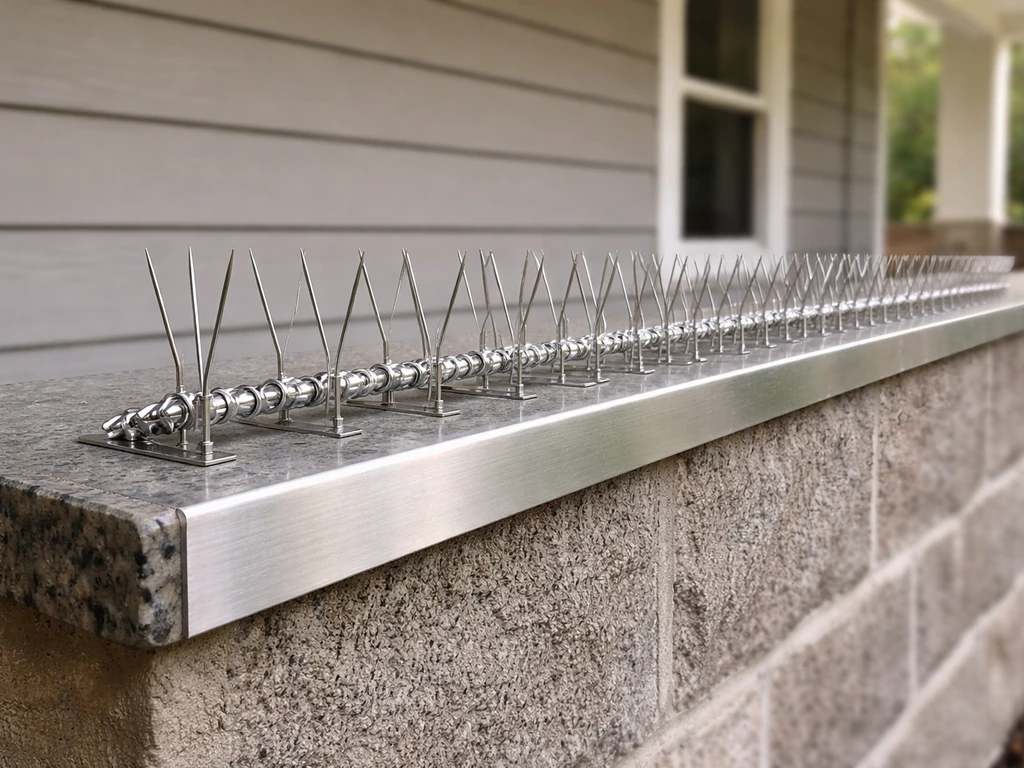
Spikes and coils work on flat ledges, beam tops, and railing caps where birds land before building. For spikes, the rods should overhang the outer edge of the ledge by at least 1/2 inch to eliminate any usable landing line at the edge. For coil systems, the coil should overhang the outer edge by at least 1/4 inch, and when multiple rows are needed, keep gaps between coils to no more than 1 inch. These measurements matter: birds are remarkably good at finding the one usable spot you left uncovered.
Sealing Gaps and Vents
Sparrows and starlings don't just nest on ledges: they nest inside gaps. Check soffit seams, loose fascia boards, spaces around utility penetrations, and any vent openings. Soffit vents are a major entry point. Hardware cloth or products like HY-C's soffit vent screens (which use 18-gauge expanded galvannealed steel mesh) can cover vents without blocking airflow. For larger gaps, use galvanized hardware cloth with 1/4-inch or 1/2-inch openings, secured with staples and caulk at the edges.
Removing Nest Material: Step by Step
- Confirm the nest is inactive (no eggs, no chicks, no birds using it).
- Put on disposable gloves and an N95 or P100 respirator.
- Scoop or brush nest material into a heavy-duty garbage bag and seal it.
- Scrub the surface with a stiff brush and a diluted bleach solution (1 part bleach to 9 parts water) or an enzyme-based disinfectant to remove scent markers and organic debris.
- Rinse and let dry completely.
- Install your physical deterrent or exclusion material before walking away.
That last step is the one people skip. If you remove the nest but don't immediately make the spot unappealing or inaccessible, the bird will be back rebuilding within 24–48 hours, sometimes faster.
Modify the Environment: Reduce What's Attracting Birds
Deterrents and physical barriers work better when you also reduce the reasons the bird showed up in the first place. Food and water are the two biggest draws that homeowners overlook.
Food Sources
If you have a bird feeder near the porch, it's drawing birds directly to the area and making your porch a natural next stop for nesting. If your main question is how to stop my bird from laying eggs, these food and water changes are usually the first step before you add barriers. House sparrows and starlings especially benefit from accessible seed and food scraps. Cornell Lab's NestWatch program specifically notes that reducing available food is one of the most straightforward ways to decrease sparrow and starling presence. Remove platform tray feeders or move any feeder at least 30 feet from the porch. If you move a feeder to reduce collision risk, Tufts Cummings recommends placing it either more than 30 feet from a window or closer than three feet blank" rel="noopener noreferrer">30 feet from the porch. Avoid spreading seed on flat surfaces or the ground, and don't leave out bread, cereal, or pet food. Bag and seal outdoor trash cans.
Water
Birdbaths, pet water bowls, and any standing water on or near the porch attract birds, especially during dry weather. Move birdbaths well away from the porch and bring in pet water dishes when not in use. Fix any dripping faucets or drainage issues on the porch floor.
Surface Modifications
Smooth, sloped surfaces are much harder for birds to build on than rough, horizontal ones. If you have rough wooden beams or concrete ledges that birds favor, consider applying a bird repellent gel (like Tanglefoot) to the surface before nesting season. These gels create a sticky, uncomfortable footing without harming birds. Note that gels can collect dust and debris over time and need to be reapplied. Follow CDC bird-flu caregiving guidance when cleaning or disinfecting any contaminated areas, including using proper PPE and respiratory precautions gels can collect dust and debris over time and need to be reapplied.. You can also physically slope a flat ledge by attaching a piece of angled sheet metal or PVC trim board at 45 degrees to eliminate the flat landing surface entirely.
Long-Term Prevention Plan by Season
This is where you lock in the gains. One-off scare tactics rarely stick. Integrated management, meaning exclusion plus habitat modification plus consistent monitoring, is what actually solves the problem year after year.
Spring and Summer (March through August): Active Nesting Season
- Start monitoring in late February or early March before migratory birds return. This is your most important window.
- Check porch eaves, rafters, light fixtures, ledges, and vent covers weekly starting in March.
- Remove any new nest material immediately (before eggs appear) and clean the surface same day.
- Keep visual deterrents in place and move them every 2–3 days.
- If you spot an active nest with eggs or chicks, mark the date. Barn swallows, for example, take roughly 44 to 64 days from nest start to fledgling departure. Mark your calendar so you know when you can legally intervene.
- Do not disturb active nests. Monitor from a respectful distance.
- Keep food, water, and loose nesting material (dead leaves, string, dry grass) away from the porch area.
Fall and Winter (September through February): Your Best Proofing Window
- Once all nesting activity is confirmed done (usually by late August or September for most species), remove all inactive nests and thoroughly clean surfaces.
- This is the ideal time to install netting, spikes, coils, and vent screens. You're working without the pressure of active birds, and you have months before they return.
- Inspect and repair any gaps in soffits, fascia, and where utilities enter the building.
- Clean out and discard old nesting debris from any enclosed spaces like light fixture housings.
- If swallows are your issue, install your exclusion netting or barriers over their previous nest sites before they return in spring, because they almost always come back to the same location.
Mass Audubon and USFWS both specifically recommend the fall and winter window for nest removal and exclusion work. This timing is safer for birds, easier for you (no active nests to navigate around), and more effective because you're blocking access before the birds scout their sites in spring.
What If Deterrents Stop Working?
Birds habituate to the same stimuli over time, especially visual and sound deterrents that don't change. If something stops working: rotate or replace visual deterrents every few weeks, add a second type of deterrent alongside the first, and escalate to physical exclusion (netting or spikes) if harassment tactics fail. Persistent rebuilding is a strong signal that it's time to move from deterrents to full physical exclusion.
When to Call a Wildlife Pro and What the Law Requires
Most porch nesting situations can be handled by a homeowner, but there are real legal limits and situations where a professional is the right call.
What Federal Law Actually Says
The Migratory Bird Treaty Act (MBTA) protects the vast majority of native bird species in the US, including all swallows, robins, mourning doves, and most songbirds. It is illegal to destroy, move, or tamper with an active nest (meaning any nest from the moment the first egg is laid until fledglings are no longer dependent on it). It is also illegal to harm, harass, or kill protected birds. The MBTA does not prohibit removing an inactive nest (one with no eggs, no chicks, and no longer in use), as long as you don't possess the bird or eggs. House sparrows and European starlings are introduced species and are not protected under the MBTA, so their nests can be removed at any stage.
If an active nest creates a genuine human health or safety concern (for example, a nest blocking a critical vent causing a fire hazard, or disease risk from a large colony), nest removal permits can sometimes be obtained through USFWS, but they are not easily or automatically granted. In these situations, contact your regional USFWS office directly.
Call a Wildlife Professional When
- You have a large colony of swallows or other protected species that has been nesting for multiple seasons and DIY methods haven't worked.
- The nest or birds are in a location that requires working at significant height or in an enclosed space (roof peaks, upper eaves, chimneys).
- The nest is blocking ventilation, electrical equipment, or another critical building system and you need to act before the nest becomes inactive.
- You're unsure whether the nest is active or which species is involved.
- You're a facility manager dealing with a multi-building site where the scale of the problem requires a formal integrated bird management plan.
- You find a nest that may contain a raptor (hawk, owl) or waterbird, which carry additional state and federal protections.
A licensed wildlife control operator or bird management professional can assess the situation, identify the species accurately, advise on permit requirements, and install commercial-grade exclusion systems with proper warranties. When you call, have ready: the bird species if known, a description of the nest location, whether the nest appears active, and photos if you have them.
A Note on Porch-Specific Scenarios
If your problem is specifically birds getting inside a screened porch rather than building on the outside structure, that's a slightly different situation. And if you're also seeing birds nesting on a porch light or exterior fixture, the same exclusion principles apply but the installation approach differs since you're working around a live fixture. Similarly, if birds are targeting your mailbox post or nearby structures, the habitat modification tips here apply across the board since birds that find food and shelter near one spot tend to use everything in range.
Your Order of Operations: What to Do and When
- Today: Check the nest status. Eggs or chicks present? Stop and wait. No eggs? Remove nest material immediately, clean the surface, and install at least one deterrent before the bird returns.
- This week: Add physical deterrents (reflective tape, predator decoy, motion sprinkler) to the target area. Move or remove food, water, and loose nesting material from the porch.
- This month: Install physical exclusion (netting, spikes, or coils) on the specific ledge, rafter, or surface being targeted. Seal any gaps in soffits or vents.
- Fall (September–November): Remove all inactive nests, deep-clean surfaces, inspect the entire porch for new gaps or damage, and install any remaining exclusion materials before winter.
- Late winter (February): Do a pre-season walkthrough before migratory birds return. Confirm all barriers are intact, deterrents are in position, and no new gaps have opened over winter.
- Ongoing: Check weekly during spring and summer. Remove any new nest material on sight, before eggs appear.
FAQ
What should I do if I see nest material but can’t find eggs?
If you only find loose feathers or small bits of nesting material but no eggs or chicks, you can usually remove the debris and then immediately install exclusion. The key is to treat it as an active site check, then act right away, because many birds start building quickly after initial scouting.
I removed a nest once and birds came back quickly, why?
Yes. If you remove an inactive nest but leave the same gap or landing surface accessible, birds can rebuild almost immediately. After cleanup, make the area physically unbuildable (netting, spikes, sealed vents, or blocked gaps) before birds return that day.
Can I trap or relocate the bird to solve the nesting problem?
Don’t rely on poisoning or trapping. For most native birds, harming or killing them is illegal under federal protections, and traps can injure birds or require permits. The safer approach is exclusion plus removing food and water sources that make the porch attractive.
What if I discover an active nest after I already planned to clean it?
If you see an active nest, don’t attempt DIY removal even if you think it’s “just one nest.” Wait until fledglings are no longer dependent on it, then clean and exclude the site immediately. In the meantime, focus on reducing nearby food and water draws rather than tampering with the nest.
What’s the best order of operations if I want the quickest results?
Start with a less disruptive plan: remove attractants first (feeder, standing water, accessible food), then add exclusion targeted to the bird’s entry points. For example, if the issue is inside soffit spaces, prioritize vent screens or sealed seams before worrying about ledge spikes.
How can I tell if the bird is nesting in a hidden gap?
For house sparrows and starlings, check for cavities and hidden entry routes, not just open ledges. They commonly nest inside gaps around soffit seams, fascia boards, and utility penetrations, so a “ledge-only” approach often fails.
What should I consider if I live in a rental or HOA community?
If you rent, notify your landlord or property manager before installing long-term modifications like netting attachments or hardware cloth. Take photos and document where birds are nesting, then confirm who is responsible for wildlife exclusion work and any required permissions.
What if I’m not sure which bird species is nesting on my porch?
Yes, species identification matters for both effectiveness and legal risk. A mis-ID can lead you to harass or remove the wrong bird type, especially if you assume it is non-protected. If you cannot confidently identify the species, pause exclusion choices and get help from a licensed professional.
Is it safe to clean bird droppings without special gear?
Household cleaners can be a problem if you aerosolize droppings or nesting material. Instead, wear gloves and a mask for cleanup, bag debris, and avoid using high-pressure methods that spread contaminants, then wash the area after it is physically cleared.
Do bird repellent gels replace exclusion netting or spikes?
Bird repellent gels are usually intended as a surface deterrent and work best on clean, dry, stable landing points. If you apply them over an active build area or without removing nest access, birds may still nest in gaps. They also require reapplication, so they are not a “set it and forget it” replacement for netting.
How do I know whether deterrents are failing or just not timed right?
If the birds keep returning after you install deterrents, rotate visual methods and add a second deterrent type only if the bird is still early in the season. Persistent rebuilding is a practical sign that you need physical exclusion, because by then the bird has established a repeatable routine.
Are there local laws or permits I should check in addition to federal rules?
Yes. You should avoid scheduling nest removal during active chick-rearing. Many regions also have local wildlife or nuisance rules in addition to federal protections, so if you’re unsure whether a nest is active or protected, contact your local wildlife agency or a USFWS office before removing anything.
How does the plan change if birds are nesting on a screened porch?
If birds target a screened porch, you still need exclusion, but the approach focuses on closing internal entry and buildable surfaces without blocking necessary airflow. Prioritize sealing frame gaps and covering entry points around vents and soffits, then manage food and water inside the screened area.
What should I do if they’re nesting around my porch light?
If birds are using a porch light, the most effective step is to reduce the attractant trail that follows insects to the light, then use targeted exclusion where they land or build. Exclusion principles still apply, but you may need to adjust timing and placement since working around a live fixture changes how you attach barriers.
I need to fix this today, what can I safely do right away?
The safest “immediate today” approach is to remove nearby food and water sources and plan exclusion for the correct entry points. If you confirm there are no eggs or chicks, you can remove nest material; if you are unsure or see eggs/chicks, stop and wait for fledglings to leave before touching the nest itself.
Next Articles
How to Get a Bird Out of a Screened Porch Safely
Humane, step by step how to get a bird out of a screened porch safely, with DIY exits, fixes, and prevention.
How to Get a Trapped Bird Out of Your House Safely
Humane, step-by-step guide to get a trapped bird out safely, handle injuries, and prevent future entry.
How to Get a Bird Out of Your House Reddit Guide
Step-by-step humane bird escape, DIY fixes, prevention tips, and when to call wildlife experts for indoor bird incidents