The safest way to get a bird down from a high place is to stop, assess before you act, reduce stress in the area first (quiet the space, move people and pets away), then use the gentlest method that fits the situation: guided exit, towel capture, or a calm ladder approach. Most birds that end up stranded on a roof, ledge, balcony, or high window will come down on their own if you give them a calm, undisturbed environment. When they won't, a few simple tools and a patient approach will get them down safely in most cases. The key is knowing when to stop DIY and call a licensed wildlife rehabilitator instead.
How to Get a Bird Down From a High Place Safely
Maya Carver
3 May 2026
Before you do anything: assess the situation
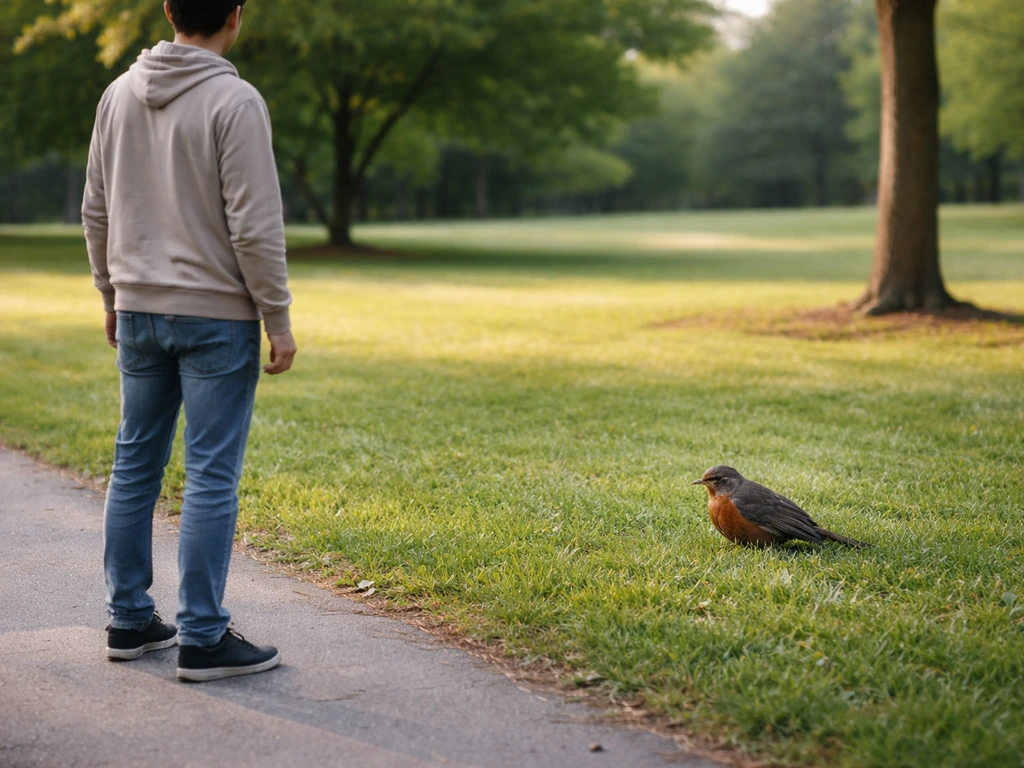
Take 60 seconds to observe the bird before you move toward it. You need to answer three questions: Is it injured? Is it in immediate danger? And is it a protected species that limits what you can legally do?
Look for signs of injury: drooping wing, inability to bear weight on both legs, visible bleeding, or a bird that's hunched and not reacting to your presence. A bird that just looks tired or confused after flying into a window is not the same as one with a broken wing. That distinction changes everything about how you handle it.
Check the immediate hazards. Is the bird near a power line, a busy road, or a steep roof edge with no safe landing area below? Is it on a ledge above foot traffic? If yes, your priority shifts slightly toward getting it to safety faster rather than waiting for it to self-rescue.
On species and legal protection: nearly all wild birds in the U.S. are covered by the Migratory Bird Treaty Act (MBTA). That means you cannot harm, harass, or handle them without authorization in most circumstances. In practice, brief gentle handling to get an injured or trapped bird to safety is considered reasonable and is consistent with USFWS humane-handling guidance, but you should not attempt to keep a wild bird, treat it yourself, or disturb an active nest without a permit. If you're looking at a raptor (hawk, owl, falcon), treat it as a specialized case and plan to contact a rehabilitator quickly.
- Fledgling on the ground or low perch: often fine, parents may be nearby, may not need intervention
- Nestling (no feathers or pin feathers only) out of nest: needs help, try to locate and return to nest
- Adult bird, clearly injured: needs a rehabilitator
- Adult bird, confused/stunned: likely a window strike, give it time before intervening
- Raptor of any age: handle with thick gloves only and call a rehabilitator
First: calm the area down
Before you climb a ladder or grab a towel, reduce the chaos around the bird. Stress kills birds, especially small songbirds. Noise, excessive handling, and pets or people close by can cause life-threatening stress for birds Stress kills birds, especially small songbirds.. A frightened bird will thrash, injure itself further, or flush into a dangerous direction. Your first job is to create a calm environment.
- Move people back at least 20 to 30 feet from the bird and ask them to stay quiet
- Get dogs, cats, and other pets completely out of the area and ideally indoors
- Turn off any nearby noise sources: radios, fans, power tools
- If the bird is indoors near a high window, dim the lights where possible and open only the exit window
- If it's outdoors on a ledge or roof, stop any nearby activity (mowing, construction) temporarily
- Give the bird 10 to 15 minutes undisturbed before you attempt anything else
For a stunned bird (one that flew into a window and landed on a high ledge), this waiting period is often all it needs. Many will recover and fly off on their own within an hour. If you move in too quickly, you may cause it to flush in a dangerous direction or exhaust itself further.
How to actually get the bird down: step-by-step methods
Which method you use depends on where the bird is and whether it can fly. Here are the three core approaches, from least to most hands-on.
Method 1: guided exit (for birds that can fly)
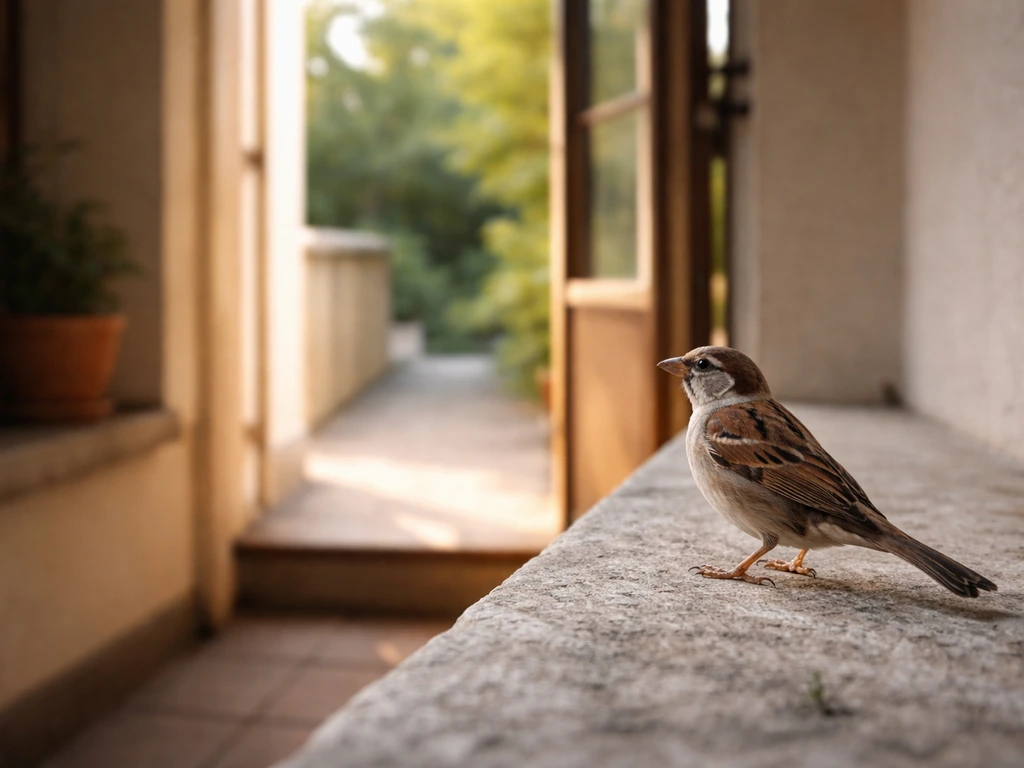
If the bird appears healthy and just needs a clear exit path, guided exit is your first move. This works well for birds on rooftops, high ledges, balconies, and inside high-ceilinged spaces near windows. The idea is to remove obstacles between the bird and the exit, create one obvious escape route, and use gentle, slow movement to guide it toward that route without chasing it.
- Identify the most natural exit: an open window, the edge of a roof facing open sky, a clear gap in a railing
- Close off other exits or directions if indoors (drape a dark sheet over windows that are not the exit)
- Stand behind and to the side of the bird, not directly in its flight path
- Move slowly toward it, keeping low and non-threatening, arms slightly out to create a soft barrier
- The goal is to gently pressure it toward the exit, not to corner it
- Stop and wait if it panics; let it settle before continuing
Method 2: ladder approach for roof or high ledge
If the bird is on a roof ridge, a high eave, or a balcony above you and won't move on its own, you may need to get to its level. Before you go up, make sure you have a second person to steady the ladder and that you are not working near power lines. Fall risk is real and serious. Do not attempt roof access on a wet or steeply pitched surface.
- Set up a stable extension ladder, secured at the base with a spotter present
- Wear rubber-soled shoes and disposable gloves before climbing
- Bring a clean, dark-colored towel or small cardboard box and a lid
- Ascend slowly and without sudden movements, pausing if the bird becomes agitated
- At the bird's level, use the towel or guided-exit method as described above
- If you need to handle the bird, follow the towel capture steps below
- Never overreach on a ladder; come down and reposition rather than stretch
Method 3: towel or low-barrier capture (for injured or non-flying birds)
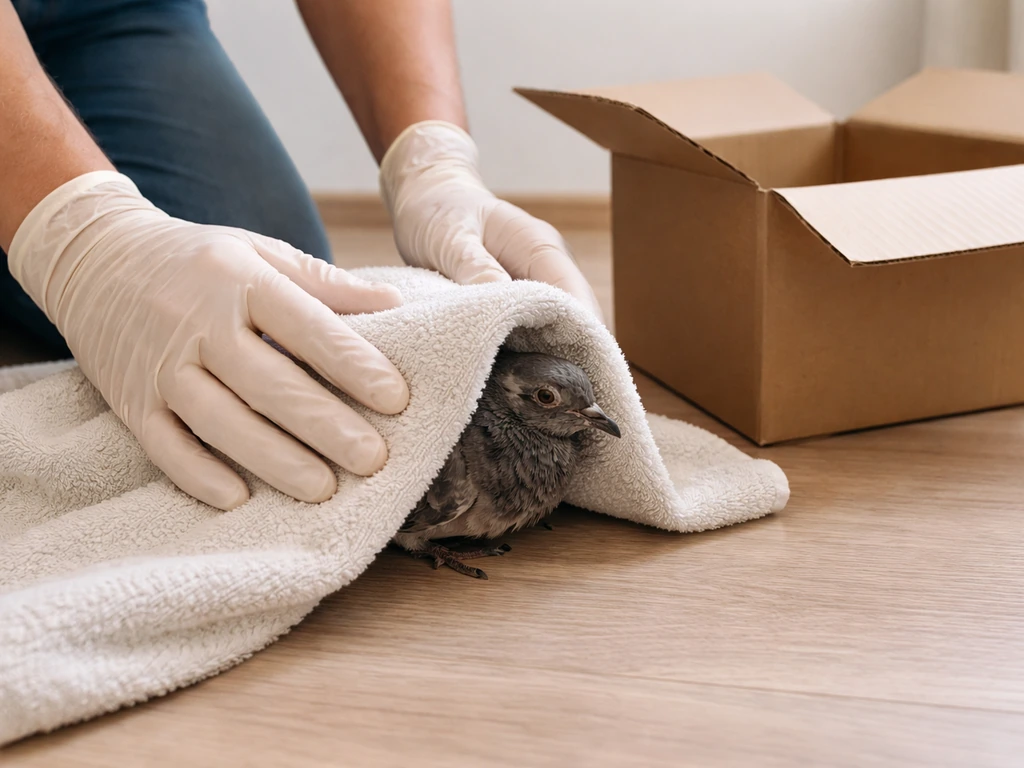
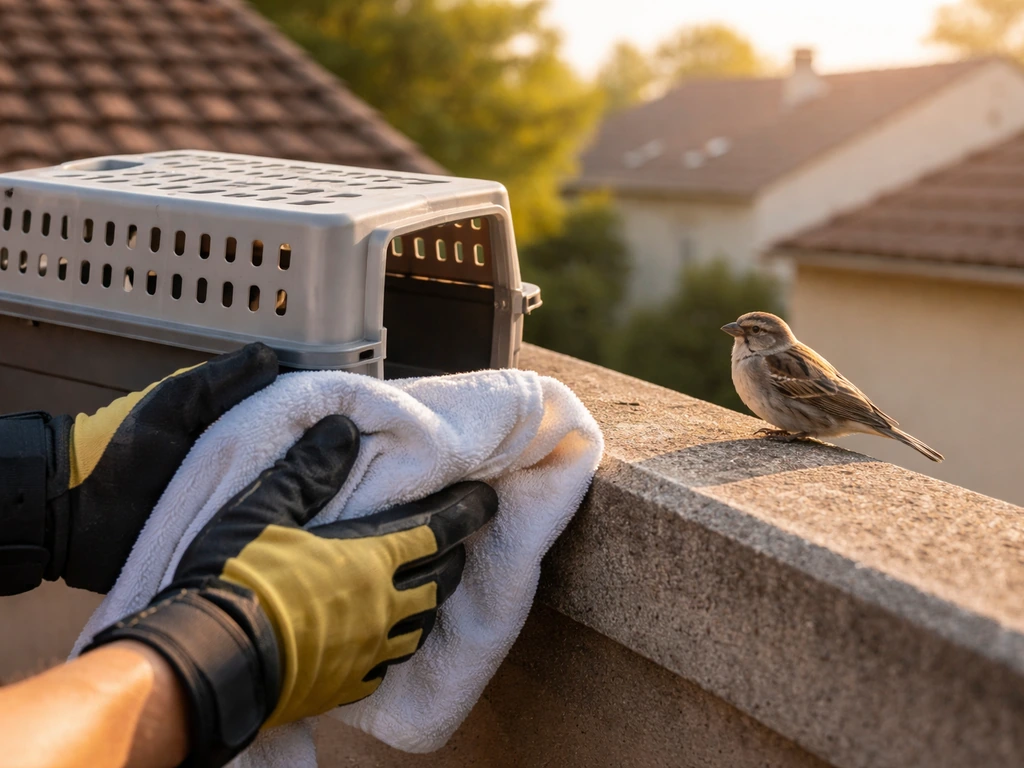
If the bird cannot fly or is clearly injured and needs to come down for its own safety, you will need to capture it gently. Prepare a box before you go up: a cardboard box with air holes punched in the sides, lined with a soft cloth, with a lid that closes securely. An unwaxed paper bag or a cloth tote also works for small birds.
- Put on disposable gloves before any contact (protects you and the bird)
- Approach from the side, not head-on, moving in a slow arc
- Drape the towel gently over the bird to cover its eyes; this reduces panic immediately
- Cup both hands around the bird over the towel, applying light, firm pressure to prevent wing flapping
- Lift the bird and lower it into the prepared box in one smooth motion
- Close the box and keep it in a warm, dark, quiet place
- Do not offer food or water
- Contact a licensed wildlife rehabilitator within the hour
For larger birds like ducks, geese, or herons stranded on a high ledge, the same principles apply but you need a larger box and heavier gloves. Waterfowl can bite hard and herons have sharp bills that move fast. If you are not confident, call for help rather than risk injury to yourself or the bird.
What to do when it won't come down: troubleshooting by scenario
The bird is stuck in a gap, under eaves, or wedged in a structure
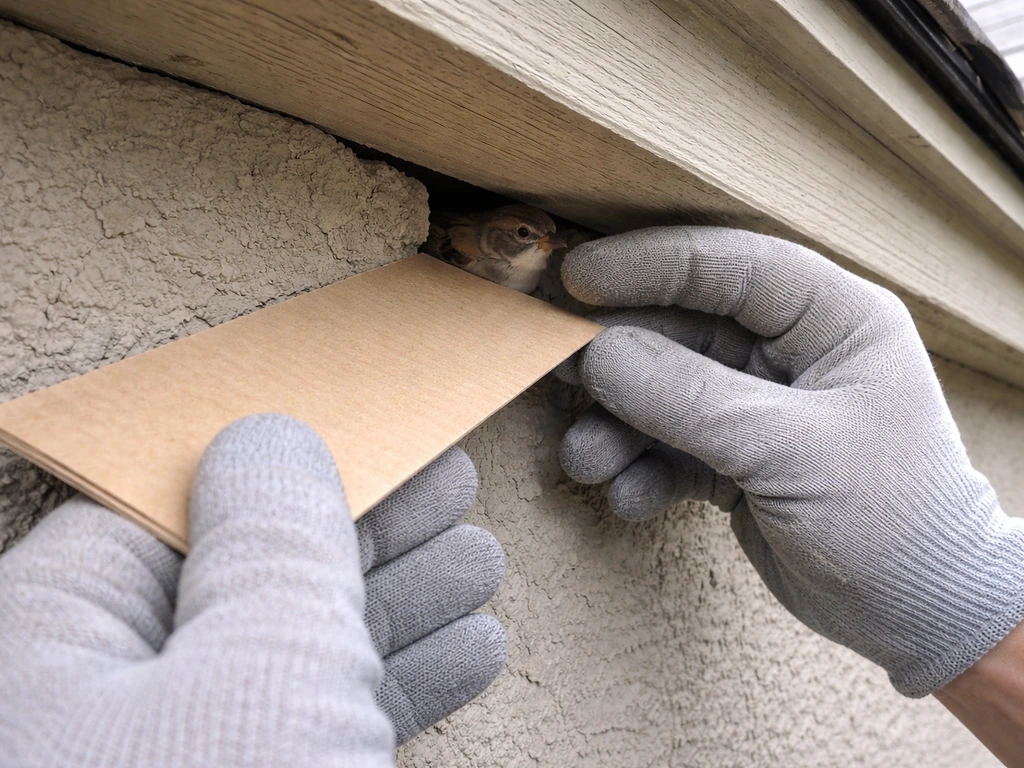
Don't try to pull a bird out of a gap by force. Reach in gently with a gloved hand and cup it, or try to guide it out with a flat piece of cardboard. If it's too deep to reach safely and won't come out on its own, call a wildlife rehabilitator or pest control professional who handles birds humanely. Forcing a bird through a tight gap can break bones or cause internal injury.
The bird is sitting on a high branch or tree and won't fly
A bird sitting motionless in a tree is often recovering from a collision or thermal stress. Give it at least one hour of undisturbed quiet. If after an hour it hasn't moved or changed position at all, that's a sign it may be injured. At that point, if you can safely reach it (with a ladder and a spotter), attempt gentle towel capture. If it's too high to reach safely, call a rehabilitator. Situations involving birds stuck in trees have their own nuances worth reading about separately. If your bird is stuck in the canopy and you need a plan for safely getting it down, follow our guide on how to get bird out of tree.
The bird is near or on a power line
Do not attempt to retrieve a bird that is on or directly adjacent to power lines. This is a job for the utility company and a licensed wildlife professional working together. Call your local utility's non-emergency line and a wildlife rehabilitator simultaneously. Electrocution risk is real even without direct contact with the line.
The bird is inside near a high window and won't find the exit
Birds inside buildings are attracted to light and will keep flying toward bright glass even when an open exit is nearby. Your job is to make the exit the brightest and most obvious point in the space. If the bird is on your shoulder, use the same calm, guided-exit approach to keep it from panicking and finding another risky landing spot make the exit the brightest and most obvious point in the space.
Close blinds or drape sheets over all windows except one, and open that one window fully. Turn off interior lights. Then back away and wait. In most cases the bird will find the open window within a few minutes once the visual cues are corrected.
If it's near a gutter or downspout area you should also check whether it entered through those channels. If you are dealing with a bird stuck at a window well, the same idea applies: make the escape route obvious and visible before you consider capture or waiting.
If the bird ended up in a downspout, use the same gentle, guided-exit approach and make sure you can access the opening safely before trying to coax it out downspout entry channels. If you’re dealing with a bird that got into a gutter, the safest approach is to check the entry path, reduce stress, and use gentle guidance or a barrier so it can exit on its own bird into a gutter.
Small songbird vs. larger raptor or waterfowl
| Factor | Small Songbird | Raptor (hawk, owl, falcon) | Waterfowl / Wading Bird |
|---|---|---|---|
| Handling risk | Low; can bite or scratch but rarely injures | High; talons can cause serious injury | Moderate; strong beak, can bite hard |
| Glove type needed | Disposable latex or nitrile | Thick leather welding or raptor gloves | Heavy-duty work gloves |
| DIY capture appropriate? | Yes, if bird is reachable and calm | No; call a rehabilitator | Only for calm, reachable birds |
| Time to wait before acting | Up to 1 hour | 30 minutes, then call a professional | Up to 1 hour |
| Box size needed | Small cardboard box | Large, ventilated box or crate | Large box or laundry basket with towel |
Humane handling and release basics
The goal of any handling is minimal contact and minimal time. Every second a wild bird is in your hands is stressful for it. Work quickly, stay calm, and keep your movements smooth and predictable. Speak quietly if you must speak at all.
- Always wear disposable gloves before touching any wild bird
- Never hold a bird by its wings, legs, or neck; cup the body with both hands
- Keep the bird's head gently but firmly against your palm to prevent thrashing
- Do not squeeze; you should feel gentle resistance, not stillness from pressure
- Do not attempt to give it food, water, or any medication
- Place it in a dark, warm, quiet box as soon as possible after capture
- Wash your hands thoroughly after handling even with gloves
For release, if the bird recovers on its own (stands, is alert, reacts to your approach), simply open the box in a quiet outdoor area away from traffic and predators and let it exit on its own terms. Do not throw or toss it into the air. A healthy bird will fly when it's ready. If it doesn't fly after a few minutes in the open box, close it and contact a rehabilitator.
When to stop DIY and call a wildlife professional
There are clear lines where DIY becomes the wrong call. Licensed wildlife rehabilitators are trained, permitted under federal and state law (50 CFR § 21.76), and equipped to handle injured or protected birds in ways that private individuals are not authorized to do. Calling them is not giving up; it is the right next step.
Call a licensed wildlife rehabilitator immediately if any of the following are true:
- The bird is a raptor (any hawk, owl, falcon, or eagle) at any age or condition
- The bird has a visible broken bone, is bleeding, or cannot hold its head upright
- The bird is a nestling (no feathers) and you cannot locate or safely reach the nest
- The bird has not moved or responded to any stimulus after an hour of quiet
- The bird is on or near an active power line
- You are dealing with a protected colonial nesting species (herons, egrets, terns)
- The bird is in a location you cannot safely reach without significant fall risk
- You have had the bird in a box for more than one hour and it has not improved
- You are unsure whether the bird is a protected species
To find a licensed rehabilitator near you, search the National Wildlife Rehabilitators Association (NWRA) or Wildlife Rehabilitators directory, or contact your state wildlife agency. Cornell Lab of Ornithology also directs people to local rehabilitator networks. When you call, tell them the species (or your best description), the bird's condition, and the location. They will guide you on whether to bring it in or wait.
One important note: raptors specifically can cause serious injury even when they appear weak. Talons can grip and puncture through standard work gloves. Audubon explicitly advises using a box-over technique (place the box over the bird on the ground rather than picking it up) and transporting directly to a rehabilitator without handling the bird further.
After the rescue: stop it from happening again
Once the immediate situation is resolved, spend a few minutes figuring out why it happened. That determines what you need to change. Birds end up stranded on high places for a predictable set of reasons: window collisions, gaps in eaves or fascia that allow entry, attractive nesting ledges with no proofing, or landscape and lighting that draws birds into awkward positions at night.
Window strikes and light attraction
Window collisions are one of the most common reasons a bird ends up stunned on a high ledge or roof. Tufts Cummings explains that birds strike windows because they cannot recognize glass as a barrier and may see reflections of habitat like sky, trees, or clouds on the glass window collisions because birds can’t recognize glass as a barrier and may see reflections of habitat.
Apply window collision deterrents: tape or decals spaced 2 inches apart vertically or 4 inches apart horizontally on the outside of the glass. Angling windows slightly downward (even 20 degrees) dramatically reduces strikes. Turn off or reduce interior lighting at night during spring and fall migration seasons (roughly March through May and August through November in most of North America), when bird activity near buildings peaks significantly.
Closing off entry and nesting points
Walk the roofline and check fascia, soffits, eave gaps, and any open vents. Gaps as small as 1.5 inches can allow small birds entry. Install bird-proof mesh (stainless steel hardware cloth at 0.5 inch spacing) over any open vents. Seal gaps in fascia with caulk or appropriate trim. For ledges that attract roosting birds, install physical deterrents like ledge spikes or netting after nesting season ends. Never install exclusion materials while an active nest with eggs or chicks is present; that's both inhumane and illegal under the MBTA for most species.
Seasonal planning
Schedule a quick inspection of your roofline, gutters, and eave gaps in late winter (February to early March) before nesting season begins. That's your best window to install exclusion without disturbing active nests. A second check in late fall (October to November) lets you address any new gaps before the next spring season. If you manage a larger facility, add this to a twice-yearly building envelope inspection. Issues like birds getting into gutters or downspouts often share the same root causes as roofline bird problems, so fixing gaps comprehensively saves you multiple call-outs.
Landscape and lighting tweaks
Trim tree branches that hang directly over roof edges or touch the building structure. These act as landing bridges and give birds easy access to ledges and eave gaps. Replace upward-facing floodlights with downward-angled fixtures, which attract fewer insects at night and reduce the lighting gradient that draws migrating birds toward your building. If you have reflective or glass-heavy exterior architecture, consider adding visible pattern elements (frosted stripes, UV-reflective films) to reduce the mirror effect that confuses birds in daylight.
Quick escalation checklist
Use this checklist to decide whether to continue with DIY or make the call. If you check any item in the 'call now' column, stop and contact a wildlife rehabilitator before attempting further handling.
| What you're seeing | Your move |
|---|---|
| Bird appears stunned but upright, reacting to movement | Wait 1 hour in a calm, quiet area before intervening |
| Bird is in an accessible, safe location and can fly | Use guided exit method first |
| Bird cannot fly but appears otherwise healthy (no visible injury) | Gentle towel capture, box, call rehabilitator if no improvement in 1 hour |
| Bird has visible injury (broken bone, blood, drooping wing) | Towel capture immediately, call rehabilitator now |
| Bird is a raptor (hawk, owl, falcon, eagle) | Call a wildlife rehabilitator immediately, do not attempt handling |
| Bird is on or near a power line | Call utility company and wildlife rehabilitator, do not approach |
| Bird is a nestling (no feathers) and nest is unreachable | Call wildlife rehabilitator now |
| Bird has been in a box for over 1 hour with no improvement | Call wildlife rehabilitator now |
| You cannot safely reach the bird without significant fall risk | Call wildlife rehabilitator or pest management professional |
FAQ
How can I tell if a bird is truly injured versus just stunned after hitting a window or glass?
Look for functional signs, not just stillness. If it can right itself, has coordinated wing movements, and responds to nearby sound, it may only be stunned and often recovers within an hour. Visible bleeding, a wing held at an odd angle, or trouble standing on both legs are stronger indicators that it needs a rehabber, even if it is calm.
Should I feed or give water to a bird after getting it down?
No. Do not offer food or water to wild birds, especially when they are cold, stressed, or likely injured. Handling already increases stress, and swallowing can increase risk of aspiration. If recovery is delayed and it is not flying after a few minutes in an outdoor box, contact a rehabilitator rather than trying home care.
What should I do if the bird keeps flying back up or into another risky area after I open the exit or window?
Return to creating one clear escape route and stop chasing. Close off other access points (another room door, adjacent skylight, or nearby interior hazards) and maintain quiet. If it repeatedly flushes toward glass or edges, switching to a guided exit plan with a barrier (for example, furniture positioned to block reentry paths) is safer than repeated attempts to capture.
Is it safe to use gloves, a towel, or a net if the bird is an unknown species?
Gloves and towels can be appropriate for small, calm birds, but avoid nets and aggressive grabbing. If the bird might be a raptor or larger waterbird, treat it as higher risk even if it looks weak, and use the box-over approach or call for help quickly. When in doubt about species, minimize contact and prioritize contacting a rehabilitator.
Can I keep the bird overnight in a box and handle it in the morning?
Sometimes, but only as a short-term containment measure while you coordinate help. Put the bird in a secure, ventilated box in a quiet, dim room away from pets, then monitor breathing and posture. If you observe injury signs, ongoing inability to stand, heavy bleeding, or deteriorating responsiveness, call a wildlife rehabilitator right away rather than waiting for morning.
What if the bird won’t move after I’ve made one escape route, but it doesn’t look injured either?
Give it time, then reassess with a second observation. If it does not improve position, alertness, or movement after a reasonable undisturbed interval (often around an hour for stunned birds), plan the next least-hands-on step, such as a gentle guided exit or, if it cannot reach safety, a towel capture by someone who can do it calmly and safely.
What if I must climb a ladder, but there is no way to keep a spotter at ground level?
Do not climb without a second person if you need to reach the bird’s height. Ladder stability and fall risk are major concerns, and a spotter can also keep others and pets away to reduce thrashing and panic. If you cannot secure safe access, wait if feasible, or call a wildlife rehabilitator or pest control team that handles birds humanely.
How should I prepare the box or container before capture to reduce risk to the bird?
Use a ventilated, secure box with soft lining and a lid that closes firmly. Pre-position it near your working area so you are not searching mid-capture. Avoid materials that can catch claws or trap wings, and keep the bird’s environment dark enough to calm it, while still allowing airflow.
Is it okay to relocate a bird that is stuck in a tree or on a high branch by cutting it down?
No. Cutting branches or shaking the tree can worsen injuries and can permanently displace nesting wildlife. Instead, wait for recovery when appropriate, then contact a wildlife professional if it is too high, not moving after the initial quiet period, or appears injured. If the situation is specifically tree-related, follow a dedicated tree-handling approach rather than DIY retrieval.
What should I do if the bird is near wires but not directly touching a power line?
Do not attempt retrieval if it is on or adjacent to power lines. Even without direct contact, electrification and grounding risk can exist, especially if the bird moves or if someone approaches with tools. Call the utility non-emergency line and a wildlife rehabilitator so the right team can handle coordination safely.
How long should I wait before assuming the bird will not self-rescue?
Use a species and situation-based window. For many window-collision cases, about an hour of quiet is often enough for recovery. For birds that remain motionless beyond that, are unable to stand, or are trapped with no clear exit, stop waiting and escalate to the next safe step or call a rehabilitator.
After the bird is gone or released, how can I prevent the same incident from happening again?
Start with the building-level causes, then address the bird’s entry and attraction points. Add window collision deterrents, seal small eave or fascia gaps, and reduce night lighting near windows during migration seasons. Schedule your roofline and vent checks in late winter before nesting, and recheck in late fall so new gaps are caught early.