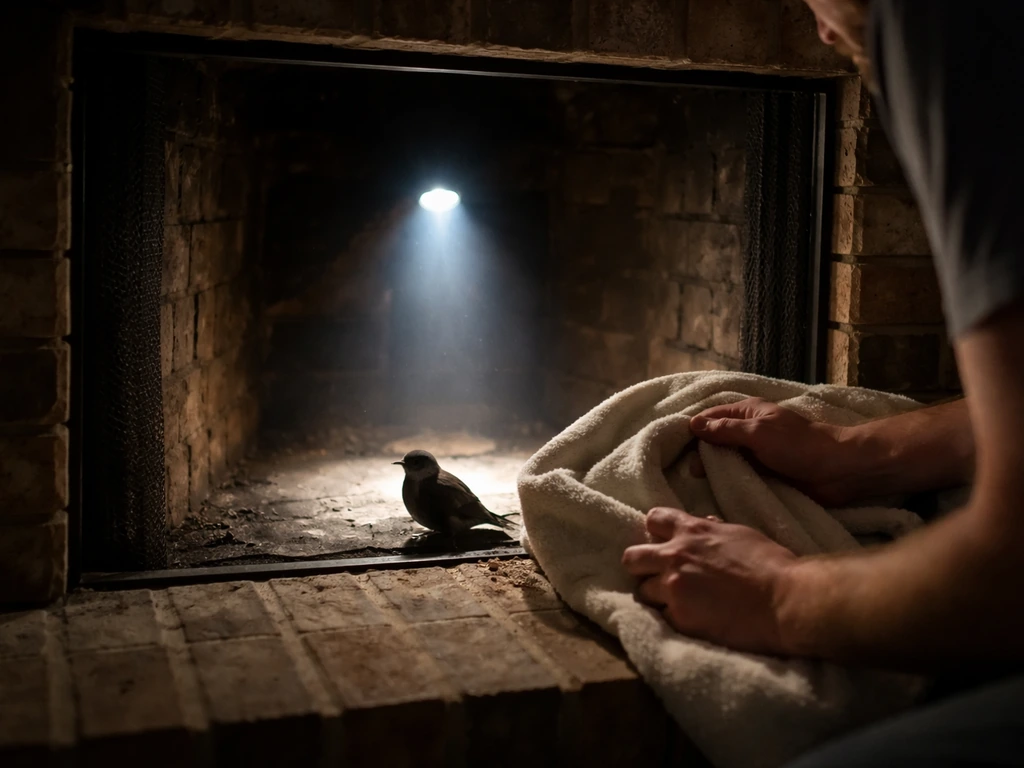
Close off the fireplace opening, darken the room, open a nearby window or door, and give the bird a quiet path to fly out on its own. That one sequence handles the majority of cases. Most birds that end up in a fireplace are not physically trapped, they're disoriented, and the right light and airflow cues will get them moving within 20 to 60 minutes without you ever needing to touch them.
How to Get a Bird Out of the Fireplace Safely
Maya Carver
23 Apr 2026
Immediate safety steps before you do anything else
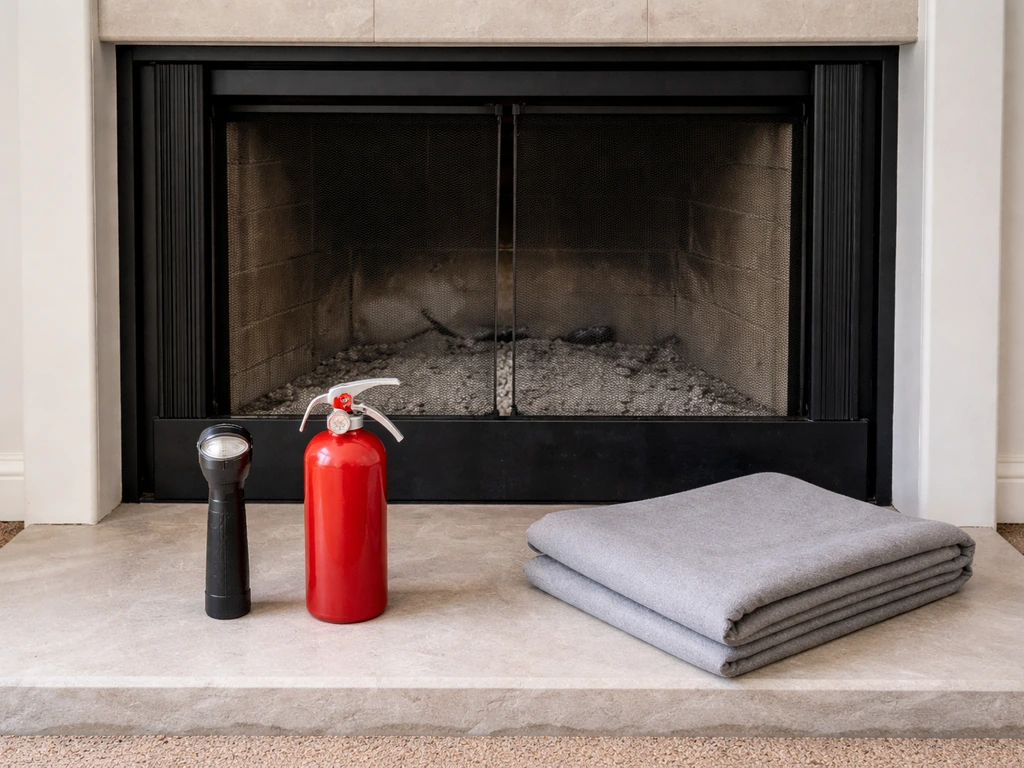
Before you focus on the bird, lock in your own safety and prevent the situation from getting messier. A panicked bird in a fireplace can spread soot across an entire room in seconds, and an active fire, even embers, is obviously a life-threatening hazard for the animal.
- Make sure the fire is completely out and no embers are glowing. Do not attempt removal with any heat source active.
- Keep pets and children out of the room and close the door behind them.
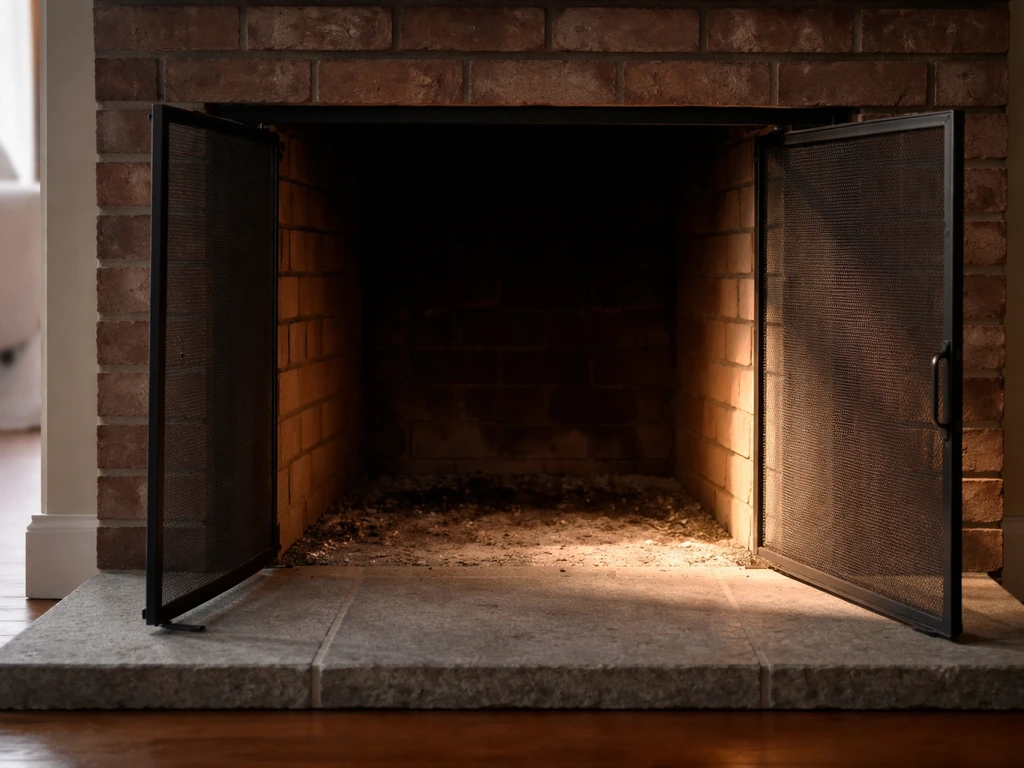
- Do not open the fireplace screen or doors yet — this is step one of containment, not release.
- Turn off ceiling fans and close interior doors you don't want the bird flying into.
- Put on safety glasses if you plan to look up into the flue — falling soot is a real risk.
- Check whether the damper (the flap between the firebox and the chimney) is currently open or closed.
- If you can hear the bird but can't see it, it may still be in the chimney rather than the firebox itself — this changes your approach slightly (more on that below).
Do not light a fire, use smoke, or spray any substance into the fireplace to drive the bird out. These tactics cause injury or death and may be illegal if the bird is a protected migratory species under the Migratory Bird Treaty Act.
How to get the bird out: fast DIY methods that actually work
The core principle here is: give the bird a clear, lit escape route, remove all stressors, and wait. Here is the sequence that works for most open-fireplace situations.
- Open the fireplace damper fully so the bird has the option of going back up the chimney if that's its preferred exit.
- Open the fireplace screen or glass doors slowly and quietly. Back away immediately.
- Turn off every light in the room — lamps, overhead lights, TV, everything.
- Open one window or exterior door in the same room as wide as possible to create a bright, obvious exit.
- Leave the room entirely, or sit completely still and out of the bird's sightline if you need to observe.
- Wait at least 30 to 60 minutes before reassessing. Most birds will self-exit given this setup.
- If the bird isn't moving after an hour, use a flashlight to carefully check whether the damper is open wide enough to allow passage. Some older dampers don't open fully and can physically block exit even when 'open.'
Daytime birds (sparrows, starlings, pigeons, most songbirds) respond well to light and will move toward a bright window naturally. They tend to freeze in the dark, so the combination of a darkened room and one bright exit is genuinely effective. Resist the urge to shoo, clap, or chase, that burns the bird's energy and sends it crashing into walls rather than out the window.
Open fireplace vs. fireplace insert: what changes
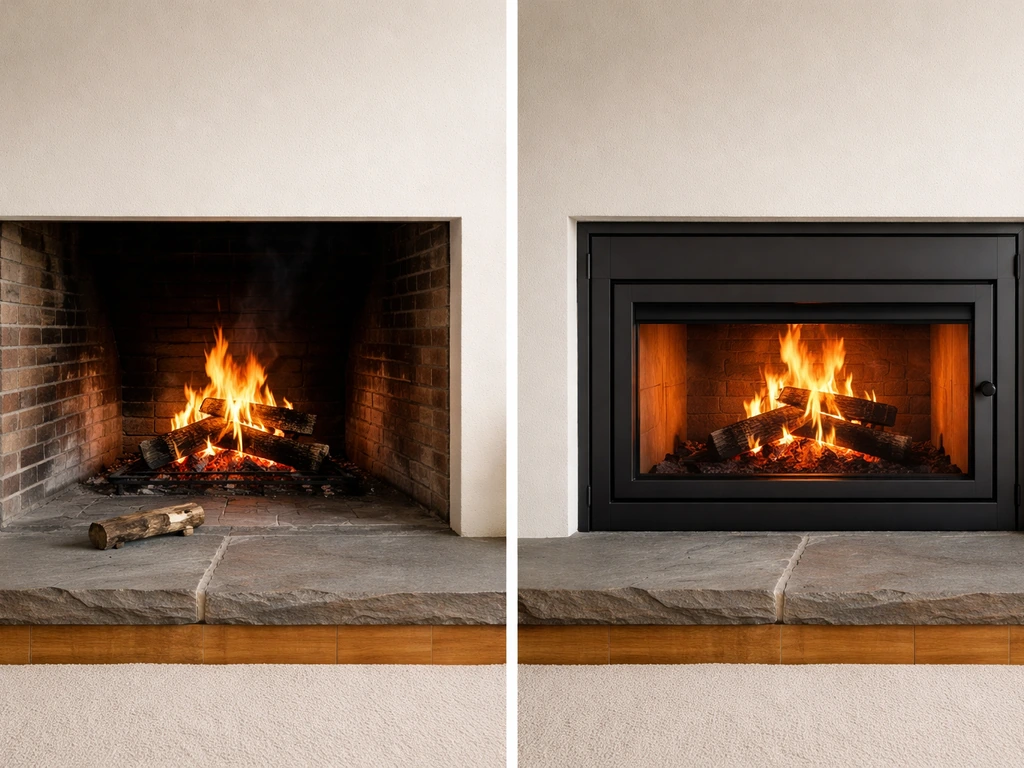
This is where a lot of generic advice falls short. A traditional open masonry fireplace and a fireplace insert are very different environments, and the removal approach needs to match.
| Factor | Open Fireplace | Fireplace Insert |
|---|---|---|
| Access for the bird | Direct access from firebox — bird can fly in and out relatively easily if doors are open | Bird enters through the flue but gets trapped in the narrow space between the insert unit and the surround — often cannot self-exit |
| Damper location | Damper is at the top of the firebox, usually accessible by hand or visible with a flashlight | Insert dampers vary; many inserts use a flexible liner that runs the full chimney height — damper may be at the top of the liner |
| DIY self-exit success rate | High — open doors, darken room, open window, wait | Lower — bird is often physically confined and cannot navigate the tight space around the insert |
| Risk of injury to the bird | Moderate — soot, stress, but usually room to move | Higher — bird may be wedged in debris or insulation behind the unit |
| Hands-on removal needed? | Rarely — give it time and light first | More often — may need to carefully pull the insert or access a side panel |
| When to call a professional | If self-exit fails after 60 minutes or bird is injured | Earlier — especially if you can hear but not see the bird, or if the bird has been there more than 30 minutes |
If you have an insert and you can hear or see a bird trapped behind or beneath the unit, do not try to yank the insert out yourself, these units are heavy, connected to liners, and can cause serious injury. In this case, skip ahead to the 'when to call a professional' section. If the bird has made it into the firebox of the insert (the actual combustion chamber with the door), treat it like an open fireplace: open the door slowly, dark room, open window, step back.
What to do if the bird is trapped, won't leave, or seems injured
If your light-and-exit approach has not worked after an hour, or the bird looks visibly injured (drooping wing, unable to stand, not responding to movement), you are moving from passive guidance into active intervention territory. Here is what to do, and just as importantly, what not to do.
Safe hands-on handling when it's necessary
- Put on a pair of thin leather or work gloves to protect against scratches and as a basic hygiene measure.
- Get a lightweight towel or pillowcase. Dim the room as much as possible before approaching.
- Move slowly and calmly toward the bird. Sudden movements cause panic and injury.
- Drape the towel gently over the bird from above to cover its eyes — a covered bird calms down significantly.
- Cup both hands around the bird through the towel, keeping its wings folded gently against its body.
- Carry it immediately to the open window or door and release it at ground level or on a ledge — let it fly out on its own.
- If it doesn't fly away within a few minutes after release, it is likely injured and needs a rehabilitator.
What to avoid
- Do not grab the bird bare-handed by a wing or leg — bones are extremely fragile.
- Do not shout, clap, or use a broom to chase it — this causes stress injuries and panic.
- Do not close the damper while the bird is still in the chimney or flue.
- Do not use any chemical repellent, spray, or smoke in the fireplace.
- Do not place an injured bird in a box and leave it alone without arranging professional help within a few hours.
- Do not attempt to hand-feed or give water to a wild bird — aspiration is a real risk.
Remember that the RSPCA reports that in 99.9% of cases, a bird that appears stuck in a chimney or fireplace is not actually physically trapped. Patience and the right conditions are almost always enough. The same patience-and-access approach also works when you're trying to get a bird out of a church, since it is still about giving the bird an easy exit Patience and the right conditions are almost always enough.. Physical intervention is a last resort, not a first move.
Clean-up and hygiene after the bird is gone
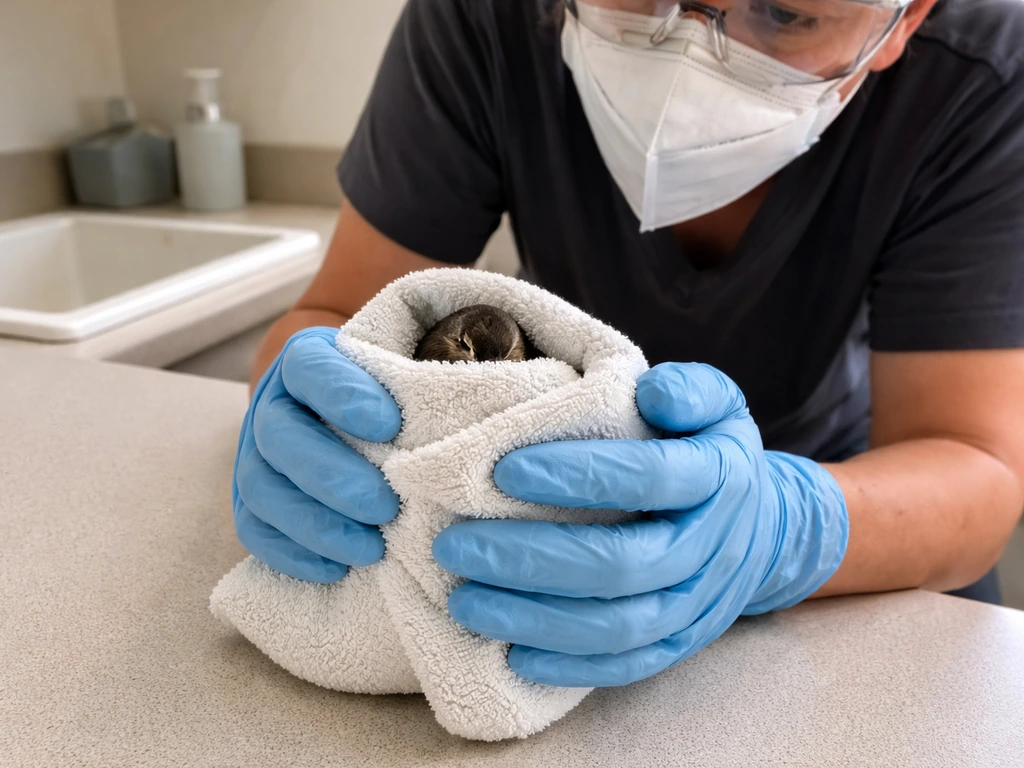
Once the bird is out, do not clean up casually. Bird droppings can carry Histoplasma capsulatum, the fungal spores responsible for histoplasmosis, which spreads through the air when dried droppings are disturbed. The CDC and NIOSH are explicit: do not sweep or shovel dry droppings, that aerosolizes the spores.
- Put on an N95 respirator (not a basic dust mask), gloves, and eye protection before you start.
- Lightly mist any droppings, nesting debris, or soot with water or a diluted disinfectant spray to keep material from becoming airborne. Do not soak — just dampen.
- Use damp paper towels or a damp cloth to wipe up the wetted material. Place everything directly into a sealed plastic bag.
- For larger accumulations inside the flue or smoke shelf, a HEPA-filtered vacuum is recommended over manual scooping.
- Dispose of bagged material in an outdoor waste bin.
- Wash gloves before removing them, then wash hands thoroughly with soap and water.
- Wipe down the fireplace surround, hearth, and any nearby surfaces with a household disinfectant.
- If the bird was nesting and there is a significant accumulation of material — think shoebox-sized or more — seriously consider calling a professional hazardous-waste or wildlife cleanup service. The CDC recommends this threshold for large volumes.
If you spotted a nest with eggs or chicks rather than a single adult bird, stop before removing anything. Destroying an active nest containing eggs or young may be illegal under the Migratory Bird Treaty Act (more on this below). Document what you see with a photo and call a wildlife rehabilitator or your state wildlife agency before touching anything.
Prevention and long-term proofing so this doesn't happen again
Getting the bird out solves today's problem. Proofing the chimney and fireplace properly means you never deal with this again. The good news is that the hardware solutions are straightforward and not expensive.
Install a proper chimney cap
Every unprotected flue is an open invitation for birds. A professionally manufactured chimney cap with 3/4-inch or smaller steel mesh (per USFWS specifications) prevents birds from entering while still allowing smoke to exit. The mesh size matters: larger openings allow smaller birds to pass through, and smaller than 3/4 inch can restrict airflow and create draft problems. Make sure whatever cap you install meets your local fire code, your chimney sweep or a wildlife control operator can confirm this. NWCO training guidance is clear that every masonry chimney flue should be capped with an approved commercial cover.
One nuance worth knowing: some caps can still allow birds to nest on top of the mesh screen itself, particularly if the cap design has a wide, flat top with low side clearance. A cap with a peaked top and mesh sides that extend down at least 6 inches is more resistant to this. If you are installing on a hinged-access flue (for example, where a sweep needs seasonal entry), caps with hinged frames are available and maintain both exclusion and access.
Keep the damper closed when the fireplace isn't in use
This is the single simplest habit change you can make. A closed damper is a physical barrier between the chimney and your home. The USFWS specifically recommends keeping the fireplace damper closed after the heating season to prevent birds (including chimney swifts) from falling into the firebox. Make it a seasonal habit: at the end of fire season in spring, close the damper and leave it closed until fall.
Chimney swift special consideration
If you hear chattering, high-pitched food-begging calls from young birds in the three weeks before they fledge, and you suspect chimney swifts, the USFWS recommends a specific interim measure: stuff foam rubber (not fiberglass insulation, which can harm the birds) above the damper to block chick access into the firebox. Remove it once the swifts have left. Do not cap a chimney actively being used by swifts, they are federally protected, and you cannot legally disturb an active nest.
Seasonal maintenance checklist
- Spring (end of fire season): Close damper, inspect cap and mesh for rust or damage, schedule annual chimney sweep.
- Late spring to summer: Check exterior cap for nesting activity before any cap removal or repair work.
- Fall (before first fire): Open damper carefully and inspect for debris or nesting material dropped during the off-season. Have a sweep clear the flue before use.
- Year-round: Replace any cap mesh showing rust or gaps — wire mesh can degrade over time and gaps larger than 3/4 inch allow bird entry.
When to call a wildlife professional (and what the law says)
Some situations are beyond reasonable DIY territory. Call a licensed wildlife control operator or migratory bird rehabilitator if any of the following apply.
- The bird has been in the fireplace or chimney for more than two hours and has not responded to self-exit conditions.
- The bird is visibly injured and cannot fly after release.
- You have a fireplace insert and the bird appears to be trapped in the space behind or beneath the unit.
- You can hear multiple birds or young chicks — you may be dealing with an active nest.
- There is a large accumulation of droppings or nesting debris requiring hazardous-material cleanup.
- You suspect the bird is a chimney swift or any other migratory species you can't confidently identify.
On the legal side: the Migratory Bird Treaty Act is a federal law that makes it unlawful to take, possess, or kill migratory birds without authorization. 'Take' includes destroying active nests containing eggs or chicks. This covers hundreds of common species including robins, sparrows, starlings, swallows, and chimney swifts. If you disturb an active nest, even accidentally during cleanup, you could be in violation. When in doubt, stop work and call your state wildlife agency or a licensed rehabilitator before proceeding.
If you are a facility manager dealing with a recurring issue in a commercial or institutional building, a licensed wildlife control operator (NWCO) can assess the structure, recommend code-compliant exclusion hardware, and handle any required permits for species-specific situations. For chimney-swift situations specifically, the USFWS advises contacting a licensed migratory bird rehabilitator if nestlings fall into the firebox, this is not a DIY fix. If you are wondering who to call when a bird is stuck in your chimney, start with a licensed migratory bird rehabilitator or a licensed wildlife control operator.
The scenario of a bird in a fireplace often overlaps with related situations: a bird deeper in the chimney flue, a bird in a wood stove (which has its own access and heat considerations), or a bird that has entered through an open damper into another part of the structure. If you are dealing with a bird in a chimney and need immediate steps, follow the guidance for getting it out safely and calling for help if it seems injured bird deeper in the chimney flue. If the bird is inside a wood stove, use the same light-and-exit idea but account for the stove door and airflow specific to that setup bird in a wood stove. If the bird you're dealing with seems to be higher up in the chimney and hasn't reached the firebox yet, the guidance for getting a bird out of a chimney covers that situation in more detail. Similarly, if you are dealing with repeated entries or an established roosting pattern, the broader question of what to do when a bird is consistently in your chimney is worth reading alongside this guide. Similarly, if you are dealing with repeated entries or an established roosting pattern, consider the guidance on what to do if a bird falls down your chimney alongside this guide.
FAQ
What should I do if the bird seems disoriented and will not go toward the window?
If the bird does not fly out, stop chasing and keep the room dark except for one bright exit (window or door). Check that the exit is actually open and usable, and that the fireplace opening stays closed so it cannot re-enter. After about an hour with no movement, switch from passive guidance to calling a wildlife professional, especially if the bird appears weak, injured, or unusually calm (which can indicate illness or exhaustion).
Should I try to grab or net the bird to speed things up?
Do not attempt to catch the bird unless a professional instructs you to. If you must contain it for safety while waiting for help, keep people and pets away, close off other rooms, and use a towel only to gently cover a bird once it is fully accessible and the heat risk is managed. Any contact risk is higher if droppings are present, so plan for minimal handling and avoid disturbing dried waste.
How do I handle different damper or flue setups so the bird can only leave one way?
If the fireplace has a chimney damper plus a separate flue cover, leave barriers set so the bird has only one way out (the bright window or door you opened). Do not open the fireplace access in a way that lets the bird escape into other spaces (like attic cavities) and do not leave multiple exits that can lure it deeper into the structure.
What if I do not see the bird, but I suspect it is still in the fireplace or chimney?
If you see feathers or droppings at the fireplace but cannot locate the bird, treat it as potentially still inside. Keep the fireplace closed, darken the room, and leave the exit open so it can reorient if it is nearby. If you do not confirm the bird is out within a reasonable period, assume it may be deeper in the chimney or behind an insert and call a wildlife control operator.
Can I use a fan or ventilation to encourage the bird to leave faster?
If you need to move smoke-free air into the room, do it gently without blasting the bird. A small fan aimed toward the open window can help airflow cues, but avoid direct gusts that panic the bird and cause it to crash. If there is an active fire or embers, do not introduce any airflow changes that would also worsen fire risk, and prioritize calling for help.
What is the safe way to clean soot and droppings after the bird leaves?
When you clean up, wait until the area is damp or otherwise not dusty. Avoid dry sweeping, dry shoveling, or vacuuming that can aerosolize spores. Use appropriate PPE and follow proper cleanup practices, because droppings can be a respiratory hazard (histoplasmosis risk) when dried.
I found a nest or signs of chicks near the fireplace, what should I do before acting?
Do not remove nests or touch eggs or chicks, even if they are in the way. Instead, document what you see, keep the area undisturbed, and contact your state wildlife agency or a licensed migratory bird rehabilitator. If nest contents are present, the legal and practical consequences are different from a single adult bird that is disoriented.
How can I tell when this is more than a disoriented bird and needs medical help?
If the bird is visibly injured or unable to stand, immediate guidance alone may not be enough. Keep it away from heat sources, reduce stress, and contact a wildlife rehabilitator. Injured birds often need controlled care, and delay can reduce survival chances.
What if I suspect the bird is still up the chimney and not in the firebox yet?
If the bird is higher up in the chimney and you cannot see it in the firebox, focus on exclusion and access planning rather than trying to reach in. Use the same light-and-exit approach for the room, but expect the bird may need time to find the path. If it does not move within about an hour, call a chimney-aware wildlife professional rather than climbing or dismantling parts.
Does the timing and approach change for birds arriving at night or in cold weather?
Bird behavior can differ, but the key is avoiding energy loss. Daytime species usually respond well to the dark-room plus bright-exit approach, but nighttime or very cold-weather conditions can slow movement. Keep the environment calm and give it the same timeframe, then move to professional help if there is no progress or any injury signs.
If birds keep entering, what indicators suggest my chimney needs exclusion repairs, not just one-time help?
For a recurring issue, prevention matters as much as the removal. After the event, schedule chimney and damper hardware checks (cap fit, mesh size, and code compliance) and keep the damper closed when not in use. If birds keep getting in, a professional can identify gaps like damaged liners, missing caps, or noncompliant screens that allow entry.
Next Article
How to Get a Bird Out of a Chimney Safely and Humanely
Safe humane steps to remove a live or dead bird from a chimney or flue, plus nest removal and prevention.