The safest legal step you can take right now depends on one thing: whether the nest is active. If there are eggs or chicks in it, or if adults are actively using it to raise young, you cannot legally remove it under the U.S. Migratory Bird Treaty Act (MBTA) without a federal permit. That applies to the vast majority of songbirds, waterfowl, and other migratory species you're likely dealing with. The good news is that most nests cycle through in a few weeks, and there's plenty you can do in the meantime, and a lot more you can do before nesting season even starts.
How to Stop Bird Nesting: Quick Fixes and Prevention Steps

Maya Carver
18 Apr 2026
Quick emergency actions when birds are nesting
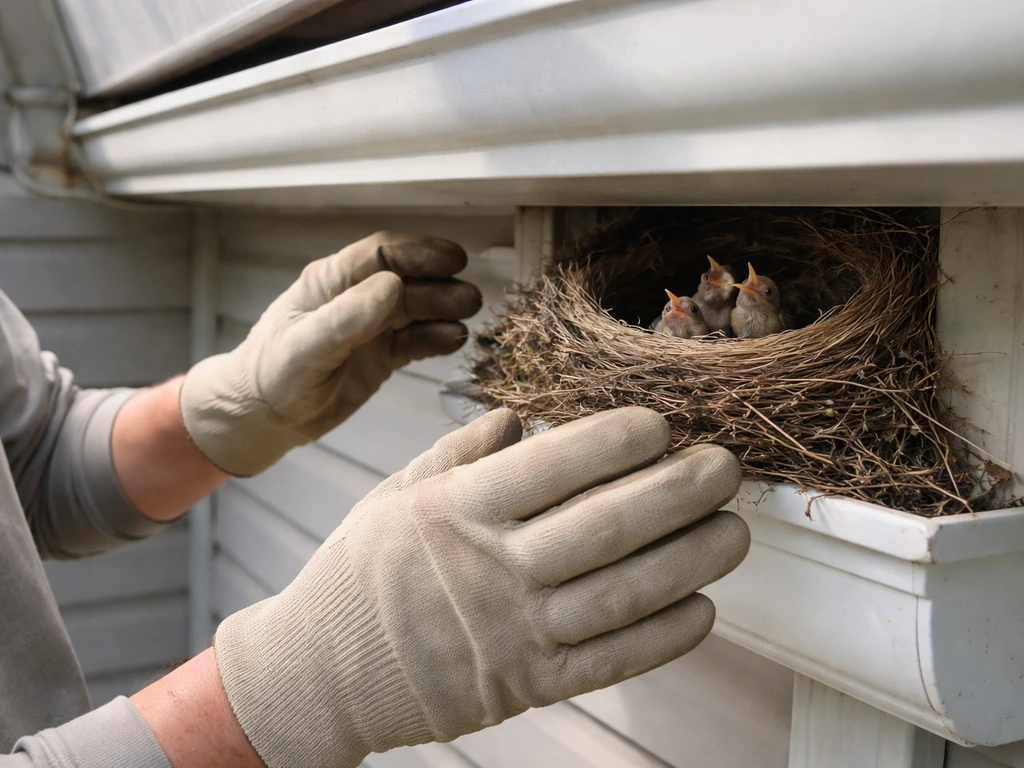
If you've just discovered an active nest in a bad spot (clogged gutter, blocked vent, right above a door), take a breath before doing anything. Removing it right now could put you in legal jeopardy and won't actually solve your problem long-term. Here's what to do in the first 24 to 48 hours.
- Stop and look before you touch anything. Check for eggs or chicks. If you see either, the nest is legally protected and must be left alone.
- Document the situation with photos, including the location, nest contents, and any structural damage or blockage it's causing.
- If the nest is blocking a vent or drain and causing an immediate safety or water-damage risk, call a licensed wildlife professional before taking action. FWS can issue emergency removal permits in genuine human health or safety situations, but that's the exception, not the rule.
- Temporarily redirect or manage the problem around the nest. For example, if a downspout is partially blocked, route a temporary drainage hose rather than disturbing the birds.
- Put on gloves and a dust mask if you must get close for inspection. Bird nests and droppings can carry histoplasma, salmonella, and mites.
- Mark the nest on a building diagram or photo map so you know exactly where to proof once it's inactive.
- Begin sourcing your exclusion materials now (netting, spikes, mesh, caulk) so you're ready to act the moment the nest goes inactive.
If the nest is in a chimney and you're not sure what species is using it, do not light a fire. Chimney swifts, which are federally protected, are a common chimney nester, and smoke can kill dependent young. Call a chimney service or wildlife professional first.
Assessing why they're nesting: inspection checklist
Birds don't pick spots randomly. They're looking for shelter from weather and predators, proximity to food and water, and a stable surface. Walk your building with this checklist to find every vulnerable point, not just the one you already know about.
- Eaves and soffits: look for gaps wider than half an inch where the soffit meets the fascia board.
- Gutters: check for debris buildup that creates a bowl-shaped depression, which sparrows and starlings treat as a ready-made nest cup.
- Roof vents and exhaust fans: confirm all covers are intact, hinged properly, and have no cracks or missing screens.
- Chimney openings: check whether a cap or spark arrestor is in place and in good condition.
- HVAC equipment on rooftops: look underneath and behind units for sheltered cavities.
- Signage and light fixtures: flat-topped or recessed signs and security cameras are prime ledge space.
- Balcony railings, beams, and overhead structures: pigeons and mourning doves favor horizontal surfaces with overhead cover.
- Window AC units: gaps around the sleeve or corroded outer housings create easy entry.
- Open loading dock doors and warehouse skylights: large openings that birds fly into and then can't exit.
- Standing water sources: birdbaths, HVAC condensate trays, clogged gutters, and flat roofs with poor drainage all attract nesting birds by supplying drinking water nearby.
After your walkthrough, rank every gap or ledge by urgency: active nest present, vacant but recently used, or never used but structurally vulnerable. That ranking drives your proofing priority list.
Humane, legal next steps during active nesting
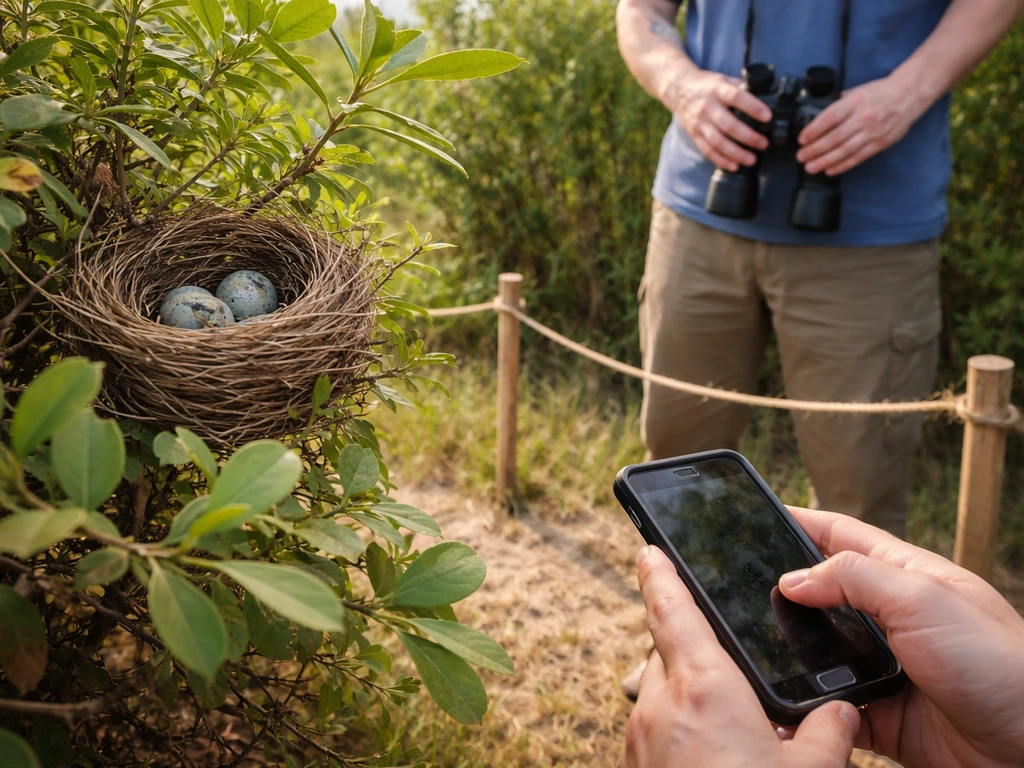
Under the MBTA, it is a federal offense to destroy, relocate, or tamper with a nest that contains eggs or chicks, or young that are still dependent on the nest, unless you hold a valid federal permit. To learn how to control bird population around your property without violating protected-wildlife rules, start with humane prevention and long-term exclusion destroy, relocate, or tamper with a nest.
This covers the overwhelming majority of migratory birds in the U. S. , including common species like robins, sparrows, swallows, wrens, and warblers. The full protected species list is codified in 50 CFR §10.
13. A few species, including European starlings, house sparrows, and feral pigeons, are not protected under the MBTA, which gives you more flexibility, but you still need to verify your local state rules before acting.
So what can you legally do while a protected nest is active? Quite a bit, actually, as long as you don't disturb the nest itself. If a species listed in 50 CFR § 10. 13 is using the nest, nest contents like eggs or part of that species are treated as a “migratory bird” under e-CFR definitions, which means they are protected under MBTA rules [“migratory bird” under 50 CFR § 10.
12 includes nest contents like eggs](https://www. law. cornell. edu/cfr/text/50/10.
12). Once you understand what you can do legally during active nesting, you can focus on balcony-specific prevention like proofing entry points and using exclusion materials after the nest becomes inactive stop bird nesting on your balcony. If birds are nesting in your reels or around a reel setup, the same exclusion and proofing steps can help you stop repeat nesting how to stop reel from bird nesting.
To learn more about how to prevent bird activity around your home, focus on the same kind of proofing and exclusion steps in every vulnerable area balcony-specific prevention.
- You can begin proofing every other gap and entry point on the building that is not immediately adjacent to the active nest.
- You can order and stage all your exclusion materials for immediate installation once the nest goes inactive.
- You can remove food and water sources that are attracting birds to the general area.
- You can install deterrents (visual or sound) at a reasonable distance from the active nest to discourage new nesting in adjacent spots.
- You can document the nest progress to estimate when it will go inactive. Most songbird nesting cycles run 4 to 6 weeks from egg-laying to fledging, after which the adults typically stop using the nest for that season.
Once you believe a nest has been abandoned or the young have fledged, don't rush. NestWatch advises waiting roughly four weeks from the last time you observed an adult at the nest before treating it as inactive. This buffer prevents you from accidentally disturbing a nest where adults are foraging away temporarily. Avoid checking nests near dusk, since females often return to roost for the night, which can make a nest appear active when the nesting cycle is actually over.
If you have a genuine health or safety emergency tied to an active nest, for example a nest blocking a critical exhaust vent in a commercial kitchen or a fire-code violation in a chimney, FWS can issue depredation permits. But these are not issued for routine nuisance situations. You'll need to document the hazard clearly and work through your FWS regional office or a licensed wildlife control operator who can apply on your behalf.
DIY exclusion and building-proofing
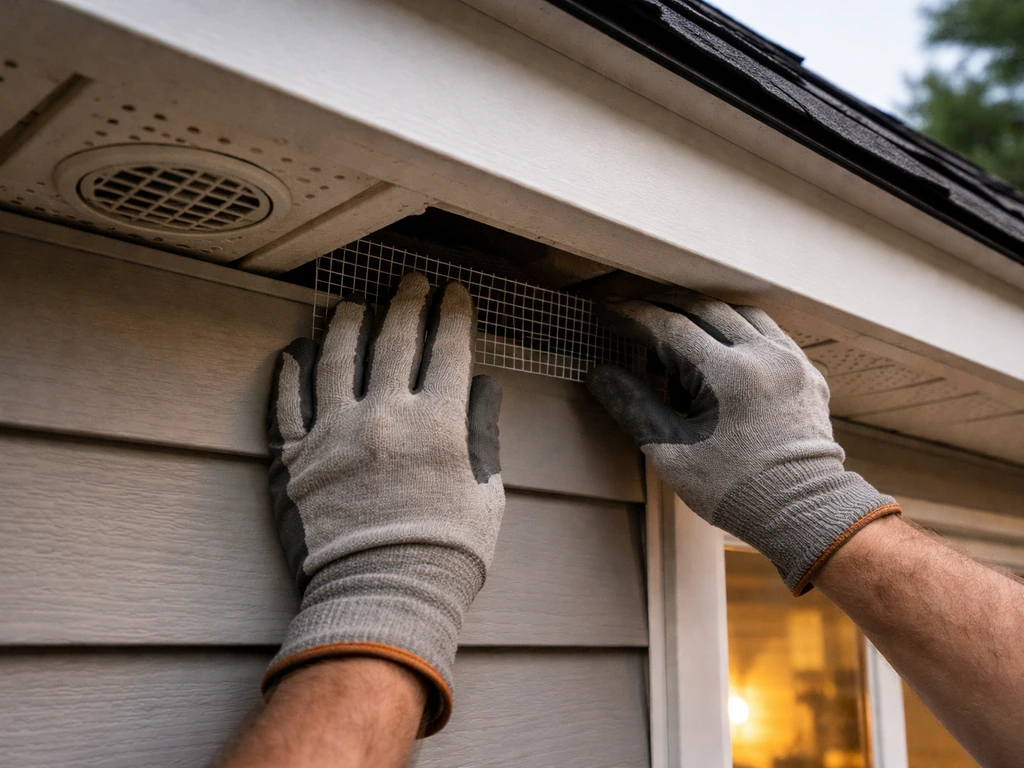
Physical exclusion is the most reliable long-term solution. Once a nest goes inactive, remove it promptly (wear gloves and a respirator), clean the area with a disinfectant spray, and then seal the gap before any bird scouts the spot again. Here's how to approach each common entry point.
Netting
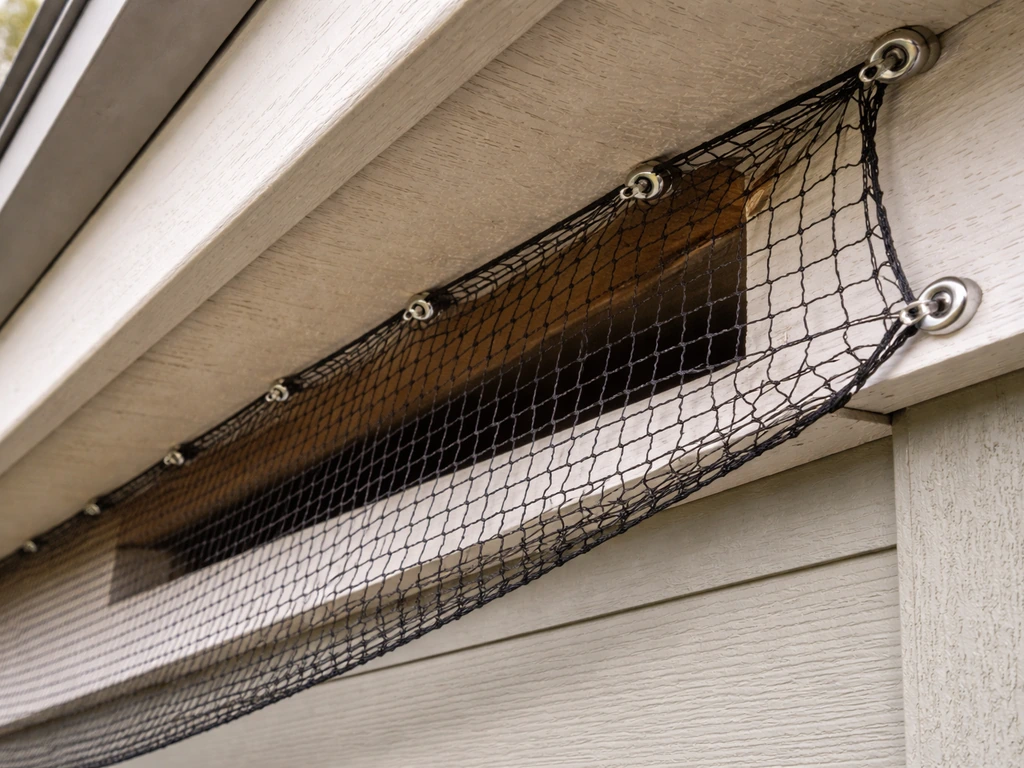
Exclusion netting is the go-to solution for large open areas like eaves, loading dock facades, rooftop equipment areas, and building facades with ornamental ledges. Use a polypropylene or knotted polyethylene netting with a maximum mesh size of half an inch (12.7 mm) to exclude birds of all sizes. Netting should be anchored tightly with no sag or gaps where birds can push through at the perimeter. A poorly installed net creates a trap, not an exclusion. If you're netting above a doorway or at height, use proper fall-arrest equipment or hire an installer.
Bird spikes
Stainless steel bird spikes are a non-lethal physical barrier that redirect birds from landing on ledges, parapet walls, pipe runs, and signage. They don't impale birds; they simply make the surface uncomfortable to land on. Install them with the spike base secured with multiple screws or adhesive approved for the substrate, and ensure continuous coverage with no gaps wider than a spike strip. For gutters specifically, gutter-point spike products are designed to sit inside the gutter channel and discourage nesting without impeding water flow. Follow the manufacturer's installation guide for spacing, since coverage gaps defeat the purpose.
Sealing gaps and vents
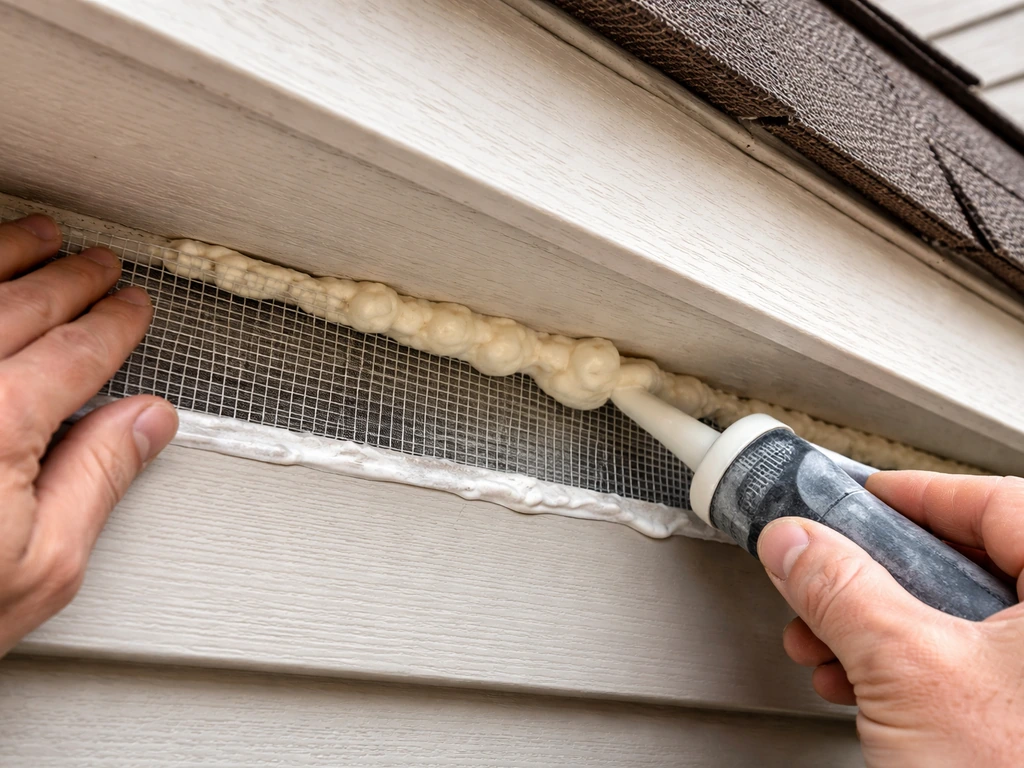
For gaps under eaves, around soffits, and along the roofline, use a combination of hardware cloth (galvanized 1/4-inch or 1/2-inch mesh), caulk or expanding foam for small crevices, and metal flashing for larger openings. For roof and exhaust vents, replace any damaged covers with louvered vent caps that have an integral wire mesh backing. For chimneys, install a chimney cap with a stainless steel wire mesh surround. Make sure the cap you choose doesn't inadvertently block chimney swifts if they're present, since they're federally protected. If chimney swifts are using your chimney, you must wait until they migrate in late summer before capping.
One-way exclusion doors
If birds have already established access to a void (an attic, a wall cavity, an enclosed eave) but haven't yet laid eggs, a one-way door or valve lets birds exit but not re-enter. Never install a one-way door when young are present inside, as it will trap them and kill them. Confirm the space is clear by watching the entry point over several days before installing.
Quick reference: proofing by location
| Location | Best exclusion method | Secondary method | Watch-out |
|---|---|---|---|
| Eave gaps and soffit edges | Hardware cloth or mesh stapled and caulked | Foam backer rod for narrow gaps | Check for active nests before sealing |
| Open gutters | Gutter guards or gutter spike strips | Regular cleaning to remove debris | Don't seal gutters shut; maintain drainage |
| Roof and exhaust vents | Louvered cap with wire mesh backing | Snap-on vent covers | Verify the vent still functions properly after capping |
| Chimney | Stainless steel chimney cap | Spark arrestor with mesh | Check for chimney swifts before capping |
| Flat ledges and parapets | Stainless steel bird spikes | Bird wire on posts | Ensure continuous coverage with no gaps |
| Large facades and eaves | Exclusion netting anchored to brackets | Netting draped over open areas | Inspect net perimeter monthly for gaps |
| HVAC units and rooftop equipment | Mesh panels around equipment base | Spike strips on top surfaces | Don't block airflow or access panels |
Deterrents that help vs deterrents that fail
Deterrents work best as a complement to physical exclusion, not a replacement. By themselves, most deterrents wear out their welcome quickly because birds habituate to them. Here's an honest breakdown.
What actually helps
- Reflective tape and flash tape: effective for a few weeks when first installed, particularly in open areas with wind movement. Rotate or reposition regularly to delay habituation.
- Predator decoys (owls, hawks): marginally useful if moved frequently (every few days). A stationary plastic owl does nothing after the first week.
- Chemical repellents (EPA-registered): methyl anthranilate and anthraquinone are EPA-registered avian repellents. Methyl anthranilate is a food-grade grape extract that irritates birds' mucous membranes and is sprayed on surfaces or turf. Anthraquinone affects birds' digestive systems and is used primarily on grain and turf. Both must be applied according to their registered label directions.
- Sonic deterrents using species-specific distress calls: devices that play recorded bird distress or predator calls can be effective in open areas like rooftops and agricultural settings. Effectiveness drops sharply in enclosed or partially enclosed spaces.
- Physical texture deterrents (post-and-wire systems): a grid of stainless steel wire strung 2 to 3 inches above a surface on posts creates an unstable landing platform. Effective on wide ledges where spikes don't cover enough surface area.
What doesn't work
- Ultrasonic devices: research reviewed by the National Academies found no apparent effect from commercial ultrasonic units on bird behavior. Birds don't hear in the ultrasonic range the way rodents do. Don't waste money on these.
- Shiny CDs or aluminum foil: same principle as reflective tape, but with no way to maintain or reposition them systematically. Birds figure them out within days.
- Gel repellents on ledges without maintenance: sticky gels can trap and injure small birds if applied too thickly, and they degrade in UV light and collect debris. If you use a gel product, follow label directions exactly and inspect monthly.
- One-time spray applications without reapplication: chemical repellents wash off in rain and lose potency. Without a reapplication schedule, they stop working.
The pattern with deterrents is the same across almost every category: they work through novelty, and novelty wears off. If you're going to use deterrents, build in a rotation or maintenance schedule from day one, and combine them with physical exclusion for anything that needs to last more than a season.
Seasonal prevention plan and maintenance schedule
Timing is everything with bird prevention. The best window to do your major proofing work is late fall and winter, after nesting season ends and before the next one begins. Most migratory birds in the continental U.S. begin scouting nesting sites in late February through March, with peak nesting running April through July. That means you have roughly October through January to seal, screen, clean, and prepare without worrying about disturbing active nests.
| Season / Month range | Priority tasks |
|---|---|
| October to December (post-nesting) | Remove all inactive nests. Disinfect and clean affected areas. Do a full building inspection and document all gaps. Begin sealing and exclusion work. |
| January to February (pre-nesting) | Complete all sealing and exclusion installations. Install spikes, netting, and vent caps. Remove food and water attractants. Check and repair gutter guards. |
| March to April (early nesting) | Monitor for new nest-building activity daily. Install or refresh deterrents in areas not yet proofed. Do not disturb any nest where eggs or chicks are present. |
| May to July (peak nesting) | Observe and document active nests. Stage materials for post-nesting proofing. Manage water and food sources. Avoid major building work near active nests. |
| August to September (late nesting and fledging) | Watch for fledging activity. Begin inspections as nests go inactive. Late migrants may still be nesting; continue monitoring before assuming inactivity. |
Beyond the seasonal calendar, set recurring maintenance tasks. Clean gutters twice a year (fall and spring). Inspect vent caps and chimney caps after every major storm. Walk the roofline and eaves quarterly to check for new gaps caused by weathering, woodpecker activity, or settling. Replace or reposition deterrents that show signs of wear or that birds are ignoring.
If you manage a facility with a flat roof, add a monthly rooftop walk to your maintenance log. Flat roofs accumulate debris that simulates a nesting substrate, and HVAC equipment creates sheltered microclimates that attract gulls, pigeons, and starlings year-round, not just in spring.
When to call a wildlife pro (and what to expect)
There are situations where DIY is the wrong call. Know when to escalate.
- You can't identify the species and aren't sure whether it's protected. Misidentifying a species and removing its active nest is a federal violation.
- The nest is in a location that requires work at height above one story, on a fragile or steep roof, or over live electrical equipment.
- You suspect birds have accessed an attic, wall cavity, or structural void and you need to determine the extent of the infestation before proofing.
- An active nest is causing a genuine health or safety emergency (blocked gas exhaust, fire risk) and you need to explore a permit for emergency removal.
- You're dealing with a large commercial or industrial building where the scale of exclusion work requires professional equipment and liability coverage.
- You've already tried DIY exclusion and birds have returned to the same spot within one season.
When you call a wildlife control operator or nuisance wildlife management company, look for someone who is licensed in your state, familiar with MBTA compliance, and willing to explain what they'll do before they do it. Good operators will conduct a site inspection, identify all species present, confirm nest activity status, and provide a written exclusion plan that includes a timeline based on nesting cycles.
Questions to ask before you hire anyone: Are you licensed for wildlife work in this state? Are you familiar with MBTA requirements and protected species identification? Will you provide a written scope of work before starting? What exclusion materials do you use, and do you provide a warranty on your work? Do you apply for permits when needed, or will that be my responsibility?
If a contractor immediately offers to remove an active nest for a flat fee with no mention of permits or species identification, that's a red flag. Legitimate wildlife professionals are trained in nest identification and MBTA compliance protocols, and they won't cut corners that expose you or them to federal liability.
One final note: wherever birds are getting into your building, there's almost certainly more than one entry point. If you’re dealing with that kind of bird behavior, use the guidance in our deep dive on how to stop droll and lock bird to choose the right prevention steps. Whether you're tackling the roof, a balcony, or a specific vent, treat the whole building as a system.
If birds are using your roofline as a nesting site, focus on sealing the entry points and using long-term exclusion methods designed for roof gaps how to stop bird nesting in your roof. Sealing one gap and leaving three others open just moves the problem. A complete site inspection, a clear priority list, and a seasonal maintenance habit are what actually solve this long-term.
FAQ
How can I tell if the nest is truly abandoned before I remove it? (Not just temporarily empty)
Not necessarily. A nest can look abandoned while an adult is away foraging. Use a time buffer, watch from a distance at least several days, and only proceed with removal or capping once you have no evidence of adults bringing food to the site.
Can I just use bird spikes or shiny tape to stop nesting right away on an active nest?
You should not use repellents as your primary control for a nest that might be active. Many deterrents lose effectiveness quickly, and disturbing birds while young are present can create a legal and animal-welfare risk.
What if the nest is blocking a vent, but it seems to be a one-time emergency, do I still need permitting?
If there are eggs or dependent young, routine “nuisance” rules do not override federal protected status in most cases. If you believe there is an urgent safety issue, you still need the right federal pathway, typically through FWS and documentation of the hazard.
Is it safe to install a one-way door to force birds out of an attic or wall cavity?
No. If young are inside an enclosed space, installing a one-way door can trap them and lead to death inside the structure. Confirm the space is clear by monitoring the entry point over multiple days before using exclusion devices that block re-entry.
Why does bird netting sometimes fail, even when it looks installed correctly?
It depends on the product and the species. Netting must fully cover the access area without sagging, and gaps at corners or at the perimeter can let birds enter. Also verify you are using mesh size and anchoring rated for the bird sizes you’re excluding.
Can I cap my chimney immediately if I suspect chimney swifts?
Yes, damaged or poorly matched chimney caps can block protected chimney swifts and other species. If swifts are present or suspected, wait until the appropriate migration window and coordinate the cap choice with a professional if you are unsure.
What personal safety steps matter most when cleaning up after nesting stops?
Wear gloves and a respirator, but also treat droppings and nesting material carefully during removal. Work when windows are open for ventilation, avoid dry sweeping, and disinfect surfaces afterward to reduce exposure to pathogens.
Is it legal to remove old nest material if I think the birds already left? (What counts as tampering)
Many “cleanup only” actions can still count as nest tampering if you remove or disrupt eggs, nest material, or dependent young. If you are uncertain about activity status, delay and confirm rather than starting with cleaning.
What should I do if I seal one gap and the birds keep coming back?
If you seal without excluding first, birds may continue to re-enter through other gaps or find the sealed spot after the young have fledged, causing repeat nesting. Prioritize finding and sealing all likely entry points as a system, then exclude.
How often should I inspect and repair exclusion materials to prevent repeat nesting?
Recheck after storms and after any roofline changes. Water and wind can open micro-gaps that birds exploit, so inspections should include gutters, under soffits, vent flashings, and around rooftop equipment mounts.
Can I combine deterrents with exclusion methods, and what’s the most common maintenance mistake?
Yes, but only after confirming the space is inactive. Also, avoid using deterrents that require ongoing power or constant replacement if you cannot maintain them, since novelty-based deterrents typically wear off.
When is DIY not the right approach for how to stop bird nesting on my property?
Yes for many minor exterior proofing tasks, but species identification and removal timing are where DIY often goes wrong. If you see eggs/chicks, protected species signs, or you cannot confidently determine activity status, escalate to a licensed nuisance wildlife professional.