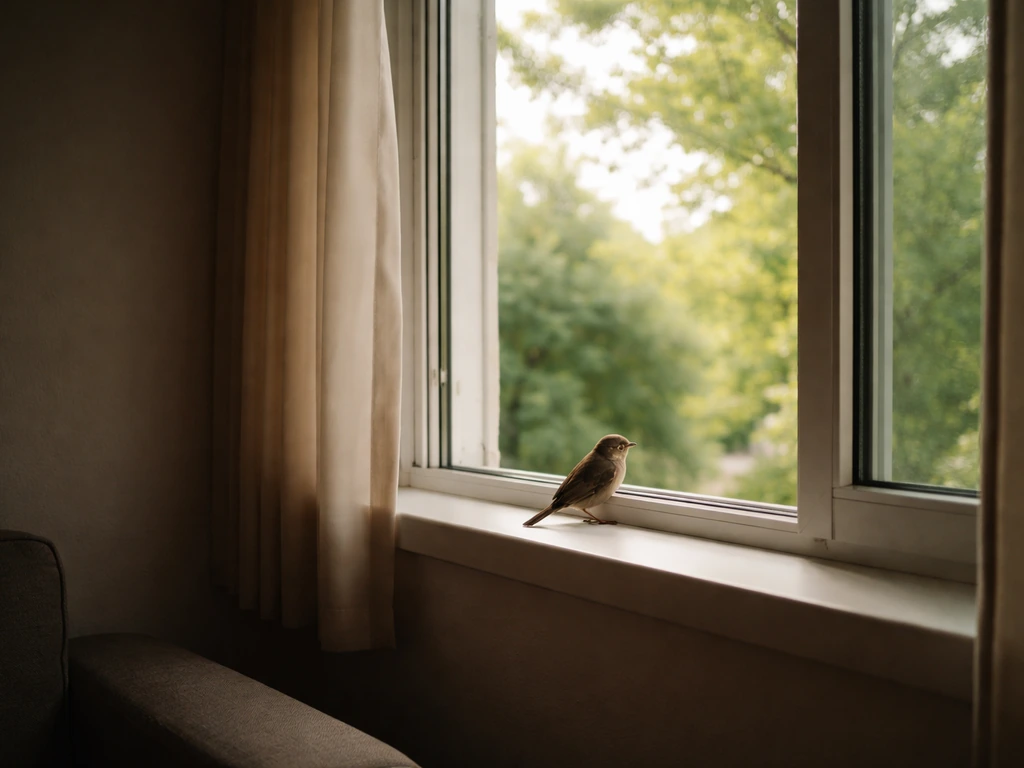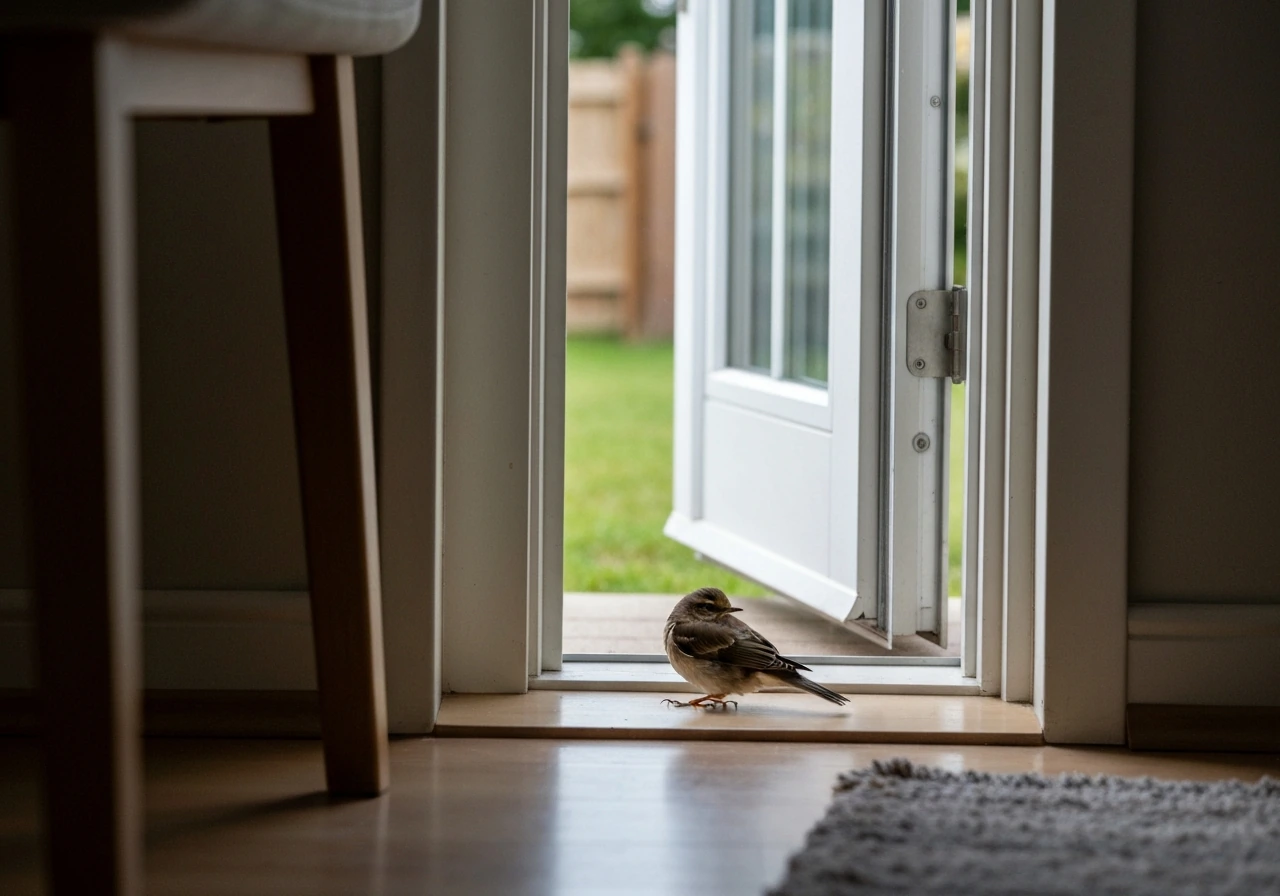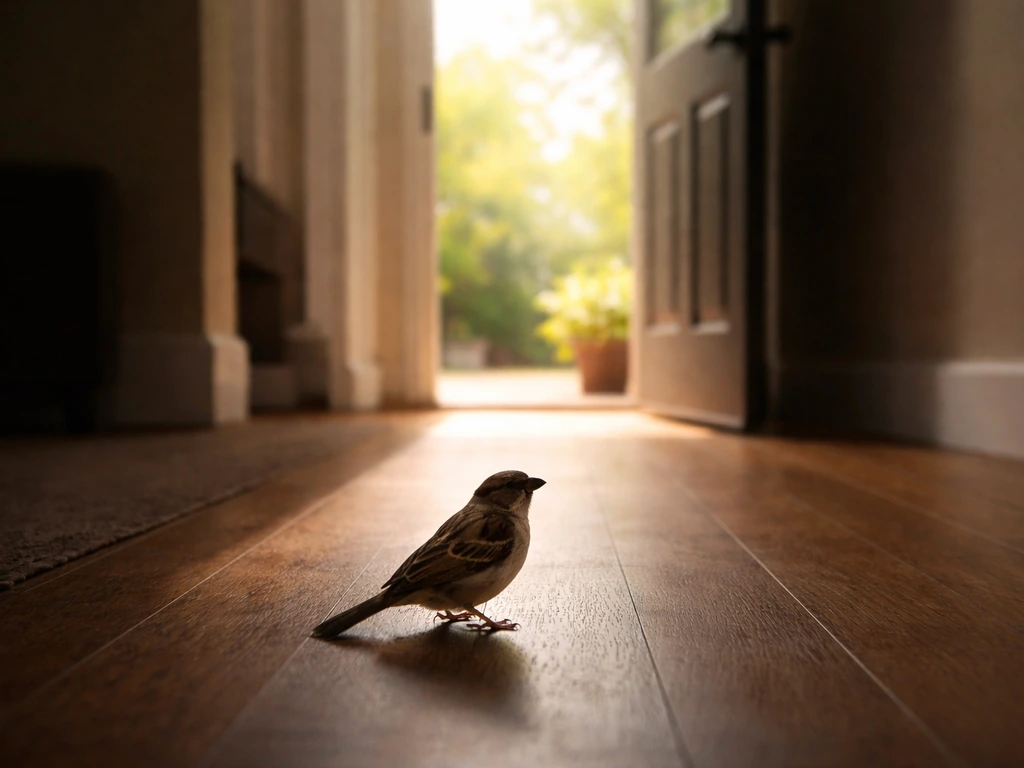
The fastest, most humane way to get a bird out of a warehouse is to open the largest exit you have, darken the rest of the building, and give the bird a clear, unobstructed path to the outside. That single combination solves the majority of warehouse bird incidents without any chasing, netting, or panic. Everything else in this guide builds on that core idea and handles the situations where it is not quite that simple.
How to Get a Bird Out of a Warehouse Safely and Humanely

Maya Carver
22 Apr 2026
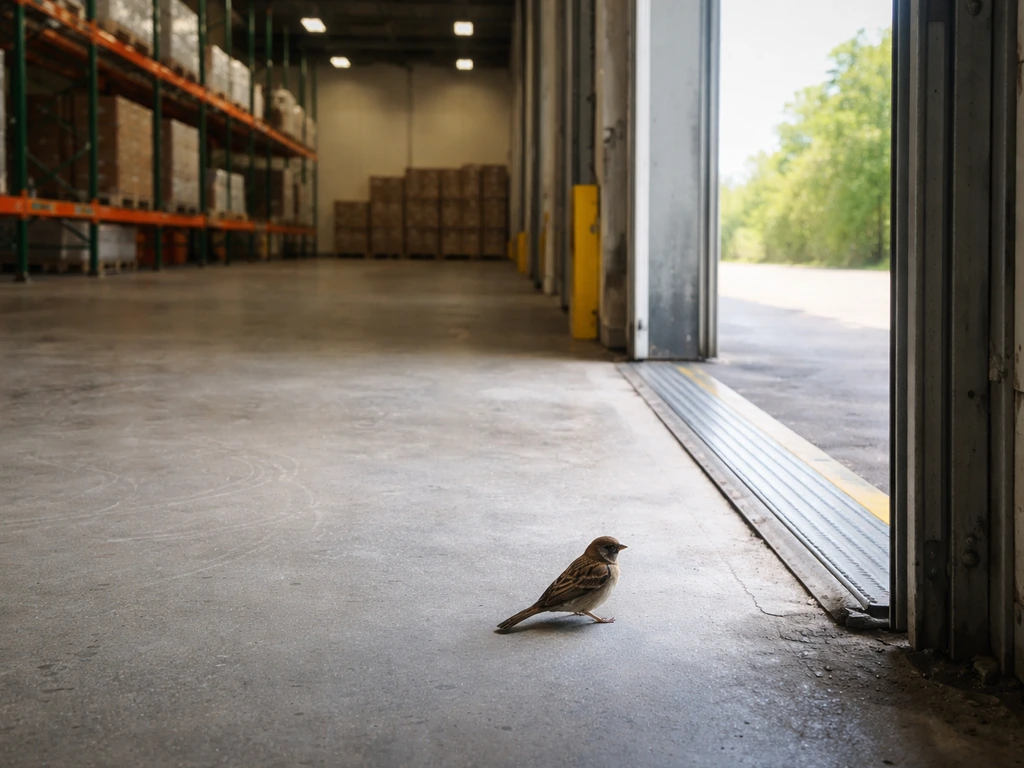
Immediate safety and humane triage
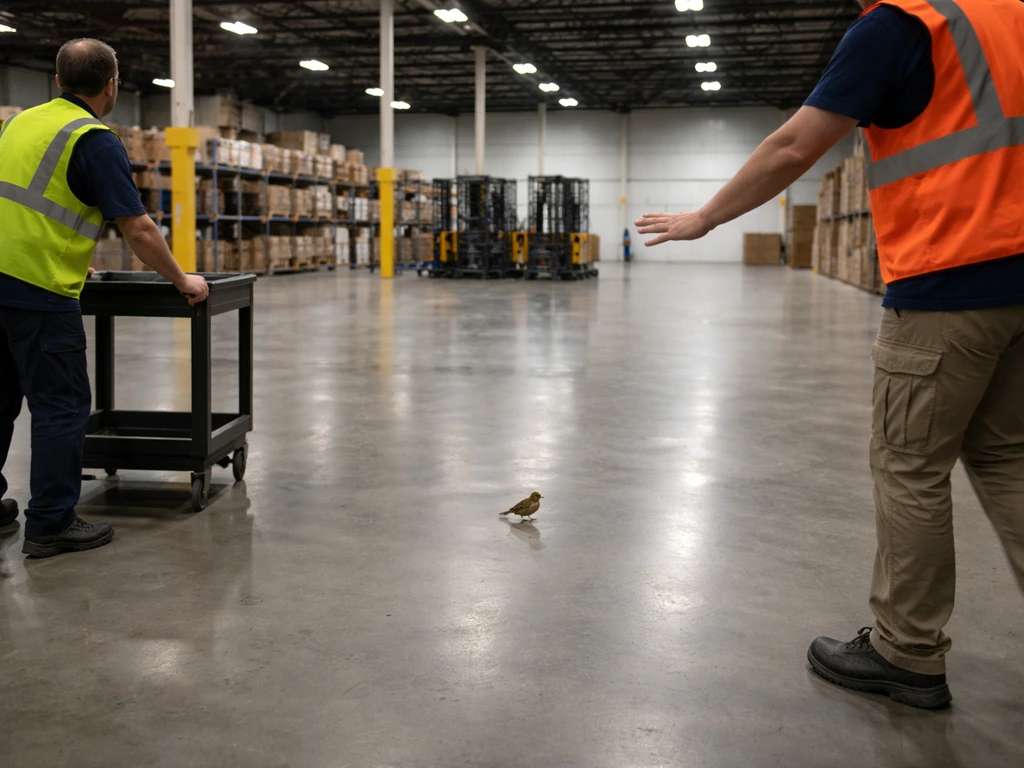
Before you do anything else, stop and take 60 seconds to assess. A panicking bird flying at speed in a warehouse full of racking, forklifts, and overhead equipment can injure itself badly, and staff trying to chase it can injure themselves too. Your first job is to slow everything down.
- Clear the area: ask staff to move away from the bird's flight path and keep the space as quiet as possible. No shouting, no sudden movements.
- Secure pets or any pest-control animals immediately.
- Put on safety glasses if the bird is a larger species (pigeons, gulls, raptors) that might scratch or peck when cornered.
- If the bird has hit a window or wall and is sitting still on the ground, do not assume it is fine. Treat it as potentially injured until proven otherwise.
- Do not chase, clap, or use brooms to herd the bird. This causes exhaustion and injury and usually just drives the bird higher into the roof structure.
- Note roughly where the bird is, what species it appears to be, and whether there are signs of a nest or multiple birds. This information matters for everything that follows.
A quick species check is worth doing now. Starlings, house sparrows, pigeons, and feral pigeons are non-protected in most US states and the UK, and you have more flexibility in how you handle them. Native songbirds, swallows, swifts, raptors, and most other wild birds are protected under the Migratory Bird Treaty Act in the US (and equivalent legislation in the UK and elsewhere). Harming them, handling them unnecessarily, or disturbing an active nest can carry real legal penalties. If you are not certain what you are dealing with, treat the bird as protected until you know otherwise.
Find the bird and identify the real problem
In a large warehouse, a bird can disappear quickly into roof trusses, mezzanine levels, or behind racking. Before you set up exits, you need to know where the bird actually is and, more importantly, how it got in. Those are two different problems, and solving only one of them means you will be back here tomorrow.
Walk the perimeter quietly and look up. Birds in a warehouse almost always head for the highest lit point: a skylight, a roof vent, a clerestory window, or daylight coming through a damaged panel. That is your first search area. Once you spot the bird, mark the general zone and resist the urge to approach it closely.
Now look for the entry point. Common entry points in warehouses include: loading dock doors left open for extended periods, damaged or missing roof vent covers, gaps around HVAC penetrations, broken or missing soffit sections, and gaps at the ridge line or around roller-shutter seals. If you can identify the entry point, you can also make it an exit point, which is the most reliable removal method available. If you need a more direct checklist, follow the steps in this guide to stop the bird from re-entering and remove it humanely from the warehouse bird in warehouse how to get rid of.
Two scenarios that need different approaches
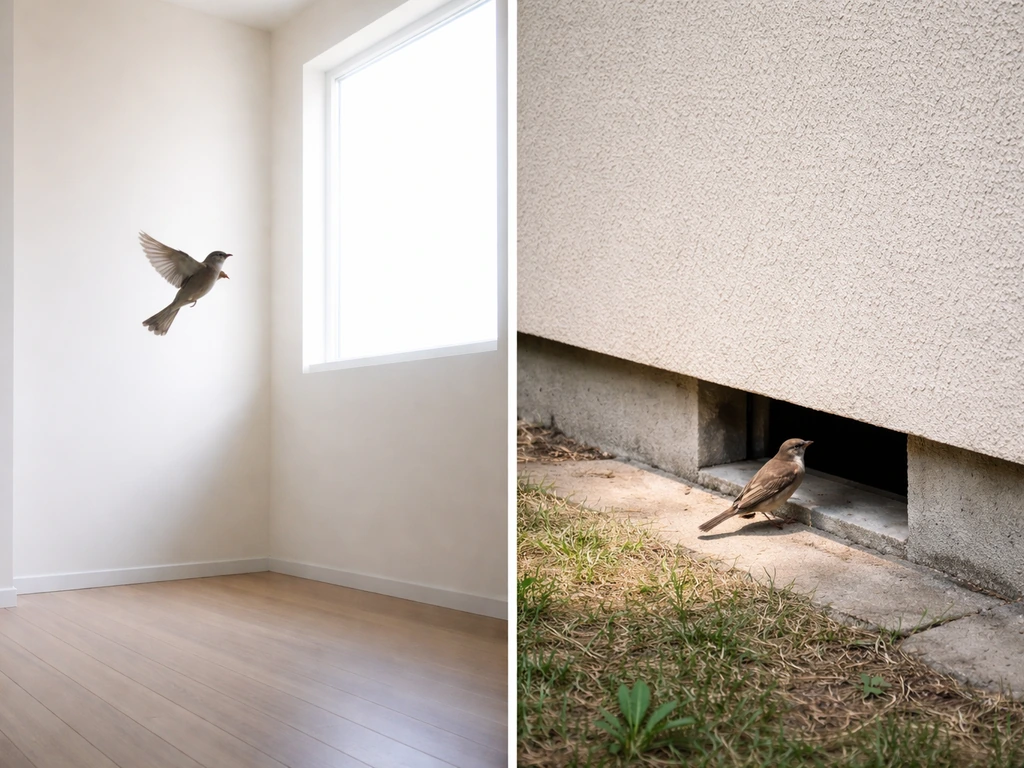
Scenario one is an escape-route problem: the bird can physically get out but cannot find the exit because it keeps flying toward light sources that are not exits. If you are dealing with a tricky escape-route or access problem, the same principles are covered in how to lure a bird out of a warehouse as an adjacent option escape-route problem. This is by far the most common situation. The fix is managing light and opening the right doors.
Scenario two is an access problem: the bird got in through a gap or vent too small for it to recognize as an exit, or it is physically trapped behind equipment or inside a void. This needs a more hands-on approach and sometimes professional help. Identifying which scenario you are in before you start saves a lot of wasted effort.
Step-by-step emergency removal
Run through these steps in order. Each step builds on the one before, so do not skip ahead.
- Open your largest exit toward the bird. A full loading dock door or a large roller shutter is ideal. The opening needs to be big enough that the bird can see daylight clearly from inside the building. Position this exit on the same side of the warehouse as the bird if possible.
- Turn off all interior lights in the bird's zone, or in the entire warehouse if you can safely do so. The San Diego Humane Society specifically recommends making the building as dark as possible because birds are strongly attracted to light and will fly toward it. If all artificial light is off and daylight is only coming through your open exit, the bird will orient toward that exit naturally.
- Cover or block skylights and other windows that are not exits. Use tarps, heavy curtains, or even cardboard temporarily. The RSPCA advises drawing curtains over closed windows for exactly this reason. You are removing competing light sources so the open exit becomes the only obvious target.
- Step back and wait quietly. Give the bird at least 15 to 20 minutes with the exit open and the lights down. In most cases this is enough. Resist the urge to intervene.
- If the bird is not moving toward the exit, position one person very slowly and quietly on the far side of the bird from the exit, at a distance of at least 10 to 15 meters. Stand still. Your presence alone provides gentle, passive pressure that can encourage the bird to move toward the open door without causing a panic flight.
- If the bird is resting low, you can try to use a large cardboard box to calmly guide it toward the exit. Hold the box flat and move it slowly and steadily. Never use a net unless you are trained to do so, as birds can be badly injured by improper netting.
- Once the bird exits, close the door immediately to prevent re-entry, then address the original entry point before reopening.
One thing worth emphasizing: patience is your most effective tool here. Most birds will find a large, well-lit exit within 30 minutes if you have removed the competing light sources and kept the space quiet. The situations that drag on for hours are almost always ones where people kept trying to chase the bird or left too many competing light sources open.
Troubleshooting the tricky situations
The bird is stuck in a high area or roof structure
This is the most common complication in warehouses specifically because of the height of the roof structure. A bird that has retreated into trusses at 10 or 12 meters is very difficult to reach safely. Do not attempt to access heights above what your facility's safe working at height protocols allow. The light management approach still applies here: darken the space, open the largest exit nearest to the bird's position, and wait. Birds roosting in roof structures will typically come down to fly when they get hungry or thirsty, so an exit that remains open and lit from outside, while the interior is dark, will usually work within a few hours.
The bird is stuck behind racking or equipment
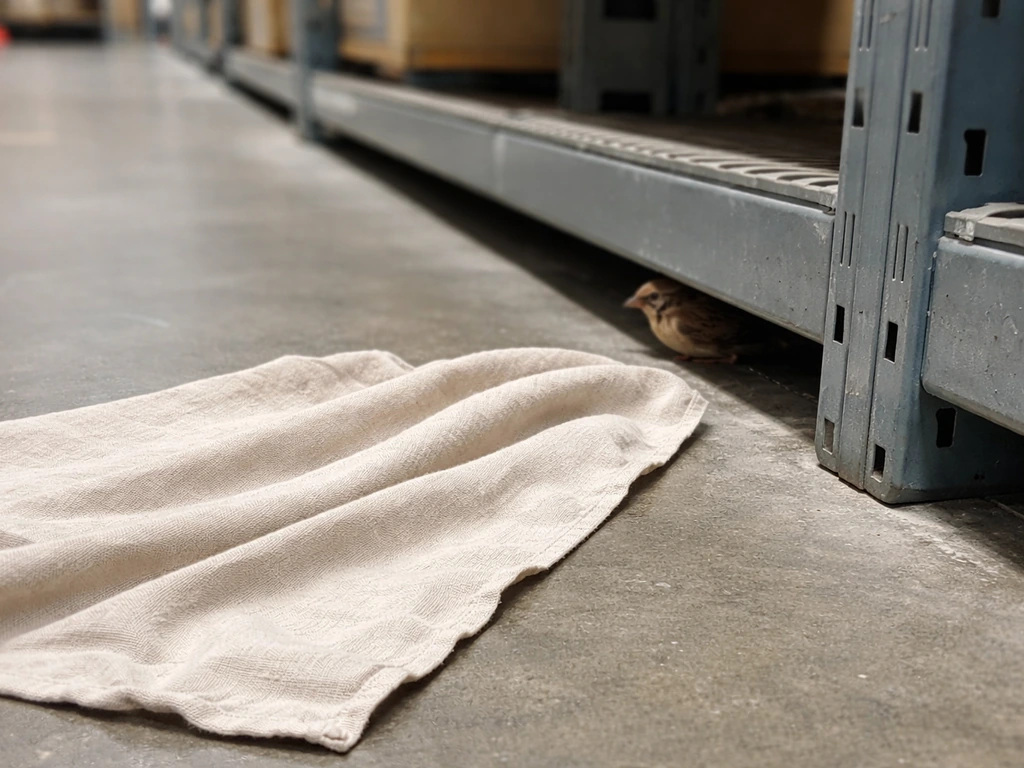
If the bird is on the ground or a low shelf and physically wedged in, approach slowly and cover it with a lightweight cloth or towel. A covered bird will usually calm down within seconds. Once covered, gently wrap the bird and carry it directly to the open exit. If you need a practical refresher on how to catch a bird in a store, focus on getting the bird to the open exit without chasing it. Release it outside by placing it on a surface (not throwing it into the air) and stepping back. Wash your hands thoroughly afterward.
Multiple birds
Multiple birds usually mean either a flock came through an open dock door together, or you have a nesting or roosting situation that has been building for a while. For a small flock, the same light-management approach works but takes longer and benefits from having two or three open exits rather than one. For an established roosting situation with many birds, you are no longer in emergency-removal territory. This is a pest management and exclusion project that needs a professional plan. Trying to chase out a large roost without exclusion in place just means they come back the same night.
The bird appears injured
Signs of injury include: sitting on the ground and not flying away when approached, one wing held lower than the other, blood visible on feathers, or the bird moving in circles. San Diego Humane Society’s “Windows and Birds” guidance also recommends examining the bird for injuries to the head or wings before deciding on next steps.
If a bird appears injured, do not attempt to remove it yourself unless it is in immediate danger (for example, in an active forklift aisle). Cover it gently with a cloth, place it in a ventilated cardboard box with air holes, and keep it in a dark, quiet place. Contact your nearest wildlife rehabilitator or humane society immediately.
The San Diego Humane Society’s blank" rel="noopener noreferrer">Wildlife Help Hub provides guidance for found wildlife, including whether an animal needs intervention, where to drop it off, and an emergency assistance phone number Contact your nearest wildlife rehabilitator or humane society immediately. Injured protected birds must be handed to a licensed rehabilitator, not released or left.
The bird is roosting inside overnight
If a bird has been inside for more than a day, it may have started to use the warehouse as a regular roost. The best window for removal is early morning, just after sunrise, when the bird is active but before it has settled into its daytime pattern. Open exits before full daylight and darken the interior. If the bird keeps returning at night through an identified entry point, that entry point must be sealed before you can solve the problem permanently.
You find a nest or eggs
This changes everything. Active nests of most wild birds are legally protected in the US under the Migratory Bird Treaty Act and in the UK under the Wildlife and Countryside Act 1981. You cannot remove, damage, or disturb an active nest (one containing eggs or chicks) without a permit. Do not touch it. Cordon off the area if you can and call a licensed wildlife professional. Even non-protected species like feral pigeons and starlings have nests that require careful management to avoid health and compliance issues.
When to stop DIY and call a professional
Most single-bird incidents in a warehouse can be resolved with the steps above in under an hour. But there are clear situations where you should stop and get professional help rather than continuing on your own.
- The bird is injured or clearly unwell.
- You have found an active nest with eggs or chicks.
- The bird is a protected or rare species you cannot confidently identify.
- There are more than a handful of birds and signs of an established roost.
- Safe access to where the bird is located requires working at height beyond your facility's protocols.
- You have tried the steps above for several hours without success.
- The bird keeps returning after multiple removals, indicating an entry point you cannot locate or safely seal.
- There are health and safety concerns such as significant droppings accumulation (which can carry Histoplasma or Cryptococcus fungi), feathers in food storage areas, or contamination of product.
When you call a wildlife professional or pest management company, give them the following information upfront: approximate species if known, number of birds, how long the situation has been going on, whether there is a visible nest, the size and layout of the building, and any entry points you have already identified. This helps them come prepared and keeps costs down.
Long-term prevention and warehouse proofing
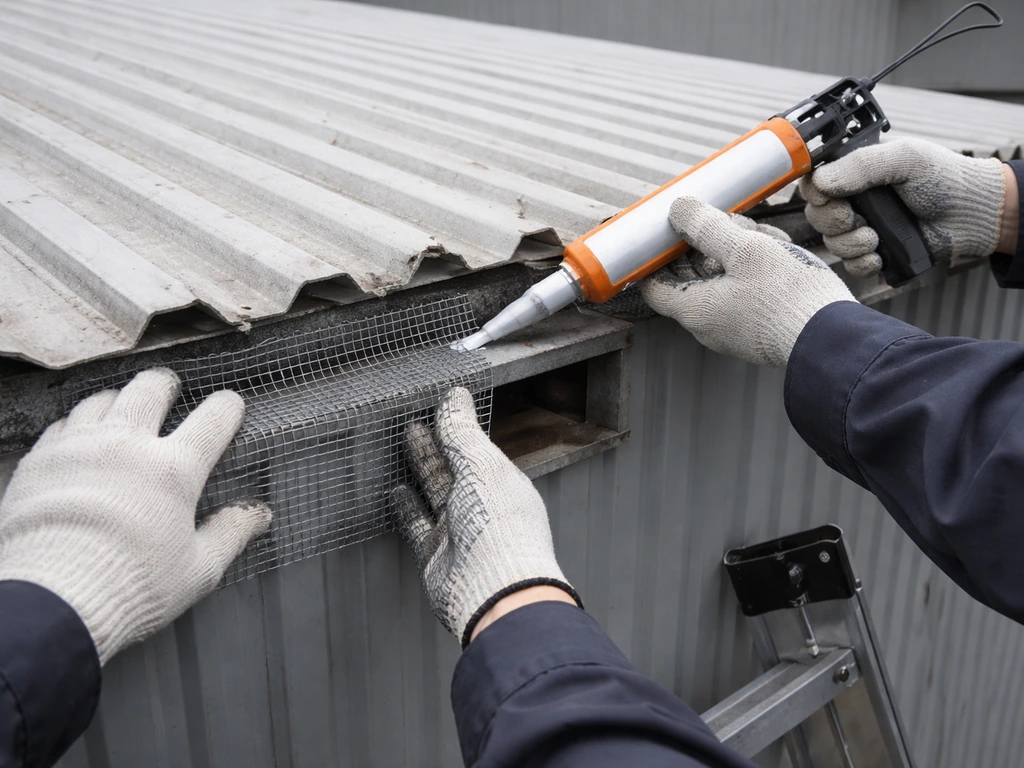
Getting the bird out today is only half the job. Warehouses are attractive to birds because they offer shelter, warmth, height for nesting, and often easy access to food and water near loading areas. Without proofing, this will happen again. Here is a practical checklist you can work through systematically.
Seal and screen entry points
- Inspect the full roofline and ridge for gaps, missing flashing, and damaged panels. Any gap larger than roughly 2.5 cm (1 inch) is a potential bird entry point for smaller species.
- Fit bird-proof covers or grilles over all roof vents, HVAC penetrations, and ridge vents. Use heavy-gauge galvanized steel mesh with openings no larger than 19 mm.
- Install brush or rubber seals at the bottom of all roller shutter and sectional doors to eliminate the ground-level gap.
- Fit screen doors or mesh curtains at pedestrian doors that are regularly left open.
- Consider installing air curtain units at frequently used personnel access points. These create a continuous airflow barrier that discourages bird entry without blocking movement of staff or equipment.
Remove attractants
- Keep loading dock areas clean of spilled grain, seeds, or food product. Even small amounts of spillage attract birds, which then discover the open dock door.
- Ensure dumpsters and waste compactors have tight-fitting lids that stay closed when not in use.
- Fix standing water issues in and around the building. Flat roofs with poor drainage, puddles near loading areas, and open drains all attract drinking and bathing birds.
- If you have a canteen or break area near loading doors, manage waste disposal carefully.
Manage interior lighting
Skylights and roof windows that are illuminated at night act as beacons for birds navigating by light. Consider fitting UV-reflective window film on skylights, which is invisible to humans but visible to birds as a barrier. For exterior lighting, direct lights downward rather than upward or outward to reduce the attraction effect on birds flying at night.
Physical deterrents for roosting areas
- Fit anti-roosting spikes or coils on ledges, beams, and structural members at roof level where birds tend to land and nest.
- Stretch parallel tensioned wire systems (also called post-and-wire systems) across wide ledges to prevent larger birds like pigeons and gulls from landing.
- Hanging reflective tape or predator decoys can provide short-term deterrence but lose effectiveness quickly as birds habituate. Use them only as a supplement to physical exclusion, not as a standalone fix.
Seasonal maintenance schedule
Bird pressure on warehouses changes through the year. Spring (March to June in the northern hemisphere) is peak nesting season and the highest-risk period for birds entering to nest in roof voids. Late summer and autumn bring large flocks of migratory birds that may shelter overnight. Winter pushes birds to seek warmth, increasing roost pressure. Build inspection and maintenance around these patterns.
| Season | Key risk | Action |
|---|---|---|
| Late winter (Feb-Mar) | Birds scouting nesting sites | Full perimeter inspection, seal any new gaps before nesting begins |
| Spring (Apr-Jun) | Active nesting, peak entry attempts | Check all exclusion measures are intact, increase dock door discipline, no gap sealing if active nest present |
| Summer (Jul-Aug) | Fledglings dispersing, second broods | Inspect mesh and screens after any storms or deliveries that may have disturbed them |
| Autumn (Sep-Nov) | Migratory flocks, roost establishment | Check and refit door sweeps and brush seals, inspect roof vents before birds settle for winter |
| Winter (Dec-Jan) | Roost pressure from cold weather | Maintain interior cleanliness, check air curtains are functioning, report any roost signs early |
Legal and safety notes you should not skip
In the United States, the Migratory Bird Treaty Act protects most native wild bird species, their nests, and their eggs. Intentionally harming, killing, or disturbing a protected bird or its active nest without a federal permit is a federal offense. This includes many species that commonly enter warehouses, such as swallows, swifts, house finches, and various sparrows. Feral pigeons (rock doves), European starlings, and house sparrows are exempt from federal protection in the US, though some state laws apply. In the UK, all wild birds are protected under the Wildlife and Countryside Act 1981 unless a specific general or individual license applies.
From a health and safety standpoint, accumulated bird droppings present a genuine respiratory hazard. If you are cleaning up after a prolonged roosting incident, wear an FFP3 or N95 respirator, disposable overalls, and gloves. Dampen droppings before sweeping to avoid disturbing dried spores. Significant accumulations should be handled by a specialist cleaning contractor. For warehouses storing food or pharmaceutical products, any bird incursion should be documented as part of your site's pest management records, especially if you operate under food safety standards such as BRC or SQF.
Your immediate next steps
If you have a bird in your warehouse right now, work through this in order: clear the area and reduce noise, open the largest exit nearest the bird, blank" rel="noopener noreferrer">turn off all interior lights and block competing light sources, step back and wait 20 minutes. After you have the right exit open, you can apply the same humane capture principles to situations like how to catch a bird in a warehouse. That handles the majority of cases. If the bird is injured, call a wildlife rehabilitator now and do not wait. If it is not out within an hour despite the correct setup, reassess whether this is a scenario that needs professional help.
Once the immediate situation is resolved, schedule a full perimeter inspection within the next week to identify and seal entry points before another bird gets in. The prevention checklist above is the starting point for that inspection. Warehouses that experience repeated bird incidents almost always have an unaddressed entry point combined with an attractant, and fixing both together is what breaks the cycle for good.
For related situations, the approach for getting a bird out of a retail store or a shed follows the same core principles but involves different scale and access considerations. For related situations, the approach for getting a bird out of a retail store or a shed follows the same core principles but involves different scale and access considerations how to get a bird out of a shed. This is similar to the techniques people use to catch a bird in a store, but warehouse layouts and entry points can make the process take a different amount of effort get a bird out of a retail store. If you are dealing with birds in multiple building types on a single site, it is worth developing a site-wide bird management plan rather than handling each incident individually.
FAQ
Can I temporarily trap the bird until I set up the exits, or will that make things worse?
Yes, but only as a short-term, humane stopgap. If the bird is on the ground and you can’t safely reach the open exit setup yet, covering it with a lightweight cloth and gently containing it prevents panic-flight and collisions. Do not hold it tightly, and release it directly at the open exit once the area is calm and exits are managed.
What should I do if I cannot find where the bird is in the warehouse?
Avoid immediate chasing. If you can’t identify the bird’s position, start with light management and perimeter scanning (look up, not from directly under the bird). Repeated staff movement and noise often pushes birds deeper into trusses or behind racking, which increases access risk.
The bird keeps flying around high up, but I cannot spot it. How do I proceed?
If you hear wingbeats but cannot locate the bird, wait for brief quiet windows, then walk the perimeter quietly and look up again. If it reappears near a skylight or roof vent, treat that area as both a likely entry and escape route, then open the nearest appropriate exit to match the bird’s likely orientation to light.
Are there any methods I should never use to get a bird out of a warehouse?
Do not use glue traps, poisons, nets, or hooks, and avoid grabbing the bird. Those methods increase injury risk, can cause frantic thrashing, and can create legal or compliance problems if the species is protected. Cloth covering and guiding it to the exit is safer and more humane for most non-injured birds.
What changes if there are multiple birds, not just one?
If multiple birds appear to share the same space, open more than one exit if you can. A single exit can still work, but birds may split, and some may keep aiming for competing light sources. If birds are already roosting in different roof zones, plan on longer time and, for large groups, involve pest management.
How dark should the warehouse be, and should I also turn off exterior lights?
Turning off interior lights is mainly about reducing competing cues. You still want the outside side to be clearly reachable through the open exit. If you turn off lights everywhere but keep the open exit area unlit or blocked by foot traffic, birds may not orient correctly.
If it’s been an hour, when is it time to stop and call for help?
A practical rule is to reassess within about an hour if the bird is not responding to correct exit and light setup. At that point, the issue is often either the wrong exit is open, the bird is trapped behind equipment or in a void, or an access gap needs to be physically addressed by professionals.
How can I tell whether it’s an escape-route problem or an access problem without taking risks?
Yes, and it helps decide what to do next. Use the observed behavior and location: a bird that keeps moving toward brighter roof or window areas usually needs escape-route management, while a bird that cannot reach an exit at all or is wedged behind equipment may require access intervention. If you suspect a nest or eggs/chicks, stop and call a licensed wildlife professional immediately.
What should I do if I suspect there’s a nest inside, even if I don’t see eggs?
If you find evidence of nesting (straw, droppings concentrated at one spot, repeated returning birds, eggs or chicks), do not attempt removal or sealing around the nest while active. In that case, cordon off the area if possible and contact a professional for a permitted, staged exclusion plan.
Once it’s gone, what’s the most important part of prevention to do first?
After the bird is out, schedule sealing and exclusion soon, ideally within the next week as a prevention step. Focus on specific entry points you can confirm (roof vents, HVAC gaps, dock door seals, soffit gaps, ridge-line gaps). Sealing only the most obvious hole is a common reason birds return.
If the bird looks injured, can I release it anyway after it calms down?
If the bird is protected and injured, keep it covered and in a ventilated, dark, quiet container, then contact a wildlife rehabilitator right away. Do not release it outdoors yourself, because injured birds can worsen and may not survive. Also avoid feeding unless the rehabilitator instructs you.
What’s the safest way to clean up droppings in a warehouse?
For clean-up after a prolonged roost, avoid dry sweeping. Dampen droppings before removal, wear appropriate respiratory protection and gloves, and isolate the cleanup area to prevent spreading dust through HVAC or traffic lanes. If the accumulation is extensive or near sensitive product areas, use a specialist cleaning contractor.
If the warehouse stores food or pharmaceuticals, do I need to document the incident even if the bird leaves?
If you are in food or pharmaceutical storage, document the incident as part of your pest management records and review whether current cleaning and sanitation steps were sufficient. Even after the bird is removed, you may need enhanced inspection of droppings, potential contamination zones, and entry-point maintenance before resuming normal audits.
The bird was out once, but it keeps coming back. What should I change?
For birds that keep returning at night, the timing is an exclusion clue. Open exits and darken the interior during a controlled daytime period, then seal the identified entry point before the next active period. Otherwise, you may successfully remove birds today but still keep attracting new arrivals at night.