If there are no eggs or chicks in the nest, you can remove it today, legally and safely. If there are eggs or live young inside, you cannot legally remove it under the Migratory Bird Treaty Act (in the US) or Canada's Migratory Birds Regulations, and you'll need to wait until the birds have fledged. That single question, active or not, drives every decision in this guide. Here's how to figure it out and what to do next.
How to Get Rid of Bird Nest on Porch Safely

Maya Carver
24 Apr 2026
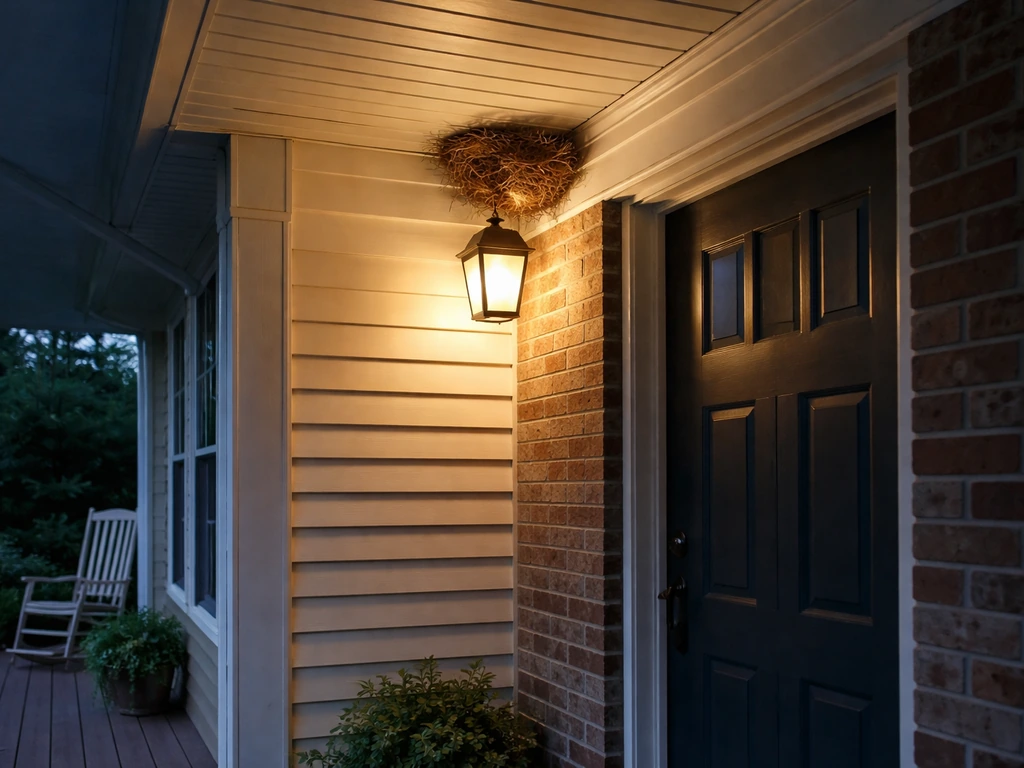
Quick safety check: is the nest active?
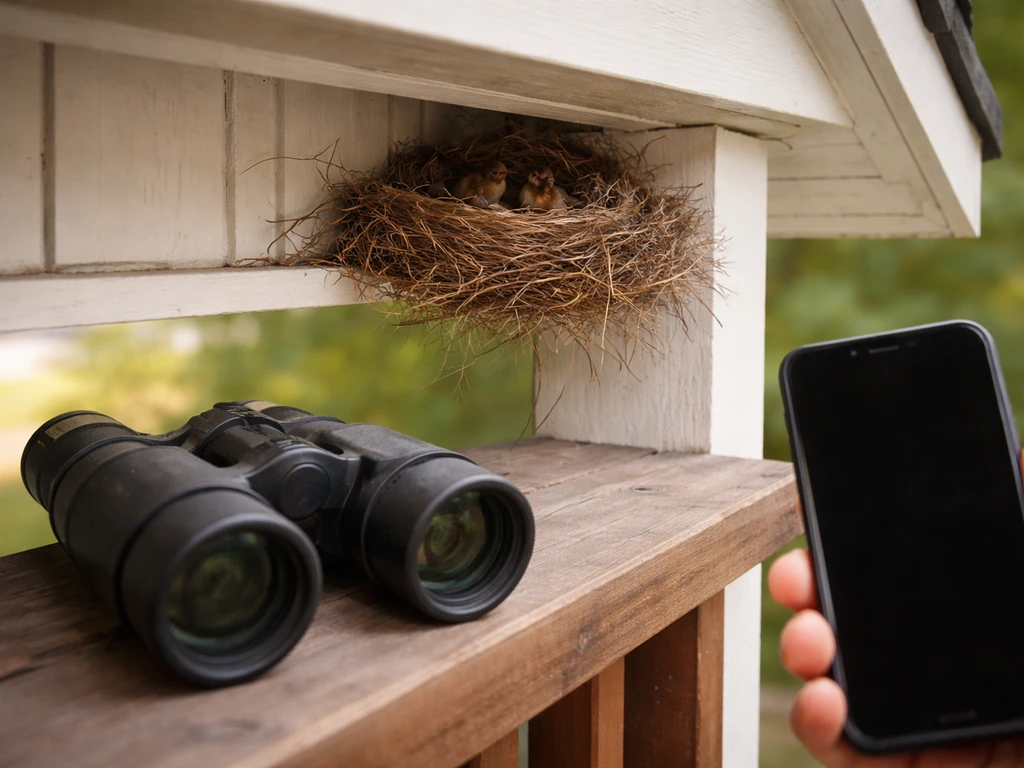
An "active nest" is any nest that currently contains eggs, live chicks, or young birds that still depend on the nest for survival. It stays active through fledging, not just hatching. That matters because parents often leave the nest for long stretches while foraging, especially during incubation. A female songbird may visit only once a day early in the incubation period, so not seeing a bird for an hour or two means nothing.
Before you touch anything, take a slow look from a safe distance. Use binoculars if you have them. You're looking for:
- Eggs or chicks visible inside the nest
- An adult bird sitting in or returning to the nest
- Fecal sacs being carried away (a clear sign of active chick-rearing)
- Parent birds flying in with food
- Fresh nest material added recently (new grass, feathers, or moss on top)
If you see any of those signs, the nest is active. Do not disturb it. If you're not sure, observe for several days. NestWatch recommends waiting a full four weeks after the last confirmed adult sighting before calling a nest abandoned, because eggs have hatched long after monitors assumed otherwise. One visit is not enough data.
If the nest is clearly old, dry, collapsed, and has shown no activity over multiple observation sessions spread across several days, it is almost certainly inactive. That's when you can act.
What to do right now
Your immediate actions depend on what you found in the safety check above. Here's how to handle each scenario:
Nest is inactive (no eggs, no chicks, no adult activity)
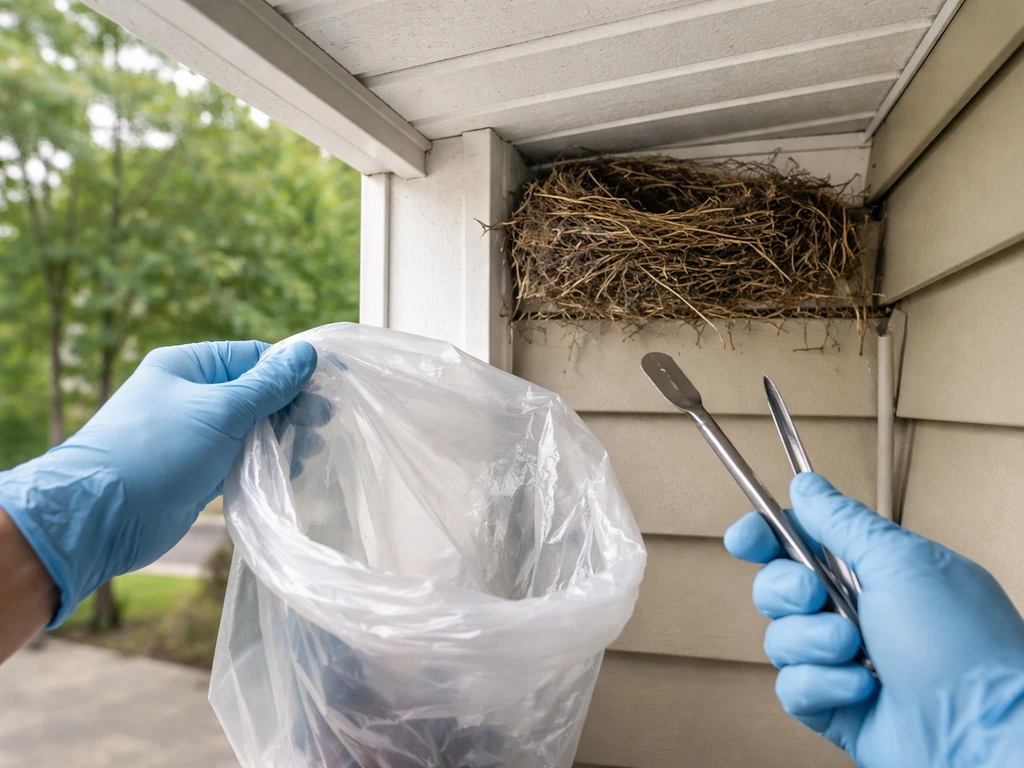
You're clear to remove it. Yes, pest control can remove an inactive bird nest, but they must avoid disturbing active nests with eggs or chicks pest control remove bird nest. If you're trying to get rid of a bird nest in a window, make sure the nest is inactive first, then use protective gear and clean the area before proofing the spot You're clear to remove it. .
Gather your supplies before you start: disposable gloves, a dust mask or N95 respirator, a trash bag, and eye protection. Bird nests can carry mites, lice, fungal spores, and dried droppings, so PPE is not optional. If the nest is on a porch light or elevated fixture, use a stable step ladder and have someone spot you.
Nest is active (eggs or chicks present)
Stop. Do not touch it. Your job right now is to minimize disturbance. Avoid using that part of the porch if you can. Keep pets and children away. Turn off any porch lights near the nest at night if birds are nesting directly on or in the fixture, since overheating is a real risk. Make a note of when you first noticed activity so you can estimate when fledging might happen, and revisit the "when to act" section below.
Nest is in a dangerous location (live hazard)
If an active nest is blocking a gas vent, inside an electrical fixture in a way that creates a fire risk, or poses an immediate health or safety hazard, that's a different conversation. The USFWS does have provisions for prompt removal of nesting birds from building interiors when there's a genuine safety concern, but that typically requires contacting a licensed wildlife professional or your state wildlife agency. Do not just remove it yourself and hope for the best. Call a pro and explain the hazard.
How to remove the nest safely
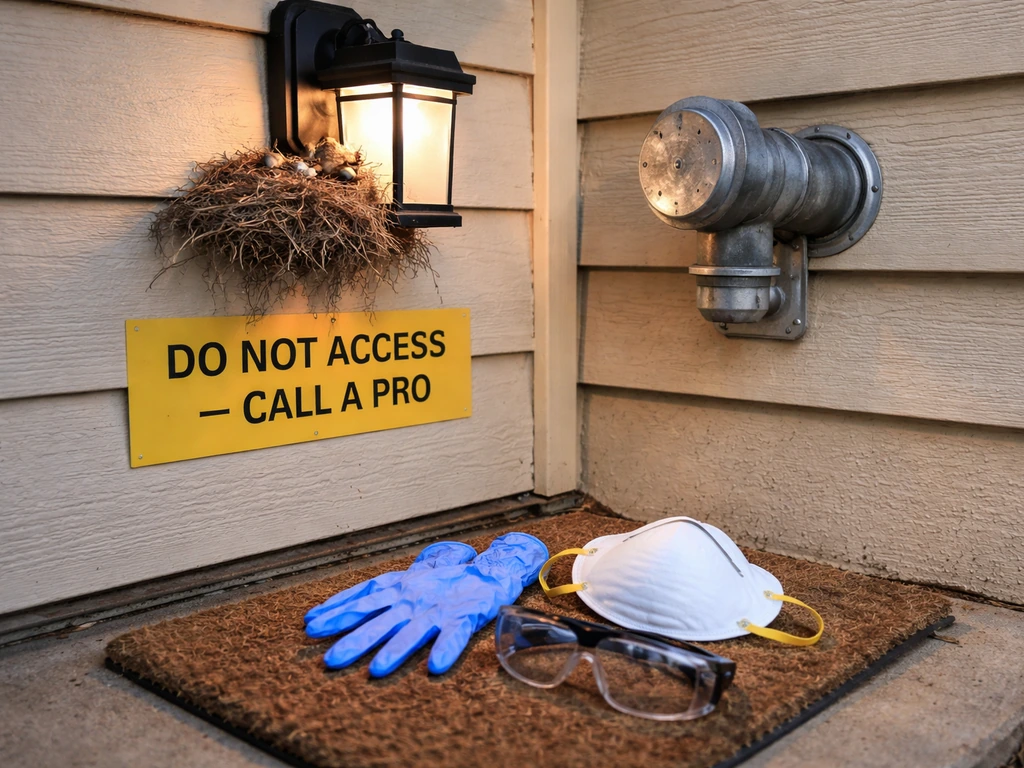
Once you've confirmed the nest is inactive, removal is straightforward. Work through these steps in order.
- Put on gloves, a dust mask, and eye protection before touching anything.
- If the nest is on a porch light or electrical fixture, turn off the circuit breaker for that fixture first. Do not work around live wiring.
- Remove the nest by hand or with a stiff brush into a sealed plastic bag. Don't shake it or blow on it.
- Double-bag the nest and dispose of it in your outdoor trash. Do not compost it.
- Wipe down the surface where the nest sat with a disinfectant spray. Dried droppings can carry Histoplasma and other pathogens.
- Wash your hands thoroughly even though you wore gloves.
- Inspect the area for damage: corroded light fixtures, stained wood, clogged drainage channels, or stripped paint. Repair these now while you have access.
Nests on porch lights specifically
Porch lights are one of the most common nesting spots because they offer a warm, sheltered ledge. After removing the nest and cleaning the fixture, check whether the fixture housing has gaps or an open top. House sparrows, in particular, will rebuild in the same spot within days if you don't modify the location. Cut a piece of hardware cloth or stiff wire mesh to cover any open cavity in the fixture housing, or temporarily cap the top of an open globe fixture with a mesh cover. The real fix comes in the proofing section below.
Nests on ledges, railings, and eaves
These locations are easier to access than light fixtures, but the same rules apply. After removing the nest, look at what made the spot attractive: a flat surface, a corner or right angle for support, shelter from rain, or proximity to food. Every one of those factors is something you can modify. Rounded or sloped surfaces, physical barriers, and surface texture changes all work.
Humane deterrents and porch-proofing that actually work
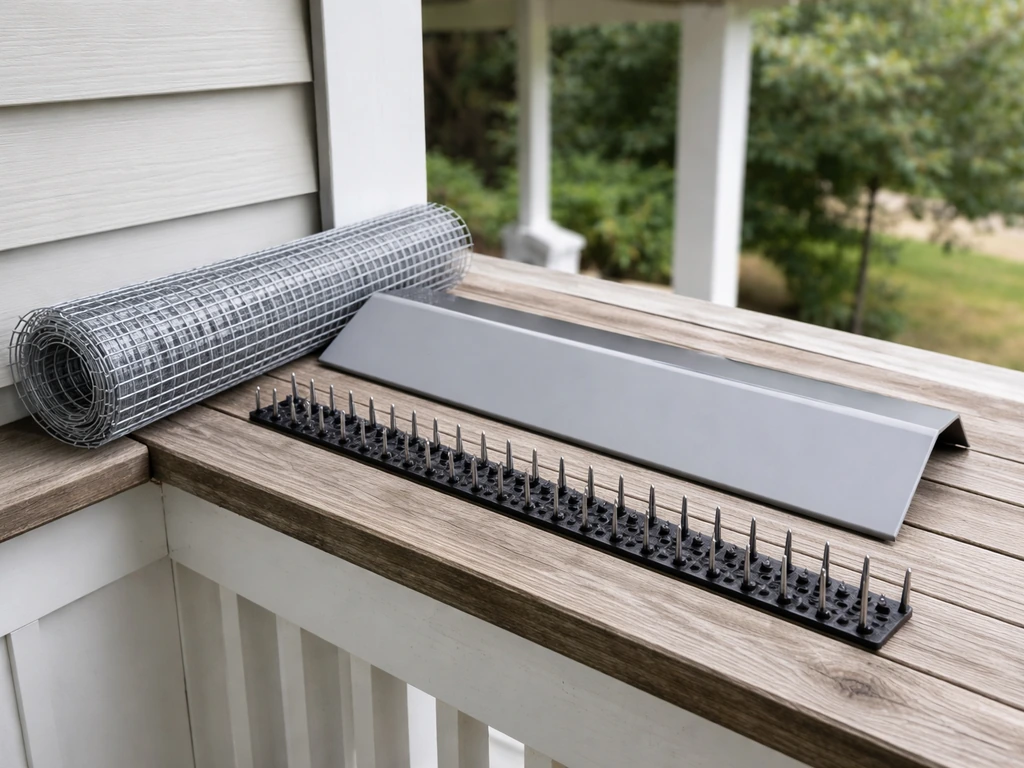
Removing a nest without proofing the spot is just an invitation for a repeat. This is where most people fall short. Here's a breakdown of what works where, and why.
| Deterrent type | Best porch location | Effectiveness | Notes |
|---|---|---|---|
| Bird spikes or coil wire | Flat ledges, railings, beam tops | High for perching prevention | Use stainless steel spikes; avoid large gaps where birds can still land between rows |
| Netting (UV-resistant polyethylene) | Eaves, open porch ceilings, large areas | Very high for area exclusion | Needs proper tensioning; droopy netting is ineffective and can trap birds |
| Sloped or angled surfaces (foam or wood) | Ledges, top of light fixtures, beam corners | High if angle exceeds 45 degrees | Cheap and durable; works especially well on porch light housings |
| Reflective tape or hanging objects | Open porch areas, railings | Low to moderate, temporary | Birds habituate quickly; use only as a short-term bridge while installing permanent fixes |
| Tactile gel/sticky repellent | Narrow ledges, fixture tops | Moderate | Degrades in UV; can trap small birds; reapply every 3–6 months if used at all |
| Hardware cloth or wire mesh | Open fixture cavities, gaps in eaves | Very high when fitted properly | Best long-term physical exclusion; cut to fit and secure with staples or screws |
For most porch situations, the combination that works best is physical exclusion (mesh or netting over the area) plus a surface modification (spikes or slope on landing spots). Reflective tape and predator decoys are temporary at best. Birds, especially house sparrows and swallows, figure them out quickly.
Swallow-specific porch proofing
Cliff swallows and barn swallows are especially common on porches with open eaves, and they're federally protected year-round. Barn swallow nestlings fledge in 17 to 24 days after hatching, and cliff swallow nestlings take 20 to 25 days. Once they're actively nesting, your options are limited until fledging. But before the season starts, hanging lightweight plastic sheeting or bird netting from the roofline down to the porch wall (leaving no gap of more than one inch for entry) is one of the most effective ways to prevent swallows from attaching mud nests to your eaves.
Timing: when to act and when to wait
Timing is the most underestimated factor in this whole process. Acting at the wrong time is both illegal and often counterproductive, because disturbed birds sometimes rebuild faster and more persistently than if left alone.
The nest cycle timeline
For most common porch species like house sparrows and various songbirds, incubation runs about 10 to 14 days, and nestlings fledge another 10 to 14 days after hatching. That means from the day eggs appear to the day the last chick leaves, you're typically looking at three to four weeks. Cliff and barn swallows take a bit longer, up to five to six weeks from egg to fledging. Mark the date you first noticed eggs, count forward, and check again after that window.
Best windows for removal and proofing
- Late fall through early spring (October to February in most of the US): The safest window. Most migratory species are gone, resident birds aren't breeding, and you can remove old nests and install proofing without any risk of disturbing active nests.
- Early spring (before nest-building begins, typically February to March): Install deterrents before birds scout locations. Once a bird has started collecting nest material for a specific spot, they're already committed.
- Mid-summer after confirmed fledging: If a nest was used earlier in the season and is now confirmed empty and inactive, remove it immediately and proof the spot before a second brood begins. Many species attempt two broods per season.
- Avoid: Peak nesting season (April through July) unless you've confirmed inactivity with multiple observation sessions over several days.
The legal side and when to call a wildlife professional
In the US, the Migratory Bird Treaty Act makes it illegal to destroy, remove, or disturb an active nest, egg, or live bird of any native migratory species without a federal permit. This is a misdemeanor under 16 U.S.C. § 707(a). Importantly, the USFWS clarifies that removing an empty nest (no eggs, no birds) is not prohibited, as long as you're not possessing the birds or eggs during destruction. In Canada, the Migratory Birds Regulations 2022, in effect since July 30, 2022, prohibit damaging, destroying, disturbing, or removing a migratory bird nest that contains a live bird or viable egg.
Non-native species like house sparrows and European starlings are not protected under the MBTA. If your nest is definitively from one of those species, the timing restrictions technically don't apply under federal law. However, many states have their own wildlife protection rules, so check your local regulations before acting.
When to stop DIY and call a wildlife professional
- The nest is active and in a location that poses a genuine fire, electrical, or structural hazard
- You can't safely access the nest without significant fall risk (high eave, steep roof pitch)
- You've removed the nest multiple times and birds keep returning despite deterrents
- You suspect the species is a protected raptor, swallow colony, or other sensitive species
- You're in Canada or a state with stricter protections and aren't sure what applies
- There are injured or orphaned birds on or near the nest
When you call a wildlife professional, give them: the location and height of the nest, the bird species if you know it, whether eggs or chicks are present, and any safety hazards involved. The more specific you are, the faster they can help. If the problem involves birds nesting in enclosed structural areas rather than your open porch, the situation is closer to what's covered in roof or wall nest removal, which involves different access and exclusion methods.
If the birds are using a wall cavity, the same roof and wall nest removal principles can help you exclude them safely and prevent repeat nesting roof or wall nest removal. If the birds are nesting in enclosed structural areas like a roof or wall, the access and exclusion steps may differ roof or wall nest removal.
DIY checklist and troubleshooting flowchart
Pre-removal checklist
- Observe the nest from a distance for at least two to three sessions over multiple days before touching anything.
- Confirm: no eggs, no chicks, no adult returning to sit on the nest.
- If uncertain, wait the full four-week observation window recommended by NestWatch.
- Gather PPE: gloves, N95 mask, eye protection.
- Turn off power to any electrical fixtures involved before starting.
- Have a stable ladder and a spotter if working at height.
- Prepare double-layered trash bags for nest disposal.
- Have disinfectant spray ready for post-removal cleanup.
Troubleshooting flowchart
- Does the nest contain eggs or live chicks? YES: Stop. Do not disturb. Monitor from a distance and return after the estimated fledging window (3 to 6 weeks). NO: Continue to step 2.
- Have you seen an adult bird at the nest in the past four weeks? YES: Nest may still be active. Observe for several more days. NO: Continue to step 3.
- Is the nest location a safety hazard (electrical, structural, fall risk)? YES: Call a licensed wildlife removal professional. NO: Continue to step 4.
- Put on PPE. Turn off power if near electrical fixtures. Remove nest into sealed bags and disinfect the surface.
- Inspect the site for damage and repair now (corroded fixtures, stained wood, clogged vents).
- Install physical deterrents (spikes, netting, mesh, or slope covers) before birds scout the same spot again.
- Monitor the location weekly for the next month to catch any early signs of nest-building activity.
Proofing upgrade checklist (do this after removal)
- Cover open porch light fixture housings with hardware cloth or install a sloped cap
- Install stainless steel bird spikes on flat ledges, beam tops, and railing caps
- Hang UV-resistant bird netting from roofline to wall across open eave areas
- Seal gaps in soffits and fascia boards with caulk or wood filler
- Check and clear any flat debris-collecting surfaces where nesting material could accumulate
- Schedule a seasonal inspection each February before nesting season begins
If birds keep returning to a specific porch spot despite your proofing, it's worth stepping back and thinking about what's still attracting them. Nearby food sources, water, or a microclimate that's warmer than surrounding areas can override deterrents on their own. Address the underlying attractants alongside the physical fixes and you'll get much better long-term results. To prevent future bird nests behind shutters, focus on sealing entry gaps and adding appropriate physical barriers after the nest is fully inactive. If you want to prevent a repeat, focus on exclusion and proofing methods after you remove the nest.
FAQ
What should I do if I’m not sure whether the nest is active or abandoned?
Use “no contact” behavior even if you believe it is inactive. If you have not confirmed there are no eggs or nestlings, treat it as active and wait, since parents can return intermittently and one quiet stretch does not prove the nest is abandoned.
Can I move a bird nest to another spot to get rid of it on my porch?
Do not relocate the nest. Even if it appears old, moving it can still be considered disturbing if viable eggs or nestlings are present, and it usually fails to stop birds from immediately searching for the same attachment point afterward.
What if the bird nest is inside an electrical light fixture or near wiring on my porch?
If the nest is inside an electrical fixture, do not remove it yourself, especially if wires or a breaker panel are involved. Treat it as a potential fire or shock hazard and contact a licensed wildlife professional or electrician for a coordinated, safe exclusion plan.
Should I turn off my porch light or leave it on while birds are nesting?
If birds are nesting on a porch light, keep the light off during active nesting and block access only after the nest is fully inactive. Leaving lights on can overheat eggs or nestlings, and blocking access too early can trigger repeated nesting attempts.
After I remove the nest, what’s the best way to stop birds from re-entering the same porch opening?
Yes, for many porch situations you can use hardware cloth or mesh, but only after removal when the area is safe and fully inactive. The mesh must be installed to cover the exact cavity and edges tightly secured, otherwise birds will find a new entry gap within days.
What if the nest looks empty and dry, but it’s still too risky to tell for sure?
A nest can be inactive to the eye but still illegal to disturb if eggs were recently laid or if nestlings are hidden within a protected cavity. If you cannot verify it is truly empty and old, switch to a wait-and-watch approach or call a wildlife professional to assess before acting.
What if I discover eggs or a dead bird in the nest on my porch?
If you find a dead bird inside the nest, do not assume you can clean or remove freely. Safety still matters, and the carcass and nest material can be regulated; contact your local wildlife agency or a cleanup professional for the correct disposal and PPE steps.
Why do birds come back right after I remove the nest and clean the area?
House sparrows are more likely to rebuild quickly on the same ledge, so proofing must be paired with changing the landing or entry structure, not just cleaning. If you see fresh nesting material within days, treat it as confirmation that exclusion or surface modification was incomplete.
How can I prevent cliff swallows or barn swallows from building mud nests under my porch eaves?
If you are trying to deter swallows or other species that attach nests to eaves, timing matters even more than deterrent type. Installing bird netting or lightweight sheeting before nesting season is the most effective approach, because once attached, options are limited until fledging.
What observation signs actually confirm a porch nest is active?
Signs like feathers, fresh droppings, or ongoing visits are “active indicators,” but they are not proof. If you cannot confirm eggs or live young status, observe over multiple days, and consider waiting at least the monitoring window you can document before labeling it abandoned.
What if I see more than one nest or multiple birds using different spots on the same porch?
If multiple birds are using the same area, treat it as active until you verify that all nesting activity has stopped and fledging has passed. Remove only after the last confirmed activity window and after proofing is ready, otherwise you can interrupt one attempt and still leave another active.